
DR Congo’s Ebola outbreak accelerates amid undetected transmission as WHO urges Ervebo cross-protection trial
Narrative Snapshot
Across outlets, the quantitative picture is converging on rapid expansion and under-detection. Telesur English reported that confirmed infections surpassed 4,000 with more than a thousand new cases in two weeks, and subsequently that the government raised the tally to 4,120 cases and 1,887 deaths. The Japan Times updated these figures the next day to 4,209 confirmed cases and 1,916 deaths and emphasized a rising crude case-fatality ratio of 45.5% alongside a push to track “hidden infections,” an angle reinforced by WHO messaging picked up by the BBC that “the virus is ahead of us.”
WHO’s reconstruction of the outbreak’s early arc anchors a second throughline. The South China Morning Post and Al Jazeera English cited WHO’s assessment that sequencing points to a February start, well before the mid-May declaration, with early illnesses misattributed to malaria and typhoid. UN News via AllAfrica adds that between 60% and 70% of deaths are occurring in communities rather than treatment centres, a pattern that explains both the pace of spread and the surveillance gap WHO says it is racing to close.
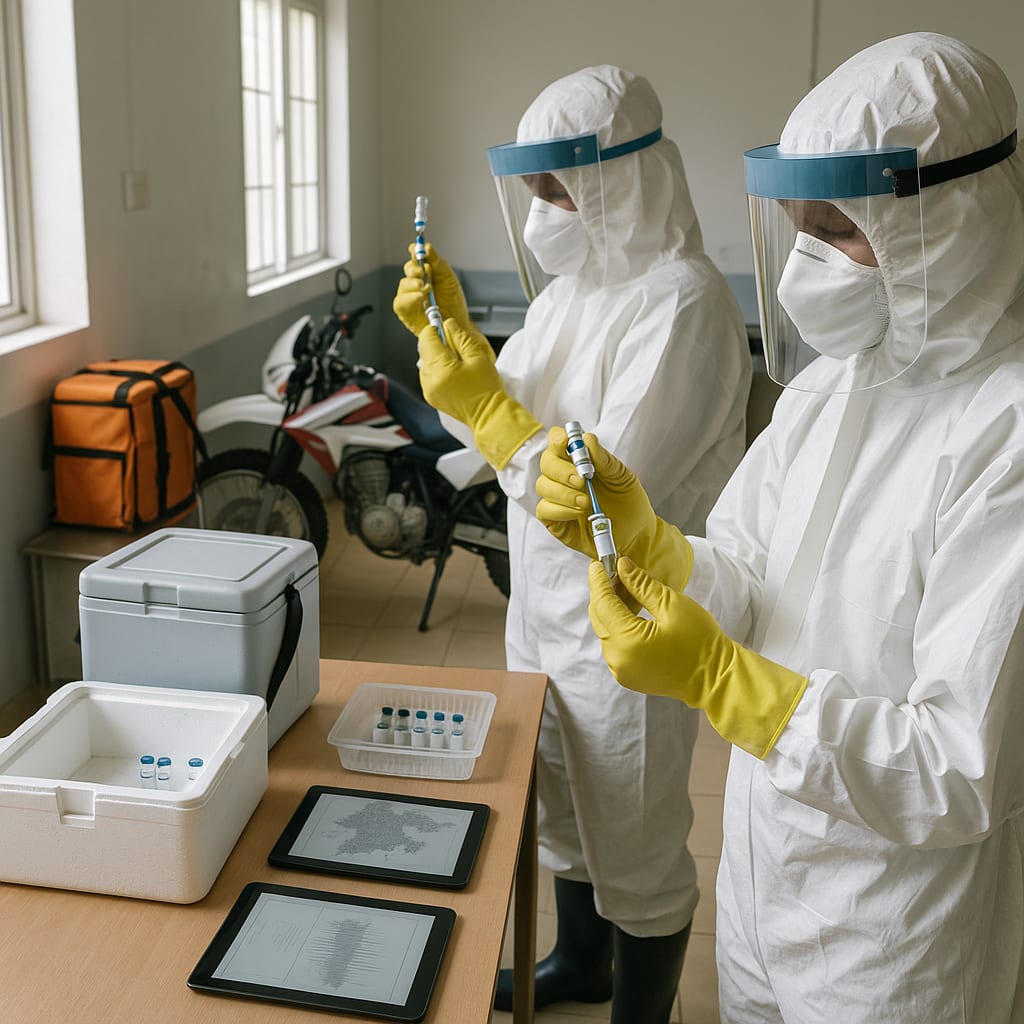
Response measures figure prominently but with different emphases. France 24 reported that WHO vaccine experts are urging a full-scale human trial of Ervebo to test cross-protection against the strain circulating in the DRC. At the same time, The Hindu’s account of a quarantined river boat near Kinshasa—where authorities later found no Ebola cases—illustrates precautionary containment efforts producing negative results. Haaretz’s note on a suspected case under investigation in Israel underscores international vigilance without confirming exportation.
What Happened
Government and media tallies show the outbreak intensifying. Telesur English reported on August 8 that confirmed cases exceeded 4,000 amid a “lethal strain,” and on August 9 that the DRC government counted 4,120 cases and 1,887 deaths since the outbreak was declared on May 15 in the east. On August 10, the Japan Times cited updated figures of 4,209 cases and 1,916 deaths and said officials expect counts to rise as they track hidden infections, putting the crude case-fatality ratio at 45.5%. WHO officials told the South China Morning Post and Al Jazeera that genomic sequencing indicates the outbreak began in February, with some early cases misdiagnosed as malaria or typhoid. UN News via AllAfrica reported that 60–70% of Ebola deaths are occurring in communities. France 24 said WHO vaccine experts urged a full-scale Ervebo trial for cross-protection. The Hindu reported that Congo authorities found no Ebola cases after quarantining a river boat near Kinshasa. Haaretz said Israel hospitalized a man returning from the DRC for testing.
Why It Matters
The reporting points to structural weaknesses and policy inflection points. WHO’s finding that transmission predated the mid-May declaration by months, amplified by the South China Morning Post and Al Jazeera, indicates surveillance and diagnostic gaps that allowed Ebola to establish community transmission chains. UN News’ figure that a majority of deaths occur outside treatment further signals access and trust deficits that impede early isolation and supportive care, issues central to WHO’s current strategy. On countermeasures, France 24’s coverage of the WHO call to test Ervebo’s cross-protection raises consequential regulatory, ethical, and operational decisions for the DRC and partners about deploying an approved vaccine against a different strain. The Japan Times’ focus on hidden infections and rising crude fatality underscores urgency for resource allocation, data systems, and community-based case finding, while Haaretz’s report of a suspected importation illustrates how domestic preparedness elsewhere is already engaged.
Diverging Narratives
Differences across sources primarily reflect emphasis and timing rather than contradiction. Telesur English highlights scale and velocity—crossing 4,000 cases with a rapid recent surge—while the Japan Times advances the count to 4,209 and foregrounds the likelihood of further increases due to undiscovered cases and a 45.5% crude fatality ratio. WHO’s characterization that responders are “chasing the virus,” carried by the BBC and aligned with the South China Morning Post and Al Jazeera’s accounts of a February start with early misattribution to malaria and typhoid, frames delayed detection as a central driver of spread. In contrast, The Hindu’s report on a quarantined boat yielding no positives shows preventive actions that, in this instance, did not uncover transmission, illustrating the balance between vigilance and the inevitability of negative investigations. France 24 adds a distinct policy vector: moving beyond containment alone to testing Ervebo for cross-protection against the circulating strain. Finally, AllAfrica’s focus on community deaths situates the crisis less as a failure of hospital-based care than as an out-of-facility mortality problem that complicates both data accuracy and intervention reach.
What Happens Next
Several decisions now shape the trajectory. First is whether national authorities and partners act on WHO vaccine experts’ recommendation reported by France 24 to run a full-scale Ervebo trial for cross-protection; watch for DRC health ministry and ethics approvals, trial protocols, and site selection. Second is operationalizing WHO’s pivot toward community-focused response highlighted by AllAfrica; key indicators include trends in the share of deaths occurring outside treatment, time-to-isolation metrics, and the scale-up of community surveillance. Third is the scope of case-finding for hidden infections referenced by the Japan Times; signals include upward revisions in confirmed counts, backlog clearance, and geographic spread metrics. Finally, vigilance beyond outbreak zones will remain visible through episodes like The Hindu’s boat quarantine and Haaretz’s report of a suspected case under investigation; outcomes of such investigations and any subsequent advisories will indicate how external systems are calibrating risk without confirmed exportation.