
Japan’s 7.1 Kyushu earthquake triggers mall explosion, rising death toll, and heat-strained rescue
Narrative Snapshot
Across outlets, there is broad alignment on the core facts: a powerful quake struck Kumamoto on Kyushu, a tsunami advisory was issued then lifted, an explosion and partial collapse at the Aeon Mall left people trapped, and fatalities rose as searches continued. Most reporting centers the rescue effort as a “race against time,” quoting Prime Minister Sanae Takaichi, and highlights compounding risks from severe heat, power and water outages, and damaged transport links.
Emphases diverge in how the event is framed. Several European and Latin American outlets foreground dramatic imagery and the mall blast, including BBC video of the explosion, Italian and Brazilian coverage of trapped survivors, and French reporting on heat conditions confronting evacuees. Japanese and North American reporting hews to operational updates on casualties, infrastructure, and search sites, including a paper mill and industrial facilities. Chinese state media adds evacuation figures, aerial damage images, and a formal message of condolence from Beijing.
Engineering and policy angles are most developed where coverage connects this disaster to 2016. Multiple outlets note that Aeon Mall Kumamoto had just reopened in June after years of reconstruction meant to improve earthquake resilience, making its renewed collapse a focal point for questions about retrofit performance, non-structural risks such as gas systems, and disaster readiness in high-intensity shaking zones.
What Happened
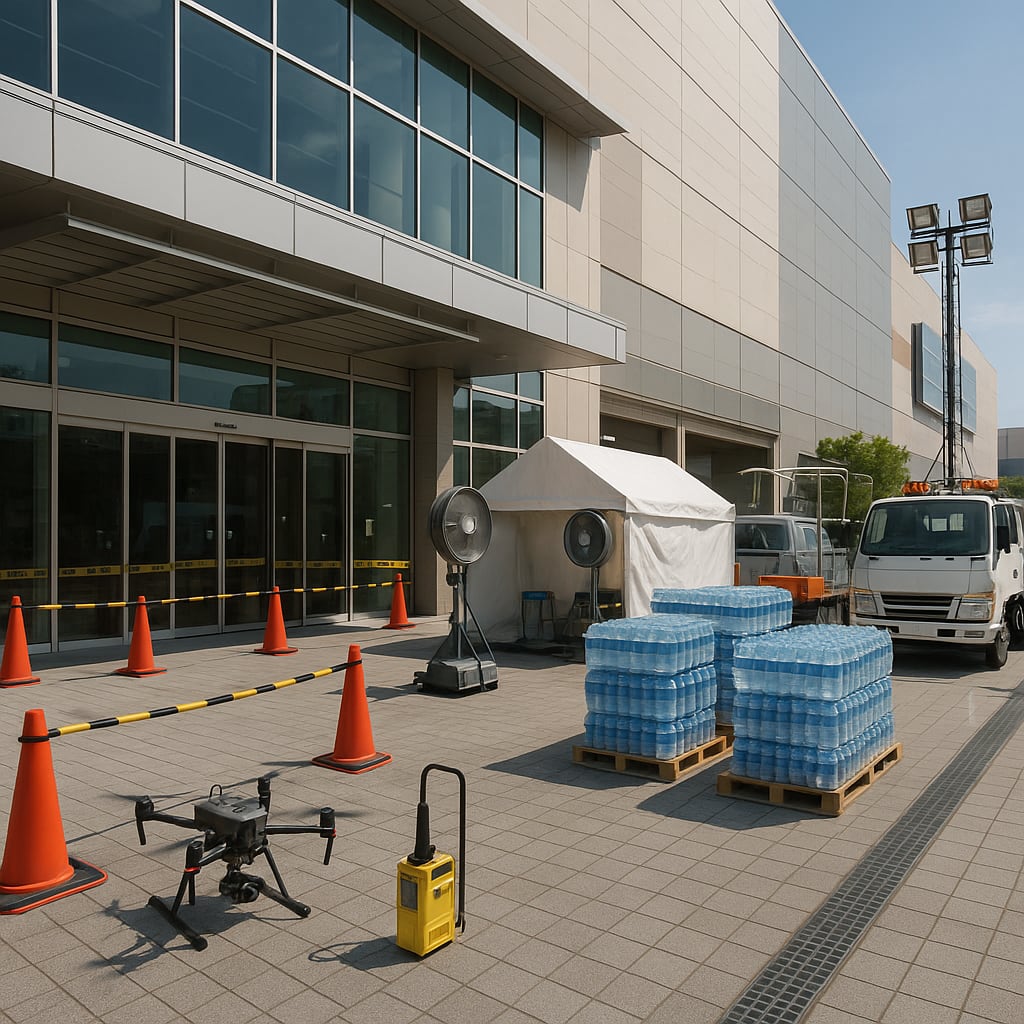
Japan’s Meteorological Agency reported a magnitude 7.1 quake striking Kumamoto at 4:27 p.m. on July 28, with shaking at the top of Japan’s intensity scale; the U.S. Geological Survey measured it at 6.8. A tsunami advisory for the Ariake and Yatsushiro seas was issued and lifted about two hours later. An explosion at the Aeon Mall Kumamoto precipitated a partial collapse, trapping shoppers and staff, while search teams also combed a damaged paper mill and other sites. Train services across Kyushu were suspended, bridges and roads were damaged, and tens of thousands lost power and water as temperatures were forecast to approach 38°C. Initial reports put fatalities at 13 as rescues began; by Thursday, Kumamoto Prefecture and national outlets reported at least 28 to 34 deaths, and by Friday several counted 34 dead, with some tallies noting 35 when including deaths under investigation.
Why It Matters
The episode stress-tests Japan’s post-2016 seismic resilience where it is most visible: a major commercial hub rebuilt to withstand earthquakes suffered catastrophic damage weeks after reopening. Reporting that points to a suspected gas blast at the mall underscores how non-structural systems can drive casualties even when primary structures are enhanced, elevating the policy salience of utility safety standards and retrofit enforcement. Simultaneous lifeline failures—power, water, transport—under heatwave conditions shift emergency management from short-duration rescue to sustained humanitarian support, with evacuation centers and hospitals contending with heat stress and limited services. For infrastructure planners, insurers, and regulators, the mix of top-scale shaking, industrial damage, and utility disruption provides a live test of building code performance, business continuity planning, and public warning efficacy, including earthquake and tsunami communications that multiple outlets documented as timely but immediately stress-inducing.
Diverging Narratives
Casualty and displacement figures move markedly across outlets and time stamps. Early counts of 13 deaths rose to 28 on Thursday and 34 by Friday in several reports, while one tally reached 35 when including deaths still under investigation for quake linkage. Evacuation numbers vary widely: one account cited authorities sending 300,000 people to evacuation centers, while another placed 9,186 evacuees across 506 centers in five prefectures early Wednesday, reflecting different reporting windows and methodologies. There is also a technical split in magnitude reporting—Japan’s agency at 7.1 versus 6.8 in U.S.-based reporting—paired with uniformly extreme intensity readings domestically.
Characterizations of the mall damage range from “destroyed” to “partial collapse,” and attribution of the explosion’s cause is uneven. Several outlets report a suspected gas blast; others refrain from specifying causation pending investigation, while maintaining the focus on trapped victims. Coverage of industrial impact is similarly framed as either a toppled chimney, a paper mill collapse, or a more general factory failure, with all describing active rescue at non-residential sites but using different labels.
What Happens Next
Three decision points are salient. First, search-and-rescue tempo at the Aeon Mall and other collapse sites, which officials have framed as a race against time; watch Kumamoto’s disaster headquarters updates on rescuer access, victim accounting, and the point at which operations shift from rescue to recovery. Second, determination of the mall explosion’s cause, with several reports noting a suspected gas blast; formal findings will shape any immediate safety orders for gas and mechanical systems in commercial complexes and could prompt targeted inspections. Third, restoration of power and water as temperatures approach 38°C; the pace of lifeline recovery will determine conditions in evacuation centers and hospitals and influence decisions on broader re-entry to damaged neighborhoods. Additional indicators include JMA guidance on aftershocks affecting structural re-occupancy, transport restoration timelines, and whether authorities revise casualty counts to include deaths “under investigation,” as some outlets have already reported.