
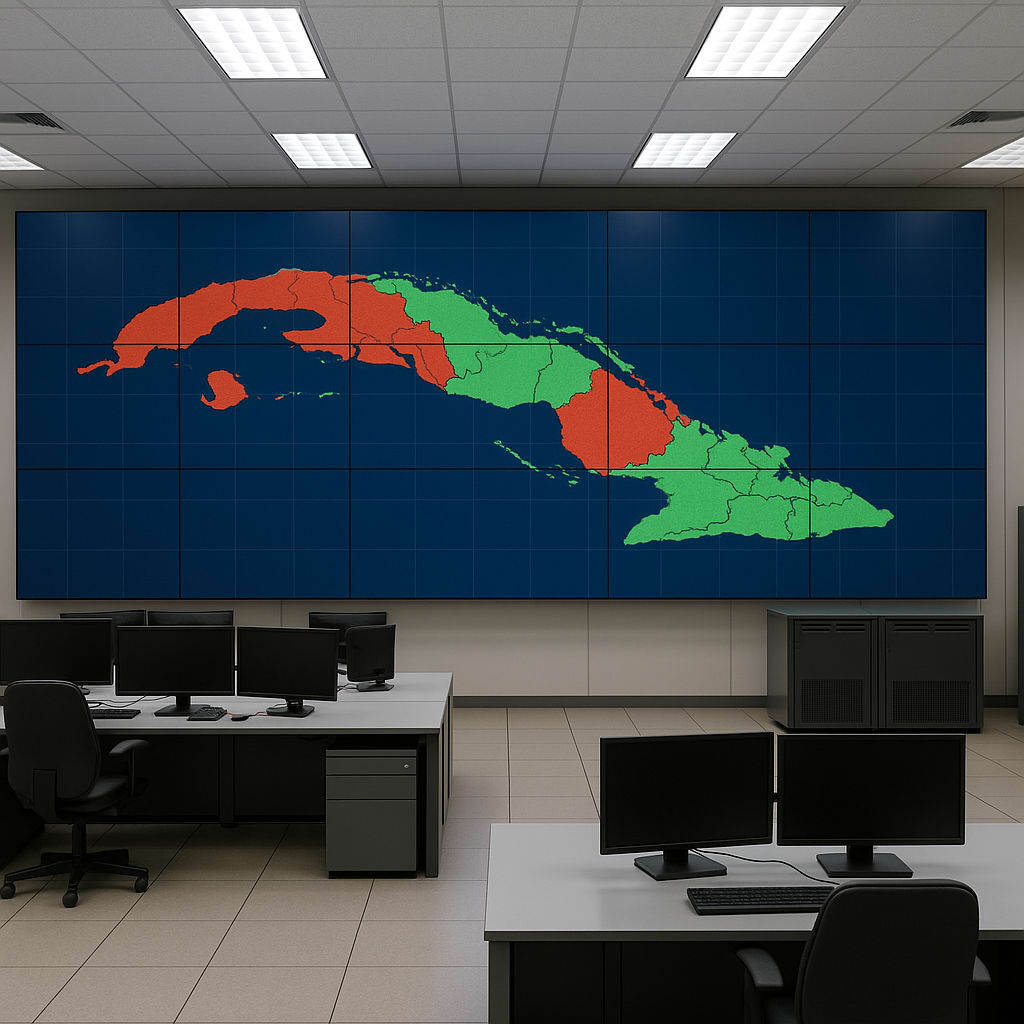
Cuba’s third nationwide blackout in six months leaves millions without power
Narrative Snapshot
- Broad agreement on scope and frequency: nationwide grid collapse at midday Monday affected around 10 million people; it is the third such outage this year/six months (CBC; The Guardian; Sky News; SCMP; Clarin).
- Causal emphasis diverges: several outlets foreground a U.S. oil “blockade” or sanctions imposed in January as depleting fuel for power plants (The Guardian; SCMP; Japan Times; Al Jazeera; Folha), while others stress chronic infrastructure fragility and aging assets (Fox News; The Hindu) or provide technical detail on multiple thermal units offline (Clarin).
- Political framing splits: Havana accuses Washington of trying to foment unrest and to prevent a UN General Assembly pronouncement on sanctions’ impact (The Hindu; Le Monde). Event-focused wires and broadcasters stick to operational facts without assigning primary blame (CBC; Sky News).
- Immediate cause remains opaque: the grid operator cited a “total disconnection” with causes under investigation; only Clarin quantified plant outages and maintenance as concurrent stresses (Fox News; Clarin).
What Happened
Cuba’s national electric grid collapsed at midday Monday, triggering a “total disconnection” across the island, the state utility said, with around 10 million people losing power before partial service returned in some areas (CBC News; Fox News). Union Eléctrica reported a system-wide failure while investigating specific causes; Clarin noted that 11 thermal units were offline that morning due to breakdowns or maintenance, underscoring thin reserve margins. This marks Cuba’s third nationwide blackout since January and, by Clarin’s count, the eighth since late 2024. Multiple outlets situate the outage within a deepening energy crunch tied to shrinking fuel availability and a deteriorating, aging grid (Fox News; The Hindu). Others add that fuel constraints were exacerbated after U.S. President Donald Trump imposed an oil blockade/sanctions in January, further depleting supplies for power generation (The Guardian; SCMP; Japan Times).
Why It Matters
The outage tests the resilience of an electricity system already operating with limited redundancy and aging assets, illustrating how constrained fuel supply can cascade into national-scale failures (The Hindu; Clarin). It also sharpens a sanctions-policy debate: several outlets link Cuba’s deteriorating fuel access to U.S. measures announced in January, including threats of tariffs on third-country oil suppliers—highlighting the extraterritorial reach of energy-related sanctions (The Guardian; Fox News). Diplomatically, Havana is pressing its case at the UN General Assembly regarding the humanitarian and economic impacts of U.S. restrictions, while accusing Washington of trying to prevent a vote—putting multilateral scrutiny and normative claims about sanctions’ consequences on the table (Le Monde; Al Jazeera). For policymakers, the episode underscores the intersection of coercive economic tools, energy security, and infrastructure fragility—and the difficulty of insulating civilian grids from geopolitical pressure.
Diverging Narratives
- Attribution of cause: A cluster of international outlets explicitly frame the fuel squeeze as significantly worsened by the January U.S. oil blockade/sanctions (The Guardian; SCMP; Japan Times; Al Jazeera; Folha). Others emphasize Cuba’s longstanding infrastructure deterioration and inadequate maintenance capacity, suggesting the system was vulnerable irrespective of recent sanctions (Fox News; The Hindu). Event-focused coverage provides minimal causal inference (CBC; Sky News).
- Government framing vs. external analysis: Cuban leadership characterizes U.S. actions as intended to “incite social unrest” and describes the situation as a “genocidal energy blockade,” while lauding electrical workers’ efforts (The Hindu). Le Monde adds Havana’s claim that Washington is seeking to prevent a UNGA pronouncement on sanctions’ impact. By contrast, several outlets stress that Cuba “was already struggling” to keep lights on before January, contextualizing—but not dismissing—the sanctions’ role (The Guardian; Japan Times; SCMP).
- Facts still in question: The utility acknowledged a complete system disconnection with causes under investigation (Fox News). Aside from Clarin’s count of 11 thermal units offline, few technical specifics are available about the initiating failure or protection-system behavior, leaving open whether fuel scarcity, equipment faults, operator actions, or a combination triggered the collapse.
What Happens Next
- UN General Assembly spotlight: Cuba signaled a push for a UNGA pronouncement on the oil blockade and sanctions’ impact, while alleging U.S. efforts to prevent such action (Le Monde). Watch for scheduling, agenda decisions, and resolution language or statements that could elevate multilateral pressure or, if stalled, entrench competing narratives.
- U.S. sanctions posture: Outlets tie Cuba’s fuel constraints to January measures and threatened tariffs on oil suppliers (The Guardian; Fox News). Key indicators include new enforcement actions, designations, or guidance, as well as ship-to-ship transfer patterns and tanker calls that would show whether suppliers are deterred.
- Grid stabilization in Cuba: UNE’s unit availability, maintenance completions, and fuel allocation to thermal plants will determine whether service normalizes or rotating outages persist (Clarin). Monitor daily generation capacity reports, restoration timelines after this event, and any government announcements on fuel procurement.
- Humanitarian and economic stress: Several outlets frame the blackout within a broader economic and humanitarian crisis (Al Jazeera; Folha). Track official rationing measures, hospital and water-service contingencies, and whether partial restorations hold under peak demand.