
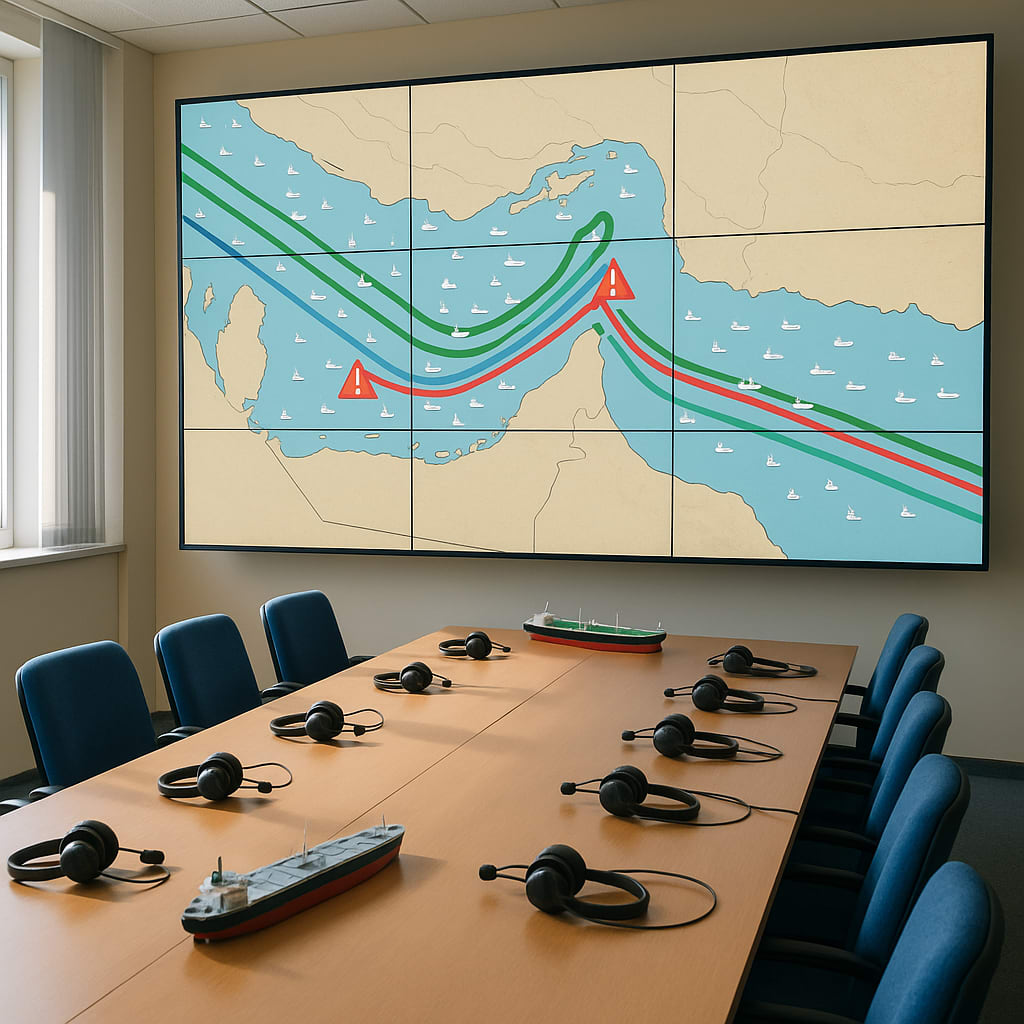
Competing claims over Hormuz deepen risk for shippers as strikes resume and diplomacy splinters
Narrative Snapshot
Across outlets, two incompatible framings run in parallel. US military statements carried by TASS, The Hindu and Middle East Eye stress that the strait remains an international waterway with forces “positioned and prepared” to keep traffic flowing, even as UKMTO maintains its highest threat level and traffic has fallen sharply, a trend documented by the Daily Nation, Japan Times and the New York Times. France 24 adds nuance, reporting that while the passage is not completely shut, Iran has targeted ships following a US-defined route.
Iranian and Iran-aligned reporting asserts either closure or conditional openness under Iranian coordination. IRNA’s Persian Gulf Strait Authority says transit is “not possible” due to “illegal US actions,” while IRGC statements via Iranian state media—relayed by Middle East Eye and echoed in the Guardian and South China Morning Post—declare the strait closed “until further notice.” Tehran Times rejects an IMO draft as politicized and reiterates Iran’s legal stance and coordination role.
Regional and multilateral responses diverge on who should steward security. NATO consultations with Gulf ministers and a Franco‑British multinational mission proposal are reported by Middle East Eye; Iran dismisses these as politically motivated. NHK highlights Oman’s new proposal for managing transit, and Telesur frames Iran–Oman talks as a regional mechanism to ensure navigation and resist US pressure. The EU signals a separate diplomatic track—calling for reopening, respect for navigation, and “no tolls”—while China urges the issue be “properly addressed.” Meanwhile, the IMO’s head warns that thousands of seafarers remain stranded and at risk.
What Happened
A fragile June truce gave way to renewed incidents and escalation in early July. Three tankers, including a Qatari LNG carrier and a Saudi crude ship, were struck within hours near the Strait of Hormuz, with UKMTO reporting an “unknown projectile” and at least one drone attack off Oman’s coast (South China Morning Post; Middle East Eye). Le Monde reports the United States responded with strikes on Iran and restored oil sanctions; President Trump publicly declared the ceasefire over, as noted by Folha de S.Paulo. The IMO condemned the attacks and cited about 6,000 stranded seafarers (Middle East Eye). Iran’s IRGC then announced a temporary closure “until further notice,” later reinforced by statements that a vessel on an “unapproved route” was hit (Middle East Eye; the Guardian; South China Morning Post). A Cyprus‑flagged ship’s crew abandoned vessel after an IRGC missile strike (Middle East Eye). CENTCOM countered that Iran “does not control the strait,” asserting traffic was flowing (TASS; The Hindu). UKMTO kept the threat level at its highest as transits fell to a five‑week low, with only six vessels on Sunday (Middle East Eye; Daily Nation). Oman’s role figured in both routing data and a reported proposal, while NATO, the EU, India, China, Saudi Arabia, Qatar and Pakistan engaged on maritime security through statements and calls (Middle East Eye; NHK; The Hindu; ECNS).
Why It Matters
The dispute is testing practical enforcement of freedom of navigation at a global energy chokepoint and exposes gaps between competing security architectures. US and European statements frame the strait as an international waterway to be kept open, with EU officials underscoring that “no tolls” or conditions should apply, while Iran advances a coordination-centric, sovereignty-based position and rejects NATO and IMO initiatives as political (The Hindu; Middle East Eye; Tehran Times). NATO discussions of a Franco‑British maritime mission and EU outreach to Gulf partners point to renewed external security provision, even as Oman pursues a regional management concept highlighted by NHK and Telesur. Le Monde’s reporting on restored US oil sanctions expands the stakes beyond tactical incidents. For multilateral bodies, the IMO’s warning about stranded crews underscores constraints on institutional protection of civilians at sea. For governments and shippers, the documented fall in transits and crew evacuations translate legal contestation into operational and insurance risk.
Diverging Narratives
Core factual claims conflict. CENTCOM, quoted by TASS, The Hindu and Middle East Eye, insists the strait is open and that “traffic is flowing,” whereas IRGC announcements via state media, IRNA’s Persian Gulf Strait Authority, and coverage in the Guardian and South China Morning Post state the strait is closed or that transit is not possible due to “illegal” US actions. France 24 bridges the gap by noting partial passage alongside targeted strikes on ships using a US‑defined route. Tehran Times maintains that navigation remains open under Iranian safety coordination while rejecting an IMO draft as beyond mandate, signaling a different legal frame from the US and EU emphasis on an “international waterway.”
There is also divergence over who should manage risk. NATO’s exploration of a Franco‑British maritime mission, and EU plans to engage Gulf states on reopening and protecting navigation, contrast with Iran’s denunciations of such fora as politically motivated and with NHK and Telesur’s focus on an Iran–Oman management track. On the tactical picture, UKMTO’s highest alert and reports of a crew abandoning the M/V GFS Galaxy sit beside CENTCOM’s assertion of flowing traffic and Politika’s observation that ships continued to pass despite heightened risk. Finally, Folha de S.Paulo and Le Monde foreground the US role in ending the truce and reimposing sanctions, shaping differing attributions of escalation.
What Happens Next
Two competing governance paths are in play. An external security mission discussed at NATO and EU‑Gulf consultations would privilege allied patrols and unconditional passage; Iran has rejected this approach, so movement here would likely be reflected in formal announcements from NATO capitals, UKMTO posture, and visible escort activity (Middle East Eye). Alternatively, an Oman‑facilitated management arrangement—reported by NHK and framed by Telesur as Iran–Oman coordination—would require explicit buy‑in from Iran and tacit acceptance by shippers; signals would include routing guidance anchoring the Omani coastal track and concordant statements from Muscat and Tehran.
Operationally, CENTCOM’s stated readiness and IRGC warnings against “illegal routes” set the conditions for further exchanges or restraint. Indicators include additional IRGC strikes on vessels, US strikes “to degrade” targeting capacity, and changes in UKMTO threat levels (the Guardian; Middle East Eye). Commercially, watch daily transit counts, insurer advisories, and any renewed crew evacuations; the drop to a multi‑week low of six transits shows market sensitivity to these signals (Daily Nation; Japan Times; New York Times). Diplomatic inflection points include whether Iran responds to US demands for a public commitment that Hormuz is open and toll‑free, and whether EU statements on “no tolls” translate into coordinated pressure or mediation (Middle East Eye).