
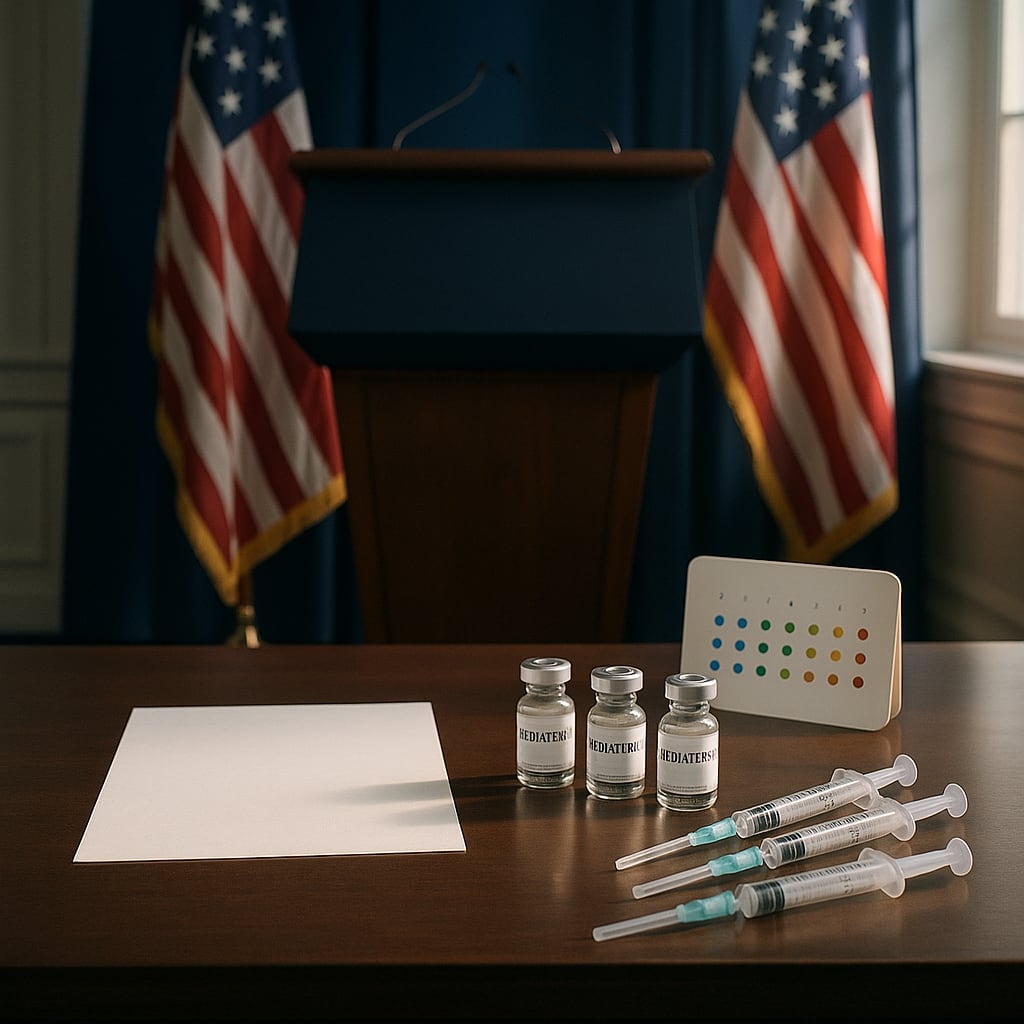
Trump signs order to scale back and space U.S. childhood vaccinations, including splitting MMR
Narrative Snapshot
Across outlets, there is broad agreement that the executive order directs fewer recommended childhood vaccinations, spaces doses into separate appointments, and calls for breaking the combined measles, mumps and rubella shot into three separate vaccinations. Where coverage diverges is less about whether the order exists than over institutional authority, scientific grounding, and practical feasibility. British, European and Canadian reporting centers on the clash with the U.S. Centers for Disease Control and Prevention’s remit and on the scientific evidence base; U.S. partisan media foregrounds parental choice and international comparators. Latin American and European outlets also underline that Trump has tied vaccines to autism, which medical authorities reject.
Two operational fault lines recur. First, several reports note the order’s attempt to override or sideline CDC processes, after an earlier effort to change CDC guidance was halted by a federal judge. Second, implementation is uncertain: one major international outlet notes the United States does not currently have separate measles, mumps and rubella vaccines available, and another stresses that administering shots together is cheaper than splitting visits. The policy context is a worsening measles landscape, with coverage linking the move to the country’s worst outbreak in decades.
What Happened
President Donald Trump on Monday signed an executive order that seeks to reduce the number of childhood immunizations recommended at the federal level, space remaining shots into separate medical visits, and separate the combined measles, mumps and rubella vaccine into three single-disease injections. Reporting varies on baselines, but multiple outlets say the administration’s new recommendations cover 11 diseases, fewer than current CDC guidance, and one U.S. outlet adds the order ends recommendations that minors receive COVID-19 vaccines. The order also pushes a rethink of school vaccination mandates. Coverage emphasizes that the CDC, not the White House, is the federal body tasked with developing vaccine schedules, and notes a previous attempt to alter CDC recommendations earlier this year was blocked by a federal judge. Trump framed the decision as expanding parental, religious and constitutional rights, while medical groups cited by several outlets said the changes lack scientific support.
Why It Matters
The order tests the boundary between executive messaging and the CDC’s statutory role in setting immunization guidance, highlighting a broader trend of political intervention in U.S. health governance. Outlets connect the move to ongoing institutional turbulence around vaccine policy, including the recent Senate confirmation of a new CDC director after a year-long vacancy and leadership changes tied to policy disputes. By urging a rethink of school mandates—typically set by states—the order also places federal-state dynamics in play, potentially pressuring state health agencies and school systems to revisit requirements amid a measles resurgence.
Internationally, the administration’s claim that the revised approach aligns with other developed countries contrasts with extensive foreign coverage foregrounding scientific consensus on combination vaccines and schedule timing. Practical constraints, such as the absence of separate measles, mumps and rubella shots in the U.S. market and higher costs from splitting visits, raise procurement and access questions for providers, insurers and families that extend beyond U.S. borders when manufacturers and supply chains are involved.
Diverging Narratives
A clear divide emerges in framing. One U.S. outlet aligned with the administration presents the order as shifting “medical power to parents,” aligning with other high‑income countries, and trimming recommendations to 11 diseases while ending COVID‑19 shots for minors. By contrast, major U.S., European and Canadian outlets emphasize the absence of scientific support for spacing or splitting vaccines and repeatedly note Trump’s promotion of a discredited autism link. Several European and U.K. reports stress institutional process: the CDC—not the White House—sets vaccine schedules, and a judge has already halted earlier White House‑driven changes.
There are also factual tensions in the baseline counts: one European source reports the new recommendations cover 11 diseases versus a prior federal list of 17, while a U.S. outlet contrasts 11 against 18 current CDC guidelines. International coverage adds feasibility constraints and cost considerations—one Latin American outlet reports no separate measles, mumps and rubella vaccines are currently available in the U.S., and a U.K. outlet notes combined dosing is cheaper—raising operational questions even if the order stands. Multiple outlets situate the move against the backdrop of the worst U.S. measles outbreak in decades, heightening concern from health experts that reduced or delayed coverage could increase vulnerability.
What Happens Next
Several decision points will shape outcomes. First is the legal and institutional pathway: prior judicial intervention blocking CDC schedule changes and coverage underscoring CDC’s authority indicate any attempt to operationalize the order’s recommendations may face court scrutiny and interagency pushback. Analysts should watch for HHS actions translating the order into guidance, and for the CDC’s response under its newly confirmed director.
Second is state-level policy on school mandates. Outlets report the order’s call to rethink requirements, but states control these rules; signals from governors, legislatures, and state health boards will determine whether mandates shift or hold.
Third is implementation capacity. Reports that separate MMR components are not available in the U.S., alongside higher costs of multiple visits, imply supply, reimbursement, and scheduling hurdles. Track manufacturer announcements, pediatric practice guidance, and insurer coverage decisions. Finally, monitor epidemiological indicators—measles case trends and routine coverage rates—given expert warnings that spacing and reduced recommendations could leave children less protected.