
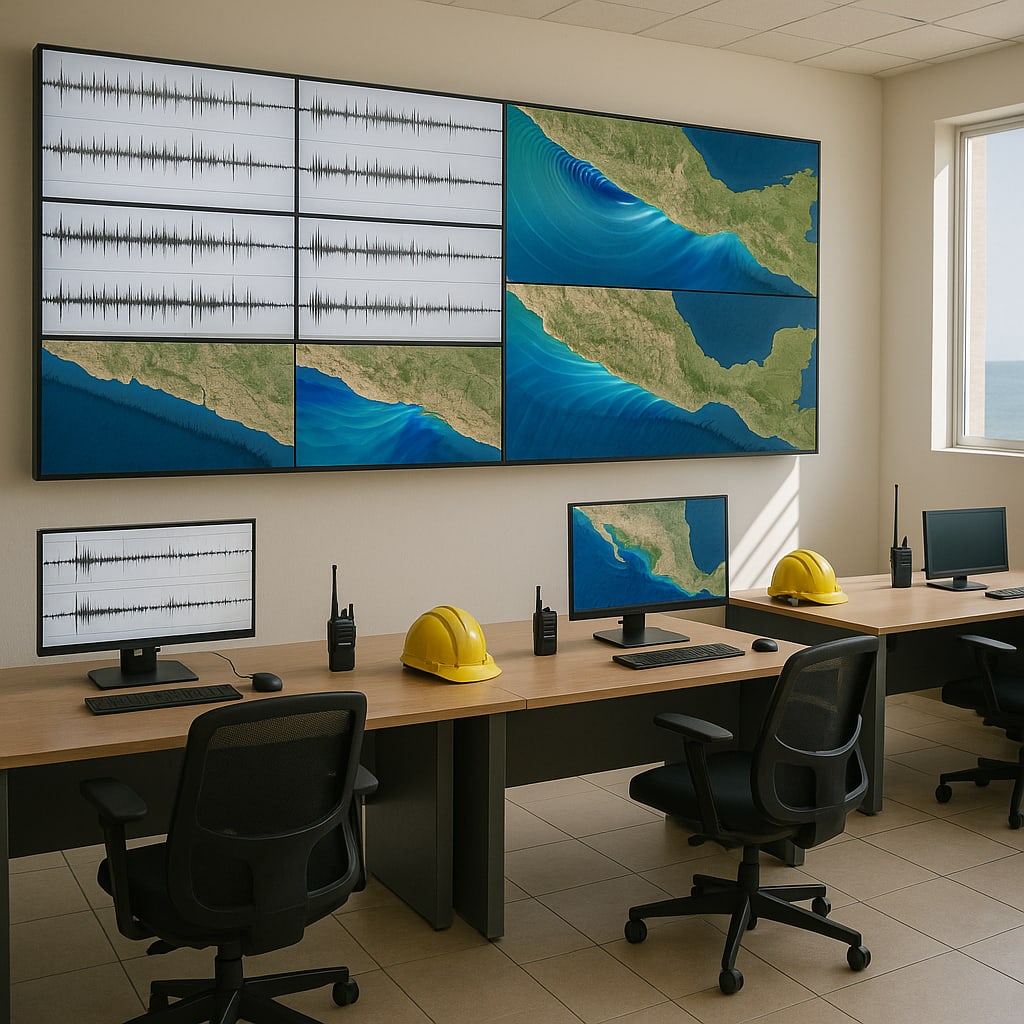
Strong quake off Mexico’s Chiapas coast triggers regional tsunami alerts, limited damage reported
Narrative Snapshot
Across outlets, the core contours are consistent: a powerful offshore earthquake near Mexico’s southern state of Chiapas was felt across borders and prompted tsunami alerts, with no immediate reports of major damage or casualties. Where they diverge first is measurement and granularity. Italian wire and daily coverage cite magnitude 7.4 and stress shallow depth and broad tsunami risk bands, while several international outlets report magnitude 7.3 and focus on the absence of early harm and the operational status of warning systems. Only some reports quantify ocean response, noting 0.3-meter waves in Puerto Madero.
Geographies shape emphasis. Latin American coverage highlights immediate regional implications, from alerts along Mexican and Guatemalan coasts to the next-day tally of Guatemalan aftershocks and a national emergency activation there. European reports foreground cross-border tremors and the tsunami risk footprint. Asian public broadcasting funnels the event through a global-warning architecture lens, relaying that Japan faced no tsunami effects based on communications from Hawaii’s U.S. center.
Governance performance and public signaling are central to what is at stake. Mexico’s presidency emphasized emergency protocols while preliminary assessments found no major issues in Chiapas or neighboring Tabasco, and Guatemala’s presidency reported no deaths amid evacuations. In Mexico City, the government’s explanation for why the quake alert did not sound—initial energy below activation thresholds—underscores how protective systems balance false-alarm risk against timely warning. The interplay between cross-border tsunami messaging, local siren criteria, and post-quake aftershock management defines the operational test highlighted across sources.
What Happened
A strong offshore earthquake struck near Mexico’s Pacific coast in Chiapas on July 17, with agencies reporting magnitude between 7.3 and 7.4. Italian outlets placed the depth at roughly 10 kilometers and flagged tsunami risk extending hundreds of kilometers from the epicenter, as tremors were felt into Guatemala and El Salvador. The U.S. Tsunami Warning System issued alerts for Mexico and Guatemala, and the U.S. center recorded waves of about 0.3 meters in Puerto Madero, Chiapas. Residents evacuated buildings in neighboring countries, and Mexican President Claudia Sheinbaum said emergency protocols were activated; initial reports from Chiapas and Tabasco indicated no major issues, and there were no immediate reports of casualties in Mexico or Guatemala. Japan’s meteorological authorities relayed that no tsunami impact was expected there. Guatemala later reported dozens of aftershocks and activated a national emergency response, citing incidents but no fatalities.
Why It Matters
The episode underscores the operational interdependence of regional and trans-Pacific warning systems and national civil protection regimes. Alerts from the U.S. tsunami system cascaded into national responses in Mexico and Guatemala, while Japan’s notification of no impact illustrates the global signaling pathways that help constrain unnecessary actions far from the epicenter. Leaders in Mexico and Guatemala publicly affirmed activation of protocols and the absence of early casualties, signaling both capacity and the priority placed on rapid cross-border communication.
It also spotlights a persistent policy tension within early warning: threshold-based urban alerting versus broad regional tsunami advisories. Mexico City’s non-activation, explained by the government as below trigger thresholds, coexisted with evacuations in neighboring countries and coastal tsunami alerts. For decision-makers, the event provides a live test of calibration—how national siren criteria, regional tsunami messaging, and aftershock management interact—and a prompt to review coordination between seismic monitoring, ocean warning centers, and civil defense communication under time pressure.
Diverging Narratives
Outlets differ on key parameters and framing. Several report magnitude 7.3, while others cite 7.4; only some specify the shallow depth near 10 kilometers. European and Latin American sources emphasize the breadth of the tsunami risk area and cross-border tremors, while others focus on the lack of immediate damage or casualties. Quantification of the ocean response appears in limited coverage, with one report detailing 0.3-meter waves at Puerto Madero; elsewhere, alerts are noted without such measurements.
The handling of public alerts in Mexico City is highlighted primarily by one source, which relays the government’s rationale that the quake’s initial radiated energy did not cross activation thresholds. This places local siren decisions in contrast with regional tsunami advisories and evacuations documented in Guatemala and El Salvador. Coverage diverges again on post-event evolution: while multiple outlets stress “no immediate” harm, subsequent reporting from Guatemala notes 42 aftershocks and a national emergency activation, framing the incident as ongoing risk management rather than a closed event. Together, these angles situate the story at the intersection of measurement variance, warning-system scope, and evolving situational awareness.
What Happens Next
Two decision points are explicit. First, coastal and regional authorities will adjust guidance as data on sea-level changes and aftershocks evolve. The recorded minor waves in Chiapas and Japan’s “no impact” notice indicate how tsunami alerts can be geographically refined; analysts should watch for official downgrades or confirmations from the U.S. tsunami system and national meteorological agencies. Second, civil protection agencies in Mexico and Guatemala will continue damage assessments and aftershock monitoring; Guatemala’s activation of a national emergency response and report of dozens of incidents set expectations for ongoing incident management absent fatalities.
A further signal to watch is public communication on urban alert thresholds in Mexico City. The government’s explanation for non-activation provides a benchmark; additional guidance or technical bulletins would indicate whether authorities aim to adjust thresholds or reinforce current criteria in light of a widely felt but offshore event.