
US to impose 50% tariffs on a wide range of Canadian goods; Ottawa weighs ‘all options’ and agrees to intensify talks
Narrative Snapshot
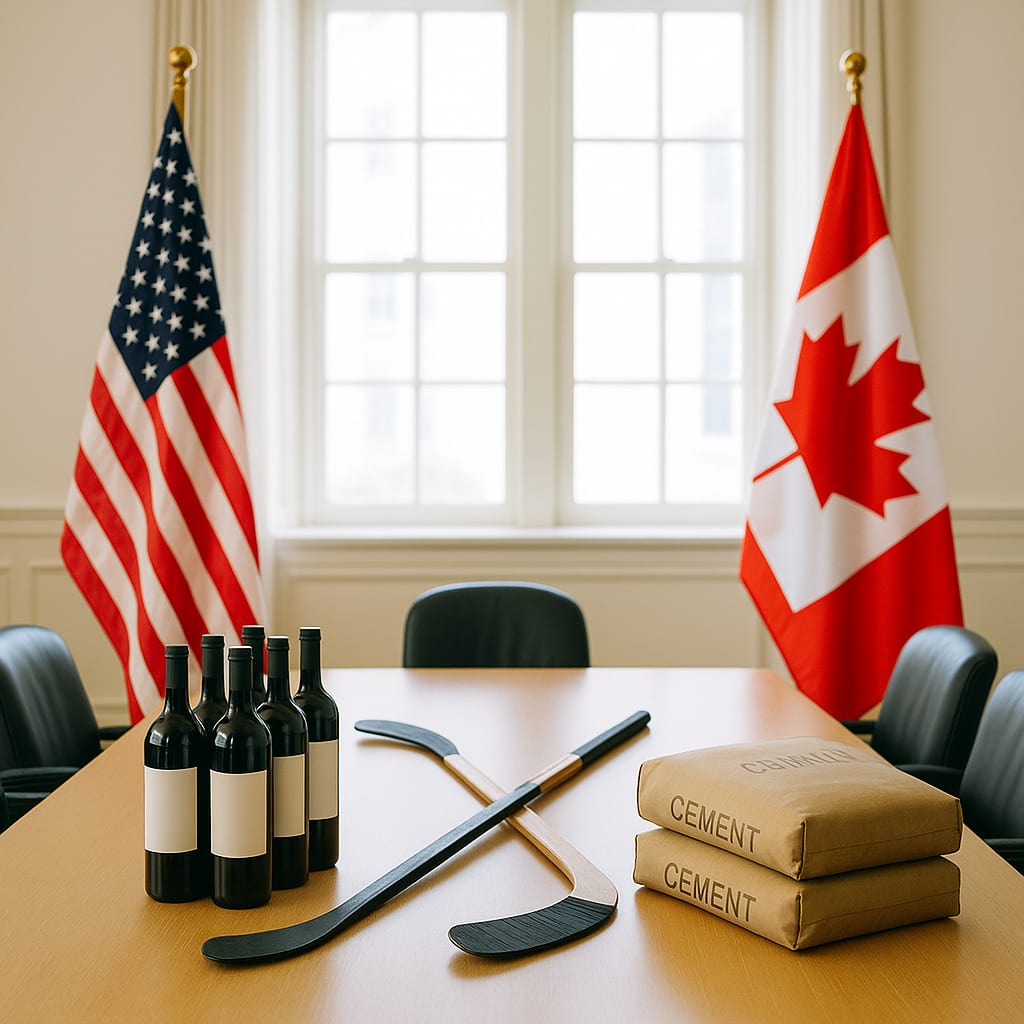
Across outlets, coverage converges on the scale and speed of the move—50% duties to take effect in 30 days—while diverging on scope and emphasis. European and North American reporting generally frames the action as a significant escalation with a close trading partner, with the BBC and Deutsche Welle underscoring the broader trade tensions and the Guardian warning of inflation risks and further strain in a tightly interwoven bilateral relationship. Several Asian outlets detail the legal mechanism and product mix, with CGTN, Japan Times, and NHK highlighting the invocation of a 1930 statute and listing examples like wine, hockey sticks, and cement.
There is a split in how expansively the measure is characterized. Some describe tariffs on “most” Canadian goods (the Guardian, South China Morning Post, Clarín), while others stress that they apply to “certain” or a “wide range” of goods and specify notable exemptions, including energy, potash, seafood, and critical minerals (France 24’s economy report, TASS, Japan Times). NBC narrows its focus to the three sectors Washington cites as discriminated against—autos, alcohol, and dairy—whereas Al Jazeera, La Repubblica, and The Hindu enumerate concrete products beyond those categories.
Ottawa’s stance is covered in two registers. France 24 from Ottawa, Le Monde, and La Repubblica emphasize Prime Minister Mark Carney’s commitment to intensify discussions and review “all options,” without signaling leader-level travel. By contrast, Telesur reports Canada’s assertion that the move violates the CUSMA trade agreement, indicating a more confrontational legal posture. A separate line of U.S. coverage links the episode to political grievances over Canadian wildfire smoke, with NBC and Fox News noting the president has floated factoring smoke-related costs into potential additional measures.
What Happened
President Donald Trump signed orders on July 20 to impose 50% tariffs on a wide range of Canadian imports, effective in 30 days, citing what the White House called Canada’s discriminatory treatment of U.S. automobiles, alcohol, and dairy products (France 24 economy; BBC; Guardian; South China Morning Post). The administration is using a nearly century‑old authority—Section 338 of the Tariff Act of 1930—which major outlets describe as obscure or untested (New York Times; Toronto Star/AP; CGTN). Examples of covered goods include wine, hockey sticks, and cement (Al Jazeera; The Hindu; La Repubblica), while energy, potash, seafood, and critical minerals are among the exclusions noted by multiple reports (France 24 economy; TASS; Japan Times; Clarín). Canadian Prime Minister Mark Carney said he is considering “all options” and that he and Trump agreed to intensify discussions in the coming weeks, without indicating immediate travel to Washington (France 24 Ottawa; Le Monde; La Repubblica).
Why It Matters
The measure directly tests North America’s trade architecture and dispute-management capacity. Canada has publicly framed the tariffs as violating CUSMA, the updated NAFTA framework, signaling potential recourse to agreement mechanisms and a new round of institutional stress within an alliance that had been “closely woven together” before Trump’s return to office (Telesur; Guardian). The White House’s reliance on Section 338—a rarely used, legally untested tool—also raises questions about the breadth and durability of unilateral tariff powers outside national security rationales, a point emphasized in U.S. reporting (New York Times; Toronto Star/AP; CGTN).
Economically, multiple outlets warn of disruption risks. The Guardian and South China Morning Post flag potential inflationary pressure and a fraying of cross‑border economic integration, while the BBC and Deutsche Welle frame the step as a major escalation with a top U.S. trading partner (Guardian; SCMP; BBC; DW). For policymakers, the episode compresses a negotiation window into 30 days and forces choices between litigation, countermeasures, or carve‑outs that could reshape sectoral trade flows.
Diverging Narratives
Disagreement begins with scope. The Guardian, SCMP, and Clarín characterize the action as hitting “most” Canadian goods, creating an impression of near-universal coverage, while France 24’s economy report, TASS, and the Japan Times stress a “wide range” of goods with specific, economically significant exemptions—energy, potash, seafood, and critical minerals—tempering the breadth of the measure. On product coverage, some outlets spotlight illustrative consumer and industrial items such as wine, hockey sticks, and cement (Al Jazeera; The Hindu; La Repubblica), whereas NBC centers on the three sectors Washington cites as discriminated against: autos, alcohol, and dairy.
Legal framing also diverges. The New York Times and Toronto Star/AP emphasize the novelty of Section 338’s deployment as an untested, Depression‑era tool, while CGTN underscores that it allows duties up to 50%, foregrounding statutory capacity. Opinion content, such as Paul Krugman’s column in the Toronto Star, condemns the trade tactic on policy grounds, contrasting with straight‑news accounts. Canada’s positioning is reported both as conciliatory—“ready to discuss” and to intensify talks (France 24 Ottawa; Le Monde; La Repubblica)—and as adversarial via an explicit CUSMA‑violation claim (Telesur). A separate U.S. political strand links trade measures to Canadian wildfire smoke, with NBC and Fox News noting the president’s threat to incorporate smoke-related costs—an issue linkage largely absent from international reporting.
What Happens Next
Two clocks are running. First, the 30‑day window before duties take effect concentrates negotiations that both leaders agreed to intensify; watch for whether working‑level talks yield sectoral carve‑outs or staged implementation, as suggested by the existing list of exemptions and product‑specific references (France 24 economy; CGTN; Al Jazeera; France 24 Ottawa). Second, Canada’s “all options” stance, combined with its public assertion of a CUSMA violation, sets up a decision on whether to initiate formal dispute proceedings versus continuing bilateral bargaining; any filing would signal a shift from diplomacy to adjudication (France 24 Ottawa; Telesur).
Legal durability is another indicator. Because the move relies on an untested 1930 statute, monitoring for court challenges or congressional pushback will help assess longevity (New York Times; Toronto Star/AP). Finally, U.S. messaging that ties potential additional tariffs to wildfire smoke costs points to a possible expansion vector; further references to smoke-related economic harms would indicate that linkage remains active (NBC; Fox News).