
[SECTION 1]
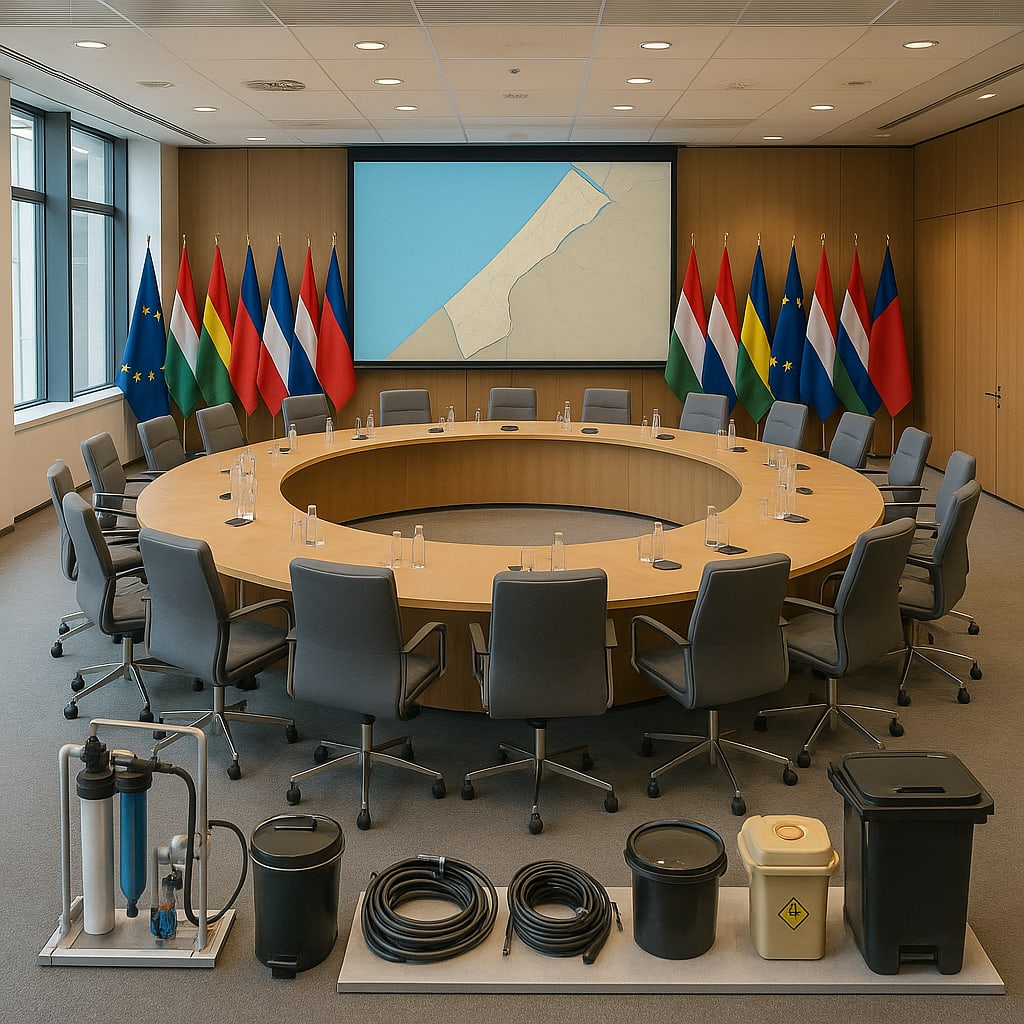
Lukas: [quietly] “Team Gaza.” It sounds like a relief convoy and a football club got together. [short pause] But the fine print keeps changing what it is.
Elena: [carefully] The label is the story. Brussels says “early recovery.” Israel’s Foreign Ministry calls the approved projects “humanitarian, not reconstruction.” Same pipelines, different verbs — and different permissions.
Lukas: [skeptical] Why does that matter to a person in a tent?
Elena: Because “reconstruction” implies rebuilding homes and power plants. “Humanitarian” means water trucks, waste removal, clinics. If you’re only allowed the second, you’re stabilizing collapse, not reversing it.
Lukas: [short pause] So, a listener reading a European release might feel uplifted — one billion dollars, a plan, a name.
Elena: [matter-of-fact] And 12 European countries plus Japan, the European Investment Bank, a “Peace Plan 2025” framing. It sounds coordinated, responsible.
Lukas: [amused] Grown-ups in the room.
Elena: [dryly] With a spreadsheet. [softly] But if you read coverage that compares the billion to the estimated seventy-one billion needed over a decade, you don’t hear “plan,” you hear “drop.”
Lukas: [exhales] The scale resets your emotion. Hope becomes… [searching] triage fatigue.
Elena: And notice what each ecosystem emphasizes. One outlet highlights that EU support depends on reforms in the Palestinian Authority. That nudges you to see governance as the hinge.
Lukas: [curious] As in: we’ll help, but fix your bureaucracy first.
Elena: Right. Another piece foregrounds that Israel “reached agreement” on two waste and water projects — which signals coordination, but also that permits sit on one desk.
Lukas: [interrupts] And then an Israeli paper says, no, these aren’t reconstruction. That’s a downgrade mid-sentence.
Elena: [thoughtful] It makes a reasonable reader conclude: rebuilding is contingent on security concessions. Which in other coverage is explicit — urging Hamas’ disarmament as a precondition.
Lukas: [carefully] So, if your feed is mostly Israeli or European officialdom, the story is: aid with guardrails, tied to disarmament and PA reforms. Responsible, conditional, sane.
Elena: And if your feed is regional or critical media, the story centers on insufficiency and control. One Balkan piece states Israel controls almost seventy percent of the strip’s territory. You come away thinking: who can even green-light a bulldozer?
Lukas: [quietly] That changes who seems powerful in your mental map.
Elena: And who seems blameworthy when nothing rises from the rubble. [short pause] There’s also a subtle moral sorting. In some narratives, donors appear trustworthy — accountants of compassion. In others, the trust is placed in the severity of need, and donors look like they’re doing optics.
Lukas: [skeptical] Optics that say “recovery,” while officials say “not reconstruction.”
Elena: [softly] Language doing policy.
Lukas: [hesitant] And what about Hamas in this story? Are they central or peripheral?
Elena: Depends again. In European and Israeli framings, Hamas is the reason for conditions — disarmament first. In some Arab coverage, Hamas is background noise to the larger fact: a population needs tens of billions and political permission doesn’t exist.
Lukas: [short pause] I can imagine two coworkers arguing past each other. One says, look, one billion is meaningful and smartly conditioned. The other says, if it doesn’t let you pour concrete, it’s a press release.
Elena: [quietly] Both are reading the text in front of them.
Lukas: And reading what’s not in it.
Elena: Exactly. One article lists governments and banks. Another lists cratered hospitals and the decade-long bill. The omissions are doing as much work as the facts.
Lukas: [thoughtful] So the tension is not generosity versus cynicism — it’s whether the word “recovery” is a door or a label on a locked door.
Elena: [long pause] And who holds the key in each telling.
[SECTION 2]
Lukas: [softly] The key might be security. I saw a report that negotiations are stuck on Hamas disarmament and even on salaries for Gaza’s civil servants.
Elena: [matter-of-fact] Mediators say salaries look solvable. Disarmament doesn’t, as long as Israeli forces remain inside Gaza. That’s the stalemate. And it loops back into the aid story.
Lukas: Because if disarmament’s impossible now, “reconstruction” is a promise later, not a policy now.
Elena: [carefully] Which is why “humanitarian” becomes the safe word. It lets everyone claim motion without conceding on security.
Lukas: [skeptical] Then this other thread: the U.N. said armed personnel interfered with aid distribution, WFP paused operations in one area. Hamas denied it. [short pause] If you mainly see that, how does it shape you?
Elena: If you trust the U.N. account, it strengthens the case for strict conditions and oversight. A reader might feel, we can’t pour money into chaos. If you prioritize the denial, or you’ve seen aid politicized before, you might feel the U.N. is being used to justify withholding — that conditions become a perpetual excuse.
Lukas: [dryly] Same incident, two intuitions: tighten the valve versus stop using the valve to starve the project.
Elena: And add one more layer: an outlet notes EU aid depends on PA reforms. To someone who sees the PA as weak or compromised, that feels like funneling leverage to a body they don’t trust. To someone else, it’s basic due diligence.
Lukas: [amused] It’s amazing how the same sentence can be “accountability” in Brussels and “outsourcing control” in Ramallah.
Elena: [softly] Or “depoliticizing aid” in a donor memo and “political engineering” on the receiving end.
Lukas: [interrupts] Let’s ground it. The EU says waste and water projects got Israeli sign-off. An Israeli ministry says don’t call it reconstruction. A regional outlet says Israel controls most of the territory. [short pause] A normal person could conclude: even with a billion on the table, the gate is not in Brussels.
Elena: That’s a coherent inference. And it reframes responsibility. Inside one narrative, donors are the protagonists and Hamas the obstacle. Inside another, Israel is the gatekeeper and the donors are spectators with tickets.
Lukas: [quietly] And Palestinians are the ones waiting outside, either way.
Elena: [long pause] Which is partly why the word “recovery” stings for some. It implies an arc toward normal. But if the arc depends on three different actors changing behavior — Hamas disarming, Israel loosening control, the PA reforming — then the word describes a destination no one can route to.
Lukas: [carefully] So two reasonable takeaways: One, this is the beginning of a serious rebuild, paced by security and governance. Two, this is a carefully staged announcement that can’t touch the actual ruins.
Elena: And the bitter twist is both can be true at the same time. The money will fund real pipes, real waste systems. It will also be dwarfed by need, and boxed in by politics.
Lukas: [exhales] Which means tomorrow morning, someone opens a tap that didn’t work yesterday, and someone else watches a bulldozer idle at a checkpoint.
Elena: [quietly] And both will say, “I know what this really is,” because their day gave them proof.
Lukas: [softly] The proof is local. The story is global. And the words… [short pause] the words belong to the people who can sign or stall a permit.
Elena: [serious] Until “recovery” is a permission and not a PR noun, that’s the uncomfortable center of it.
Lukas: [long pause] Team Gaza, with three captains, none of them on the field.