
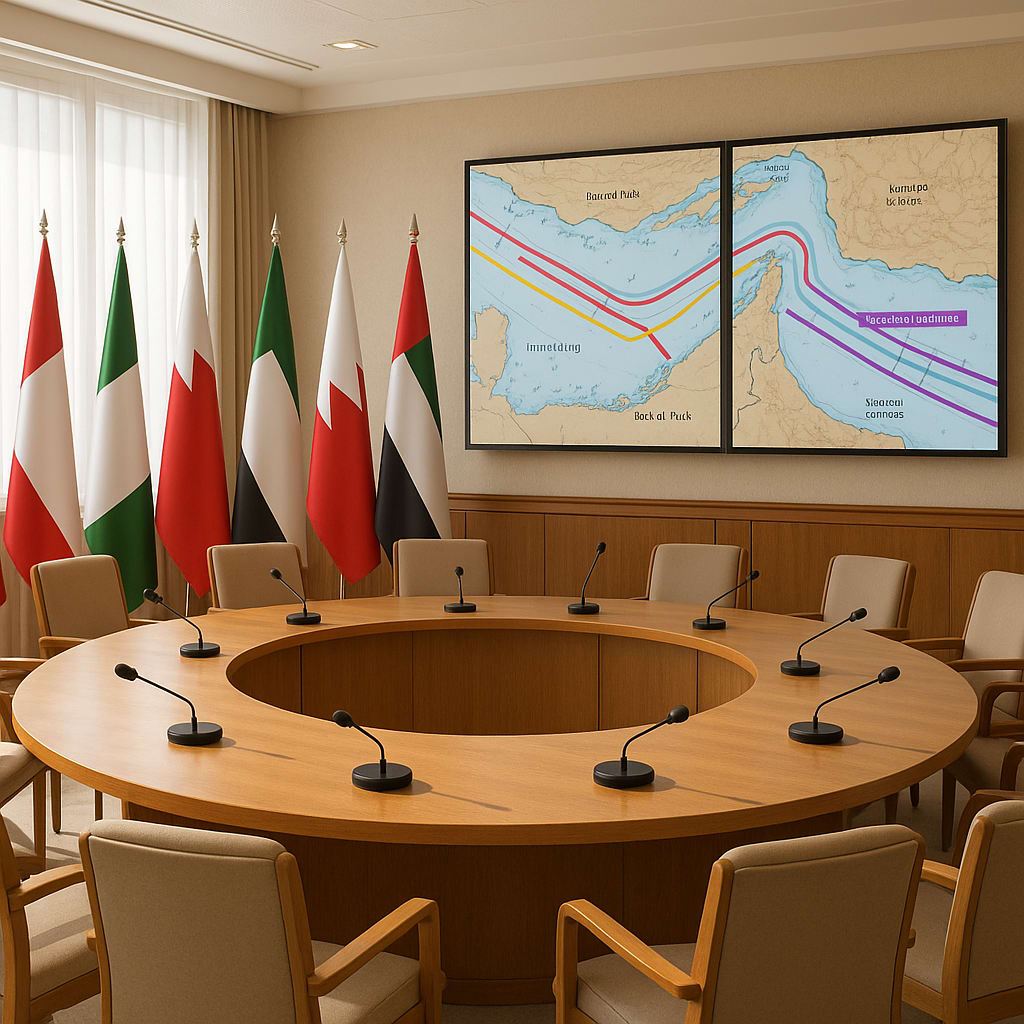
Rubio seeks Gulf backing for US–Iran ceasefire framework amid contested control of the Strait of Hormuz
Narrative Snapshot
- US and European outlets emphasize alliance management. The Guardian and the New York Times frame Marco Rubio’s tour as reassurance to the UAE, Kuwait, and Bahrain about their security and about a 60-day ceasefire with Iran; Le Monde focuses on his schedule and the parallel negotiations with Tehran. Coverage highlights that some Gulf governments are uneasy that the deal could benefit Iran financially, while Qatar’s role as mediator is noted by The Guardian.
- Regional reporting centers the operational volatility in Hormuz. IRNA, SCMP, and Middle East Eye detail Iran’s 60‑day fee waiver under the Islamabad MoU and accelerated transit authorizations, then document IRGC-ordered closures following Israeli strikes in Lebanon. Oman’s IMO‑coordinated, no‑toll corridors and Qatar–Oman talks on a multilateral reopening regime (with Gulf states pushing for no fees) are covered by MEE and The Hindu.
- Competing national narratives are explicit. Fox News publishes the MoU text and foregrounds US enforcement concerns and sanctions relief; Iranian and Russian state-linked outlets cast the deal as a US setback and amplify President Trump’s assertion that only the US could impose post‑ceasefire tolls.
- Process fragility is visible across sources. Follow‑up talks in Switzerland were postponed amid continued fighting in Lebanon (The Guardian, RT), even as The Hindu describes a flurry of US–Iran diplomacy led by Vice President J.D. Vance.
What Happened
On 18 June, US President Donald Trump and Iran’s President Masoud Pezeshkian electronically signed a 60‑day ceasefire and negotiating framework, the Islamabad Memorandum of Understanding, according to Middle East Eye and Fox News, which published the text. Iran’s Supreme National Security Council announced fee waivers in the Strait of Hormuz during the 60‑day period and expedited authorizations via its Persian Gulf Strait Authority (IRNA; MEE; SCMP). On 20 June, after Israeli strikes in Lebanon, Iran’s IRGC warned vessels to avoid Hormuz and announced a closure (IRNA; MEE). With risks mounting, Oman opened temporary, no‑toll maritime corridors coordinated with the IMO, and Qatar’s prime minister traveled to Muscat to discuss a regional reopening mechanism involving Iran, Iraq, and Gulf states (MEE; The Hindu). Rubio began a two‑day tour of the UAE, Kuwait, and Bahrain to brief allies and seek support, describing “frank” talks (Al Jazeera; The Guardian; NYT; MEE).
Why It Matters
The episode tests multiple governance regimes at once: Gulf security cooperation (GCC), maritime safety under IMO coordination, and the enforceability of an interim US–Iran framework that defers the hardest nuclear issues while front‑loading sanctions relief and maritime steps (Fox News). Divergent preferences over who sets and funds navigation norms in Hormuz—state-imposed fees, environmental or safety services, or no charges—surface through Iran’s time‑limited waiver, Oman’s no‑toll corridors, and Gulf states’ push for zero transit fees in prospective multilateral talks (IRNA; MEE; The Hindu). For Washington, Rubio’s consultations speak to sustaining deterrence and reassurance while the MoU’s verification and claw‑back mechanisms are still being defined (Fox News; The Guardian). Regionally, IRGC closures linked to fighting in Lebanon tie the strait’s openness to conflict dynamics beyond the Gulf, underscoring the vulnerability of energy and trade flows to spillover violence (IRNA; MEE; The Guardian).
Diverging Narratives
Fox News presents the MoU as a calculated risk: immediate oil‑related waivers and a bet on verification to deter Iranian noncompliance, alongside warnings from US officials that Tehran may “lie and cheat,” and explicit Iranian conditionality that commitments lapse if the US does not deliver (Fox News). By contrast, RT amplifies Iranian officials calling the MoU proof of US failure and notes the White House’s initially muted rollout; it also highlights Trump’s statement that no Hormuz tolls will be allowed unless imposed by the US after the 60 days if a final deal stalls (RT). On maritime management, Iranian sources and MEE outline a 60‑day fee holiday and expedited clearances, then justify closures after Israeli strikes; Oman and The Hindu detail alternative, no‑toll corridors. The Guardian underscores divisions among Gulf states, while the NYT notes the particular sensitivities of the countries Rubio visited, which it reports were targeted by Iranian attacks during the war. Process reporting also splits between accounts of intensive US–Iran engagement (The Hindu) and delays triggered by renewed violence (The Guardian; RT).
What Happens Next
- Ceasefire-to-negotiations transition: Rescheduling of the postponed Switzerland talks and any joint readouts will signal whether the 60‑day framework advances despite Lebanon‑related violence (The Guardian; RT). Watch for explicit verification and “claw‑back” provisions referenced by US officials (Fox News).
- Hormuz operating regime: Outcomes from Qatar–Oman consultations on a regional mechanism—particularly on transit fees, environmental/safety services, and participation by Iran, Iraq, and GCC states—will indicate whether a shared governance model emerges (MEE). Omani notices about the duration and scope of IMO‑coordinated corridors are immediate indicators (MEE; The Hindu).
- Enforcement versus conditionality: Iranian fee waivers and 48‑hour transit procedures functioning in practice, or renewed IRGC closure orders tied to Lebanon, will show whether maritime steps are insulated from external shocks (IRNA; SCMP; MEE).
- Gulf alignment: Any GCC communiqué from Bahrain and public positions by the UAE, Kuwait, and Bahrain after Rubio’s visit will clarify the extent of regional buy‑in or demands for additional US assurances (MEE; The Guardian; Le Monde).
- US tolls stance: Follow‑on US policy signals regarding Trump’s “no tolls unless by the US” assertion would affect fee debates and legal risk assessments for shippers (RT).