
[SECTION 1]
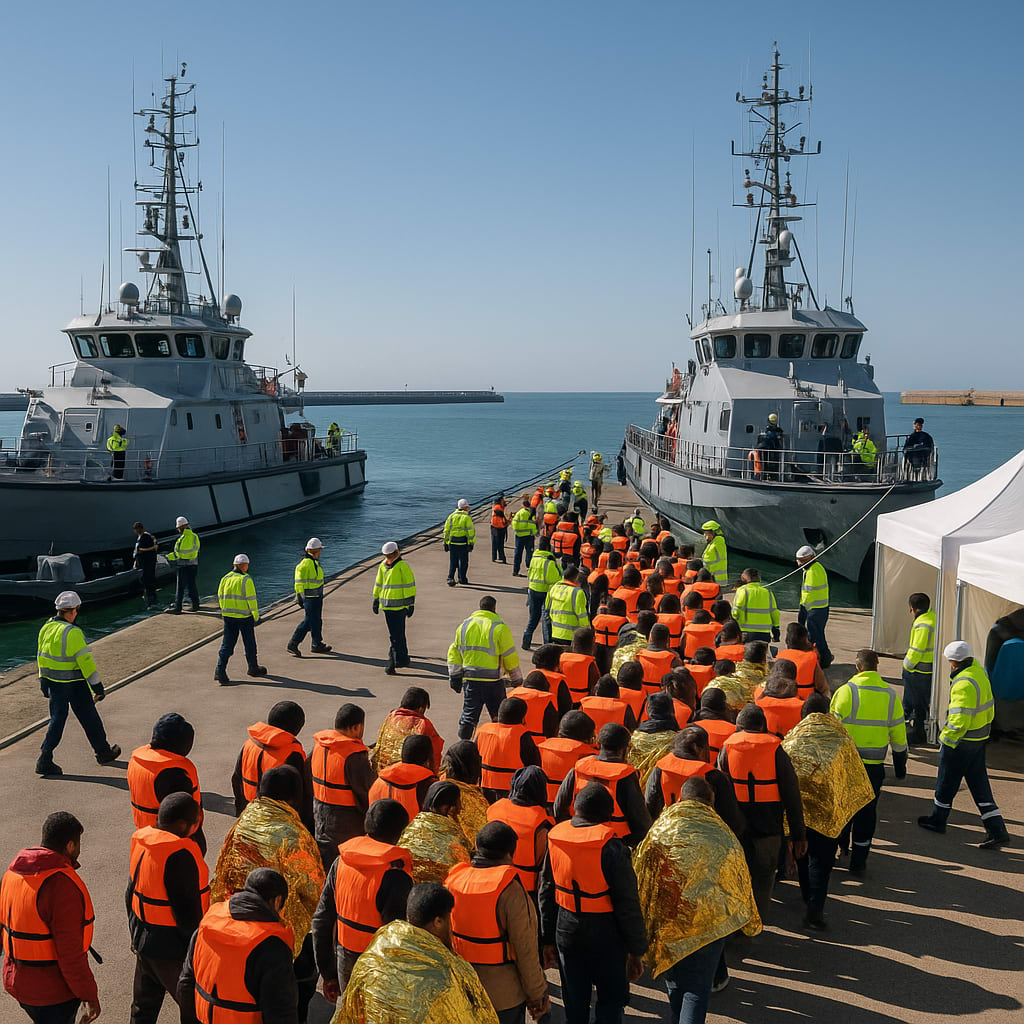
Elena: [quietly] It’s a success story that sounds like an alarm: 157 people pulled from the Channel after a boat caught fire. French and UK vessels side by side.
Lukas: [short pause] So is that… victory or warning?
Elena: [carefully] Depends what you zoom in on. If your eyes go to the coordination—two countries, one dangerous sea, fast rescue—you feel relief, maybe pride. If your eyes go to the fire—why were that many people in harm’s way at all?—you feel dread. And anger.
Lukas: [curious] Two headlines from the same sentence.
Elena: [matter-of-fact] Exactly. One version says: trained crews did their job, systems worked, lives saved. Another says: the system failed long before the radio call, and we were lucky not to be counting bodies.
Lukas: [thoughtful] What does each version leave out?
Elena: [serious] The rescue-first framing often omits the chain of decisions and conditions that put a crowded boat in that channel. The crisis-first framing often omits the particular human competence under pressure—the quiet heroism that kept 157 people alive.
Lukas: [sigh] And the reader? How do they walk away?
Elena: A reader bathing in the rescue narrative might think, “We can manage this. With enough coordination and resources, we keep people safe.” Trust rises a notch. A reader soaking in the crisis narrative might think, “This is untenable. Something upstream is broken.” Urgency spikes, and tolerance for risk drops.
Lukas: [skeptical] Is it fair to feel pride and alarm at once?
Elena: [softly] It’s probably the most honest reaction. But media ecosystems tend to choose a center of gravity. A shot of gratitude, or a shot of indignation.
Lukas: [interrupts] And what about the cross-Channel piece—France and the UK together? That sounds like a rare moment of… détente.
Elena: [dryly] Or a fresh round of “who deserves credit.” The same cooperation can be narrated as partnership—or as subtle scorekeeping. “We moved first.” “We took the lead.” Because credit deflects blame.
Lukas: [exhales] So if I mostly hear about coordination, I might forgive a lot. If I mostly hear about the fire, I might forgive very little.
Elena: [thoughtful] Yes. The emotional anchor changes what feels proportional. Relief primes you to see complexity; fear primes you to demand decisiveness.
Lukas: [short pause] And neither is irrational.
Elena: [quietly] Neither is irrational.
Lukas: [pause] Okay—take me one layer deeper. Who becomes the protagonist in each story?
Elena: [carefully] In the rescue story: the crews, the vessels, the call logs, the horizon closing fast. In the crisis story: the chain of responsibility—operators, regulators, policymakers—anyone whose choices preceded the smoke.
Lukas: [softly] Same water, different movie.
Elena: [long pause] And that choice of movie quietly teaches you what to feel is reasonable.
Lukas: [curious] Reasonable gratitude… or reasonable fury.
Elena: [matter-of-fact] And when the coffee hits, reasonable policy preferences to match.
Lukas: [short pause] I can already hear two people arguing in an office later—about the same sentence.
Elena: [gentle] One saying, “Did you see how fast they moved?” The other, “Did you see it was on fire?”
[SECTION 2]
Lukas: [carefully] Let’s talk incentives. Who benefits from each framing?
Elena: [serious] Institutions on both shores benefit from the competence frame. It showcases capacity: trained crews, interoperable protocols, shared language on the radio. It says, “Trust us. We can handle danger.”
Lukas: [skeptical] But the danger itself doesn’t evaporate.
Elena: [matter-of-fact] Which is why critics lean into the crisis frame. Not as theater—often out of genuine alarm. “If we normalize rescue, we’re normalizing preventable risk.” That’s the heartbeat of the second story.
Lukas: [short pause] And for the public, those heartbeats feel different in the body. Relief is warm. Alarm is electric.
Elena: [amused] Neuroscience by breakfast. But, yes. And that physiology maps to headlines. One reader’s morning becomes a quiet nod to professionalism. Another’s becomes a demand to change upstream conditions—laws, enforcement, routes, safety… pick your lever.
Lukas: [interrupts] Wait—within “crisis,” there are forks. Some people will hear “protect people earlier.” Others will hear “stop the crossings entirely.”
Elena: [thoughtful] And that’s the crucial divergence. The same fire can be proof that people need safer options—or proof that the whole pattern must be deterred. The article doesn’t tell you which; the frame nudges you.
Lukas: [softly] So on one shore, a reader might feel, “We showed up.” On the other shore, a reader might feel, “We showed up.” Same sentence—slightly different pride, slightly different subtext.
Elena: [dryly] And maybe a quiet competition for whose vessels did more. Cooperation with a side of branding.
Lukas: [dry laugh] Of course. Even the sea has PR.
Elena: [carefully] Here’s the humane test I use: Can you hold the image of a burning boat and feel both gratitude for the people who pulled others aboard and impatience with a reality that put them there? If yes, you’re probably resisting the binary.
Lukas: [pause] But most of us don’t wake up wanting complexity. We want to know who did well and who messed up.
Elena: [softly] And media helps us decide. If it leads with numbers rescued and calm quotes about coordination, a reader may store this as competence. If it leads with the fire and the scale of risk, a reader may store this as system failure.
Lukas: [skeptical] Are we over-reading from one thin line of fact?
Elena: [honest] We only have that thin line: a boat fire in the Channel, 157 rescued by French and UK vessels. From that, we can map plausible narratives—not to accuse, but to explain how reasonable people land in different places.
Lukas: [thoughtful] One coworker hears “proof we can manage danger.” Another hears “proof danger is managing us.”
Elena: [quietly] And they might both support “saving lives,” but disagree on what saving lives requires tomorrow morning.
Lukas: [exhales] Which is why the lunch debate gets so heated. They’re not disputing the rescue—they’re disputing the meaning.
Elena: [serious] Meaning allocates responsibility. It allocates budget. It allocates blame.
Lukas: [softly] And empathy. Who we picture first when we close our eyes.
Elena: [long pause] The crews on deck. Or the chain of choices before there’s even a deck to reach.
Lukas: [carefully] If the same rescue can be read as competence and collapse, what do we fix next?
Elena: [quietly] That’s the uneasiest part. Your answer depends on which perfectly reasonable feeling you had while reading the same single line.