
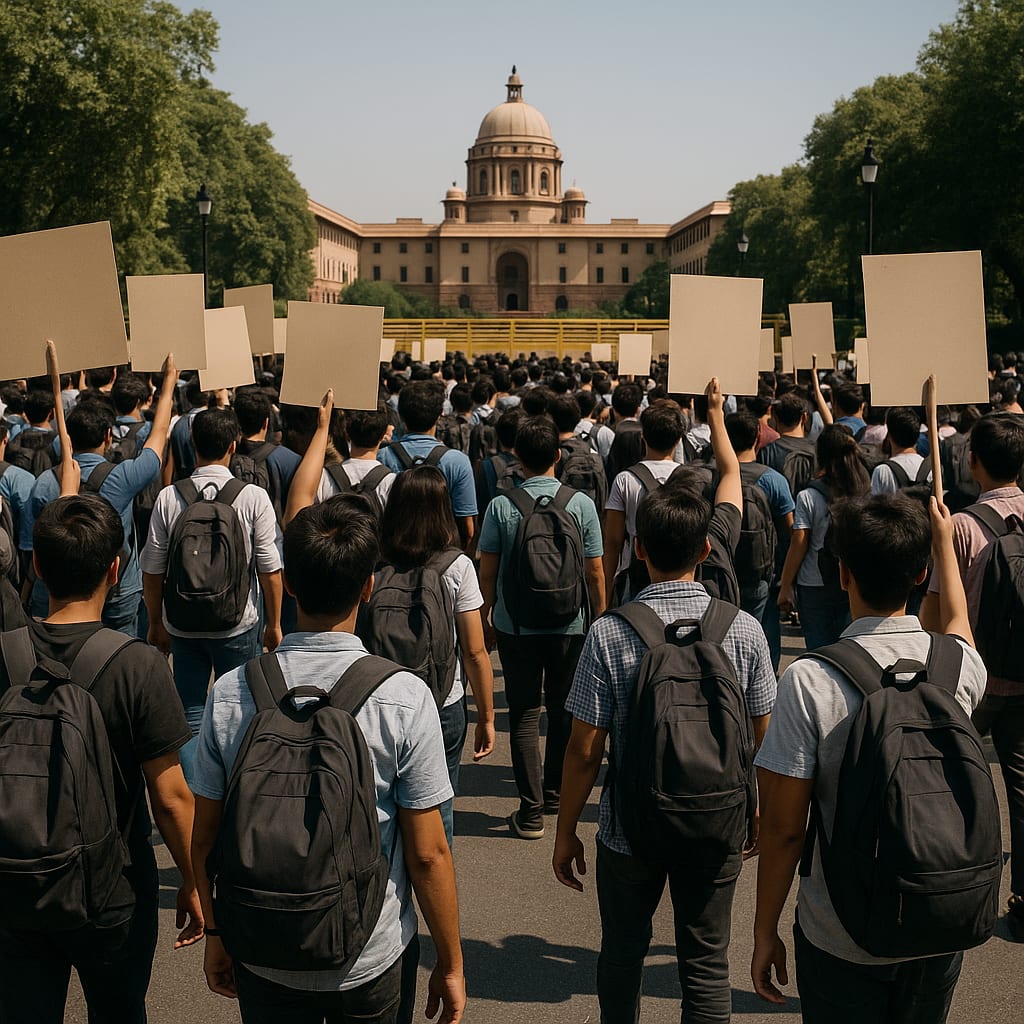
Delhi students march on parliament over exam scandal as police move to block rally
Narrative Snapshot
Across the eight outlets, the core picture is consistent: a youth-driven mobilization branded as the Cockroach Janta Party challenged restrictions in India’s capital to demand accountability after exam irregularities, and police responded with force. Where they diverge is in emphasis and framing. The Guardian and BBC center the movement’s generational profile and programmatic aims—resignation of the education minister and system-wide fixes—while Al Jazeera underscores the exceptional measures protesters say they defied, describing a “lockdown” in Delhi to prevent the march. La Repubblica and Folha de S.Paulo concentrate on the coercive toolkit—tear gas, batons, and barricades—used to stop the march, fixing attention on state response rather than internal dynamics of the movement.
Two outlets situate the event’s scale within India’s protest politics: The Guardian calls it one of the largest anti-government gatherings in years, and the Japan Times compares Monday’s turnout to the biggest since the 2021 farmer protests, explicitly linking the episode to political pressure on Prime Minister Narendra Modi. That framing contrasts with BBC’s and Le Monde’s focus on examination governance—Le Monde also introduces the movement’s origin story, noting the “cockroach” party was launched in May by an Indian student recently graduated in the United States to channel anger over recurring higher-education exam failures and scandals.
A final axis of variation is the target of accountability. Most outlets say demonstrators demanded the education minister’s resignation, but Folha headlines a sharper demand reaching the prime minister. Politika hews to the minister-focused call, describing thousands of supporters of the youth movement (CJP) seeking his resignation. This spread—from administrative reform to leadership change—defines what is most at stake: whether the scandal is resolved as a sectoral governance problem or escalates into a broader political confrontation.
What Happened
On Monday, thousands of mostly young protesters gathered in central New Delhi and attempted to march on India’s parliament in response to exam irregularities, despite police orders denying permission for the rally. The Guardian reports that crowds assembled from early morning, with some camping overnight, and called for the education minister to resign. BBC says the demonstrators pressed for changes to how the education system is run, while Al Jazeera notes they answered a call by the Cockroach Janta Party for sweeping reforms and accountability. Police erected barricades and used force to disperse the march; La Repubblica and Folha de S.Paulo describe tear gas and baton charges. Le Monde likewise reports police dispersal, setting the protest against a backdrop of repeated higher-education exam scandals and a youth-led party launched in May. The Japan Times says protesters pressed on after the crackdown, maintaining pressure on the government.
Why It Matters
The immediate dispute centers on the integrity of India’s higher-education examination system, which multiple outlets say has been marked by irregularities and scandals. Le Monde frames the mobilization as a response to recurring failures in exam administration, while BBC and Al Jazeera describe demands for systemic reform and accountability. If the government responds with credible remedial action, this episode could become a test case for the state’s capacity to restore confidence in core gatekeeping institutions central to social mobility and human capital formation. If not, the rift between youth expectations and administrative performance may widen.
The scale and endurance of the march carry political implications. The Guardian characterizes it as among the largest anti-government demonstrations in years, and the Japan Times calls it the biggest in Delhi since the 2021 farmer protests, signaling potential for sustained contention that reaches beyond the education sector. La Repubblica and Folha’s accounts of aggressive crowd control, and Al Jazeera’s reference to lockdown-style restrictions, spotlight the governance choice set: de-escalation through policy concessions, or containment through public-order measures. For decision-makers, the trade-offs now link exam governance credibility with protest management and political accountability.
Diverging Narratives
Outlets differ on whether the protest is primarily about sectoral reform or political challenge. BBC and Al Jazeera emphasize structural fixes to the education system and “sweeping reforms” after an exam scandal, while the Japan Times and Folha frame consequences in terms of pressure on Prime Minister Modi; Folha explicitly reports calls for his resignation, whereas Politika, The Guardian, and La Repubblica focus on the demand that the education minister step down. This divergence shapes how outcomes will be read—either as technocratic accountability within a ministry or as a broader referendum on national leadership.
Accounts of state response vary in intensity and terminology. La Repubblica and Folha detail tear gas, baton charges, and barricades; Le Monde says police dispersed the protest; The Guardian foregrounds the crowds’ persistence despite police orders and overnight camping; Al Jazeera introduces “lockdown” as a descriptor of restrictions protesters say they defied. Scale is also framed differently: The Guardian calls it one of the largest anti-government rallies in years, while the Japan Times anchors it to the benchmark of the 2021 farmer protests. Finally, only Le Monde foregrounds the movement’s recent genesis—a party launched in May by a US-educated Indian student—whereas other outlets treat the Cockroach Janta Party chiefly as the protest’s convening label.
What Happens Next
Key decision points now turn on accountability and reform. One is personnel: multiple outlets say protesters seek the education minister’s resignation; should the government remove or retain him, it will signal either concession to movement demands or a decision to stand firm (The Guardian; La Repubblica; Politika). A second is policy: Al Jazeera and BBC report calls for sweeping changes to exam governance; watch for announcements of investigations, audit mechanisms, or regulatory overhauls aimed at irregularities cited by Le Monde and La Repubblica.
A third centers on protest management. La Repubblica and Folha report forceful crowd control, while the Japan Times says demonstrators pressed on after the crackdown. Whether authorities continue to rely on barricades, dispersals, and movement restrictions noted by these outlets—or shift toward dialogue—will shape protest endurance. Analysts should monitor official statements on exam reforms, any moves on the minister’s status, the maintenance or lifting of restrictions referenced by Al Jazeera and The Guardian, and turnout indicators relative to the “largest since 2021” framing in the Japan Times.