
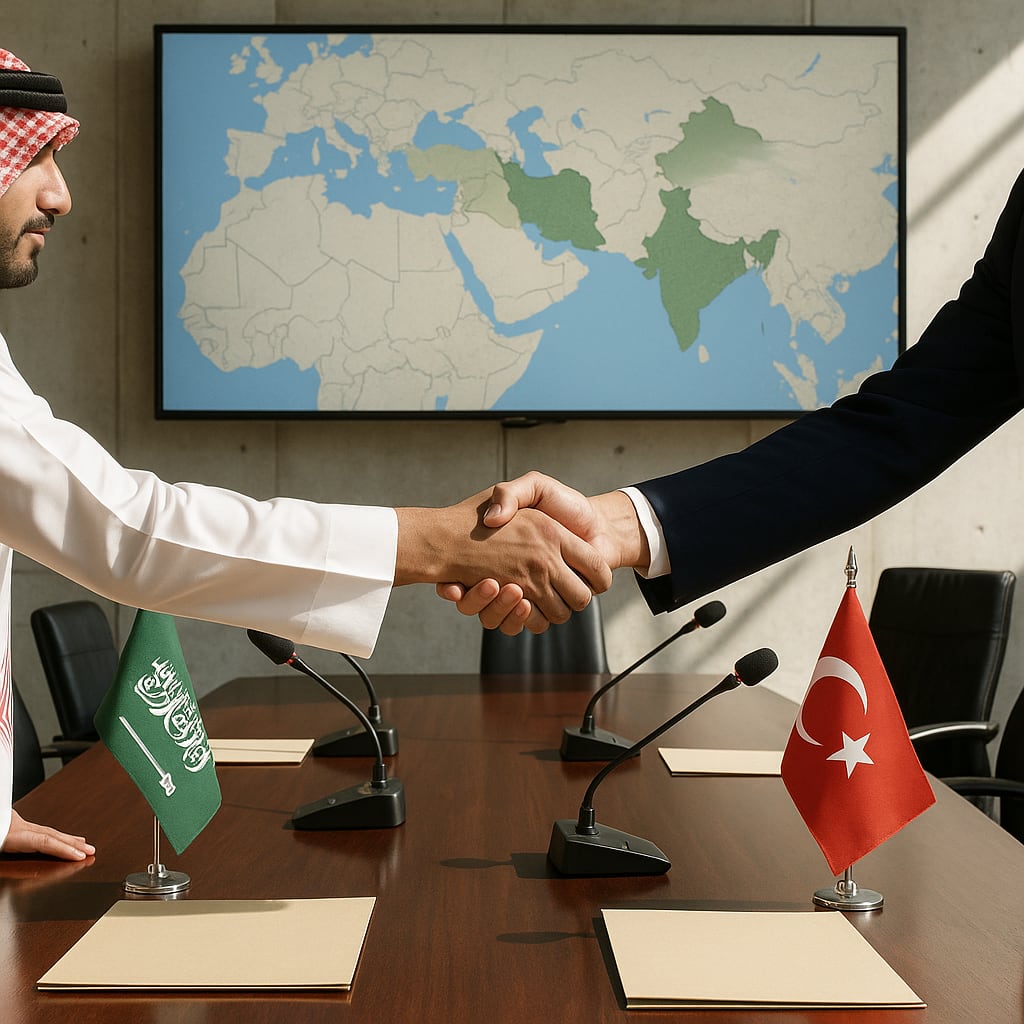
Saudi Arabia, Turkey and Pakistan sign mutual defense pact with collective-defense clause
Narrative Snapshot
Across outlets, there is broad agreement that the pact’s core provision treats an attack on one signatory as an attack on all, but coverage diverges on how binding that commitment is in practice. Turkish officials publicly equate the text to NATO’s Article 5, with Hakan Fidan saying it is “technically the same” and stressing it does not target Iran, while other reporting underscores that the joint statement did not specify what military action, if any, would be automatic. Turkish state messaging also rejects claims the pact conflicts with NATO obligations.
Interpretations differ on intent and strategic orientation. Several outlets situate the agreement within escalating tensions involving Iran and recent strikes on Saudi territory attributed to Iranian allies, while Ankara and allied coverage emphasize regional stability and deny the pact is aimed at any one country. Some European and Latin American coverage frames the trio as Sunni allies aligning in a NATO-like structure, and one Italian report highlights an Iranian warning to Riyadh, underscoring the deterrence signaling at stake.
There is also variance on scope and process. One report suggests Egypt could join, hinting at potential expansion, though this is not widely corroborated. Most coverage places the signing in Mecca, with photo evidence labeling it the Makkah Joint Defense Agreement, but at least one wire dispatch cites Jeddah, a minor factual discrepancy that reflects how quickly the story moved across time zones and languages.
What Happened
On August 7, 2026, Saudi Arabia, Turkey and Pakistan concluded a joint defense agreement in Saudi Arabia that enshrines a collective-defense clause, committing each to treat aggression against one as an attack on all. The signing brought together Saudi Crown Prince Mohammed bin Salman, Turkish President Recep Tayyip Erdogan and Pakistani Prime Minister Shehbaz Sharif, with multiple outlets identifying Mecca as the venue and an accompanying image labeling it the Makkah Joint Defense Agreement. The allies’ joint statement outlined the mutual-defense principle but did not specify what form of military action would be required in response, a point several reports highlighted. The accord was announced amid sustained security pressures, including drone and missile strikes on Saudi territory that Riyadh has attributed to Iran’s allies in Yemen and Iraq, and broader U.S.-Iran tensions referenced in regional and transatlantic coverage.
Why It Matters
Several outlets argue the pact could reshape the region’s security architecture by formalizing a minilateral collective-defense framework among an oil-rich Gulf power, a NATO ally, and a nuclear-armed state. Coverage links the move to a perception of diminished American strategic presence in the region and to the fallout from U.S.-Iran confrontation, suggesting partners are seeking additional layers of deterrence and crisis insurance. For NATO and EU policymakers, Ankara’s role bears watching: Turkish officials have portrayed the pact as Article 5-equivalent while insisting it does not conflict with NATO commitments, a balance Western allies will parse closely. For Gulf and South Asian stakeholders, the agreement signals a reconfiguration of deterrence dynamics around Saudi Arabia’s threat environment and Turkey-Pakistan defense ties, even as Pakistani outreach to Tehran days earlier underscores efforts by at least one signatory to keep diplomatic channels open with Iran.
Diverging Narratives
The central ambiguity concerns the strength and justiciability of the collective-defense obligation. Turkish officials describe the provision as technically equivalent to NATO’s Article 5, yet the public text, as reported, stops short of defining automatic military responses. French and international broadcasts stress this lack of specificity, while Turkish government communications focus on countering claims of any conflict with NATO membership.
Intent is another axis of divergence. Ankara and wire services quoting the Turkish foreign minister state the pact is not aimed at Iran or any country, whereas U.S., European and regional outlets situate the agreement firmly in the context of Iran-related tensions and recent projectile attacks on Saudi territory. An Italian daily highlights Tehran’s warning to Riyadh that “no document” can guarantee its security, reinforcing a deterrence-versus-provocation frame that differs from Ankara’s stability narrative.
Framing also varies by geography: Latin American and Italian newspapers deploy “Sunni NATO” analogies, while Al Jazeera and Indian coverage emphasize systemic reordering and diminished U.S. presence. One live update suggests Egypt could join, but this prospective expansion is not echoed elsewhere. Finally, most reports identify Mecca as the venue, though at least one dispatch names Jeddah, a minor inconsistency in the immediate record.
What Happens Next
Three decision points emerge from the reporting. First, clarification and implementation: because the joint statement did not specify required military actions, signals to watch include any publication of implementing protocols or official guidance that defines consultation mechanisms, thresholds, and response options. Second, alliance management: Turkish authorities have already moved to dispel claims of conflict with NATO obligations; further outreach to NATO allies or additional statements from Ankara will indicate how the pact is being harmonized with existing treaty commitments. Third, regional diplomacy and scope: Pakistan invited Iran’s foreign minister for talks shortly before the signing, and Iran has publicly cautioned Riyadh; whether those talks proceed and how Tehran calibrates its rhetoric will shape the pact’s deterrence environment. Any indication of prospective expansion, such as the mooted Egyptian participation referenced in Turkish commentary, would further signal the pact’s trajectory.