
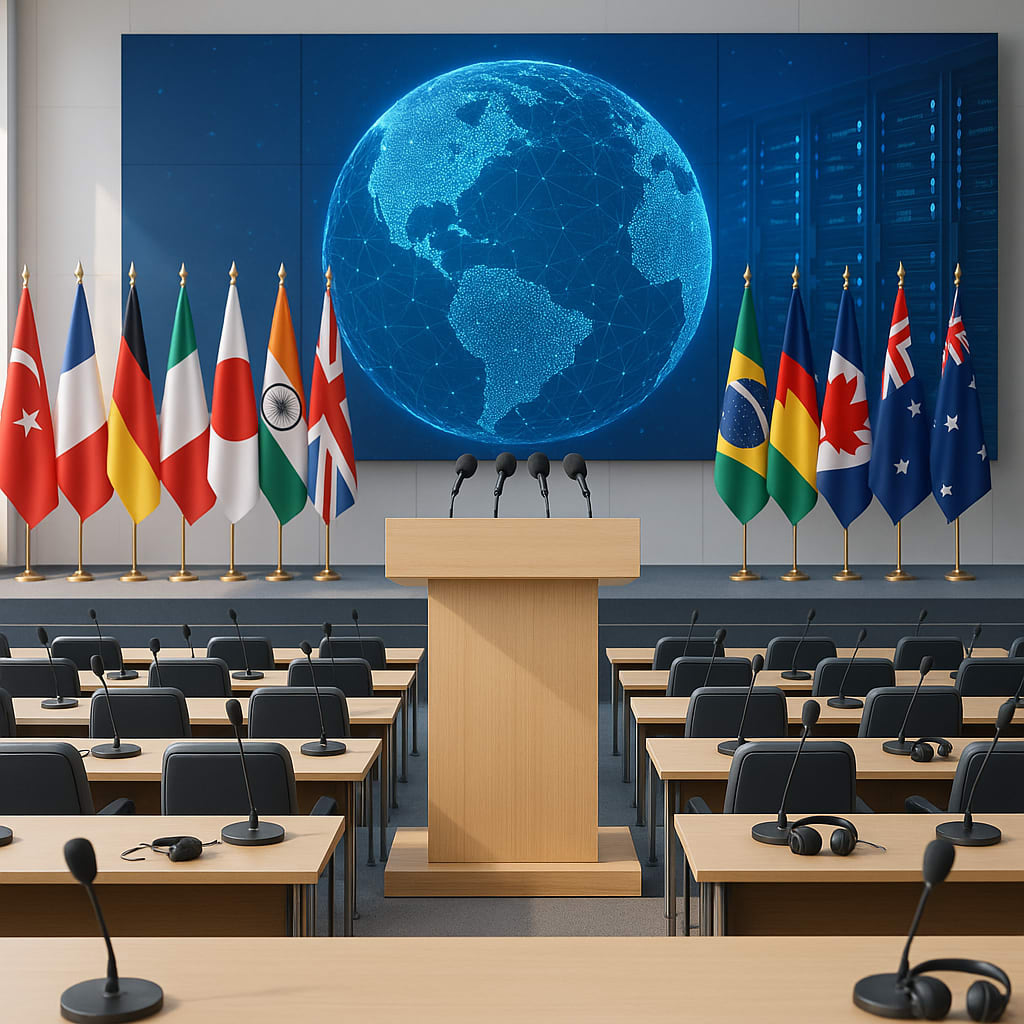
China launches a World AI Cooperation Organization as Xi urges inclusive, human-centered governance
Narrative Snapshot
Across outlets, there is broad agreement that Beijing paired conciliatory language about openness with a concrete bid to shape rules by announcing a new multilateral body. Chinese state media highlighted Xi Jinping’s “four observations” and themes of inclusivity, human-centered development, and respect for “global civilizational diversity,” while aligning values with “universal” ones (CGTN; ECNS; TASS). Non-Chinese outlets largely quoted Xi’s “symphony of global collaboration” framing (Le Monde; New York Times) but situated it within strategic competition: analysts described the new grouping—referred to in several reports as the World AI Cooperation Organization or “WAICO”—as a vehicle to influence global AI regulations and court the Global South (Al Jazeera English; Corriere della Sera).
Where the emphasis diverges is on intent and implications. Japan Times, Al Jazeera, and Corriere stress geopolitical positioning against the United States, with Japan Times adding that nearly 30 countries are involved and that China’s AI rise creates as much a security dilemma as a diplomatic stage. African and European commentary ranges from viewing the move as leadership on risk—Xi warning of “loss-of-control” scenarios—to a harder-edged challenge in which China “dictates the rules,” offers training and data-center investment, and aligns with partners such as Russia and Cuba (Daily Nation; La Repubblica; Corriere). NHK frames it as a bid to lead international rulemaking amid a U.S.-China race, while SCMP underscores Xi’s call to avoid “new historical injustices” and notes the immediate U.S. political backdrop of a prime-time attack on Beijing by President Donald Trump (NHK World; South China Morning Post).
What Happened
Speaking at the World Artificial Intelligence Conference in Shanghai, President Xi Jinping announced the establishment of a new international body for AI cooperation—described across reports as the World AI Cooperation Organization and, in some coverage, as “WAICO”—with participation reported at nearly 30 countries (CGTN; Al Jazeera English; Japan Times). Chinese outlets said Xi set out “four observations” for AI development and governance emphasizing openness, safety, and benefits shared across societies (CGTN; ECNS). He called AI a “symphony of global collaboration” and said it should be “human-centered,” respectful of civilizational diversity yet aligned with universal values (Le Monde; New York Times; TASS). Coverage from Italy and Latin America reported that Beijing coupled the initiative with offers of training for developing countries and investment to build data centers, and that Russia and Cuba are among participants (Corriere della Sera; La Repubblica; Telesur English). SCMP noted the speech followed a prime-time U.S. presidential broadside against Beijing.
Why It Matters
Multiple outlets frame the initiative as an institutional gambit to set agendas and norms in a domain where the United States has dominated technology and standards-setting to date. Analysts cited by Al Jazeera say the new organization is likely to become a channel for Beijing to shape regulatory approaches. Japan Times reports Beijing aims to “jostle” with Washington via a grouping of nearly 30 countries—creating a platform that both amplifies China’s voice and introduces a security dilemma as AI capabilities diffuse. European and African coverage adds detail on policy levers—training, technology provision, and data-center investment—that can translate governance preferences into adoption in the Global South (Corriere della Sera; La Repubblica; Daily Nation). NHK and SCMP emphasize China’s bid to lead international rulemaking while framing it in universalist terms and warning against “new historical injustices,” signaling a narrative calibrated to attract countries seeking alternatives to U.S.-led models.
Diverging Narratives
Chinese state media and TASS cast the move as principled multilateralism anchored in inclusivity, human-centered development, and values consonant with global norms, presenting Xi’s “four observations” as a cooperative roadmap rather than a geopolitical maneuver (CGTN; ECNS; TASS). Le Monde and the New York Times reproduce Xi’s openness rhetoric while noting his push to “shape the path of A.I.,” an implicit acknowledgment that rulemaking is at stake. Japan Times and Al Jazeera make the strategic logic explicit, describing a near-30-country bloc that positions Beijing to influence regulations and compete with the U.S. model. SCMP situates the speech against immediate U.S. political confrontation and highlights Xi’s appeal to avoid “new historical injustices,” a frame aimed at the Global South.
Other outlets foreground the distributional politics. Corriere and La Repubblica describe offers of training and infrastructure finance as instruments of attraction and report participation by Russia and Cuba, while Daily Nation characterizes the initiative as an “audacious bid to hijack” global governance even as it notes Xi’s warnings about loss-of-control risks. There is also a labeling discrepancy—some reports use “WAICO,” others “World AI Cooperation Organization”—and variation in specificity: Japan Times quantifies participation as “nearly 30,” while Telesur refers to a signing led by Wang Yi without a full roster, leaving membership breadth and commitments an early uncertainty.
What Happens Next
Two decision points will shape trajectories. First is membership consolidation: whether the reported “nearly 30” countries formalize participation, which states beyond those cited by European and Latin American outlets join, and how visible roles by Russia and Cuba are perceived will signal whether the body is seen as broadly multilateral or bloc-aligned (Japan Times; La Repubblica; Telesur English). Second is agenda-setting: publication of principles or regulatory proposals reflecting Xi’s “four observations,” references to civilizational diversity and universal values, and concrete programs on safety and risk control will indicate whether the organization becomes a standards forum or a cooperation platform focused on capacity-building (CGTN; ECNS; TASS).
Analysts should watch for training rollouts and data-center financing promised in supportive coverage, as deliverables that could lock in policy alignment, and for U.S. or allied responses following the sharp rhetoric noted by SCMP and the competitive framing by Japan Times and Al Jazeera. NHK’s emphasis on rulemaking leadership suggests early moves to convene working groups or issue guidance will be key indicators.