
Trump pledges major support to Lebanon as US-brokered Israel–Lebanon framework enters ‘pilot zones’
Narrative Snapshot
Across regional and international outlets, there is broad alignment that Washington has reinserted itself as a central broker while Beirut positions the Lebanese Armed Forces (LAF) to assume responsibilities in southern Lebanon. Politika, TASS, Al Jazeera English, South China Morning Post, and France24 all report that President Joseph Aoun publicly set the aim of ending hostilities with Israel “forever,” thanked President Donald Trump for brokering a framework, and sought sustained US support for the LAF as the mechanism to operationalize that goal.
Coverage diverges on instruments and optics. Folha de S.Paulo and France24 emphasize a fragile effort to disarm Hezbollah anchored in state capacity and US backing, an approach echoed by France24’s Bilal Saab, who warns against coercion in favor of gradual state strengthening. By contrast, TASS reports Trump floated deploying Syrian forces against Hezbollah, while Al Jazeera features analysts who call that push short-sighted. Several outlets note Trump’s openness to talks with Hezbollah if requested by Beirut, introducing a diplomatic track that some regional media, including the Tehran Times and The Times of Israel, highlight as unprecedented.
Field reporting underscores different risk frames. The Times of Israel focuses on immediate security frictions and rules enforcement as the “pilot zones” begin, including IDF warning shots and LAF guidance to displaced civilians. Middle East Eye details the initial localities and notes Hezbollah has denounced the plan. RT and Telesur anchor the backdrop in the intensity of Israeli strikes and, in Telesur’s account, UN special rapporteurs’ accusations that Israel is escalating hostilities and committing grave crimes, situating the framework within an ongoing high-casualty conflict environment.
What Happened
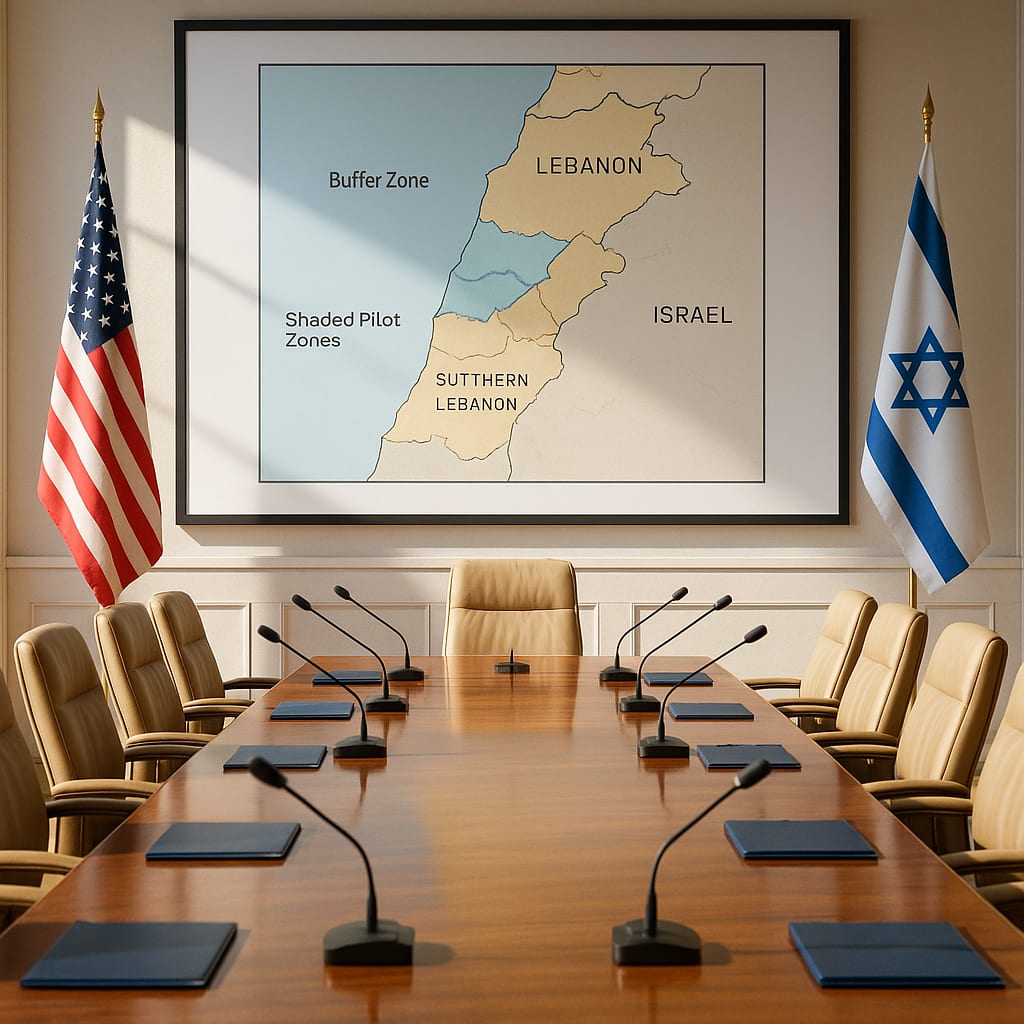
Lebanese President Joseph Aoun met US President Donald Trump at the White House, thanked him for brokering a framework agreement with Israel, and stated Lebanon’s objective to end hostilities “forever” (Politika; TASS; Al Jazeera English; South China Morning Post). Trump vowed to help Lebanon “a lot,” said he was open to talks with Hezbollah if Beirut requested, and, per TASS, suggested deploying Syrian forces against Hezbollah (Politika; The Times of Israel; Al Jazeera English; Tehran Times; TASS). On the ground, US-backed “pilot zones” commenced in southern villages including Froun, Srifa, and Zawtar al-Gharbiyeh, entailing IDF withdrawal, LAF deployment, and disarmament of non-state armed groups; coordination involves the IDF, US military, and LAF (Middle East Eye; TASS). The Times of Israel reported IDF warning shots near LAF troops and that the LAF urged displaced residents not to return. Middle East Eye notes Hezbollah has denounced the plan. Telesur cites UN experts accusing Israel of escalating hostilities, with thousands killed and injured.
Why It Matters
The initiative tests whether a US-brokered, trilateral mechanism can reassert Lebanese state authority in areas where non-state armed actors have dominated, while reducing the risk of cross-border escalation. The “pilot zones” model—full IDF pullback paired with LAF deployment and disarmament of non-state groups—constitutes an incremental approach to security governance that several outlets frame as contingent on sustained US support for the LAF (Middle East Eye; South China Morning Post; France24). This is also the first White House visit by a Lebanese president since 2009, signaling a renewed US commitment to Lebanon’s security institutions and to shaping the Israel–Lebanon file (South China Morning Post; France24).
Competing prescriptions carry structural implications. France24’s Bilal Saab underscores that durable outcomes hinge on building state capacity, not coercion, while Al Jazeera flags analysts’ concerns that externalizing enforcement to Syrian forces could destabilize Lebanon’s internal security. Concurrently, UN special rapporteurs’ allegations reported by Telesur place international-legal scrutiny on Israeli conduct, potentially influencing how the framework’s implementation is judged by multilateral actors.
Diverging Narratives
Media differ on the means and optics of de-escalation. One thread, reflected by France24, South China Morning Post, Politika, and TASS, highlights formal diplomacy and LAF-centered state-building—Aoun’s thanks for a US-brokered framework, requests for continued military support, and the declared objective of ending hostilities “forever.” Another thread centers on the coercive axis. TASS reports Trump proposing Syrian deployment against Hezbollah; Al Jazeera cites analysts calling that short-sighted, implying risks to Lebanese stability. Simultaneously, Trump’s stated openness to engage Hezbollah if Beirut asks—covered by Al Jazeera, The Times of Israel, and the Tehran Times—introduces a negotiation vector that sits uneasily alongside a disarmament agenda.
On the ground picture, Israeli and Arab outlets accent different risks. The Times of Israel spotlights immediate security incidents and procedural discipline in the “pilot zones,” including IDF “warning shots” and LAF advisories to civilians. Middle East Eye specifies pilot localities and reports Hezbollah’s denunciation. RT and Telesur foreground the conflict’s lethality and attribution of escalation to Israel; Telesur cites UN experts alleging war crimes and crimes against humanity. France24’s Jerusalem-based analysis casts the Aoun–Trump meeting as diplomatically awkward for Prime Minister Netanyahu, underscoring sensitivities in Israel about the process and Washington’s role.
What Happens Next
Three decision points will shape trajectories. First, pilot-zone implementation: expansion depends on disciplined IDF withdrawals, sustained LAF deployments, and coordination among the IDF, US military, and LAF, as described by TASS and Middle East Eye. Indicators include additional localities entering the scheme, fewer incidents like the IDF “warning shots” reported by The Times of Israel, and LAF guidance on civilian returns.
Second, US resourcing and political backing for the LAF: Aoun explicitly sought continued support, and France24 and SCMP frame this as pivotal. Watch for US announcements on financing, training, and equipment.
Third, engagement channels with Hezbollah and regional proposals: Trump’s willingness to talk if asked, versus the TASS-reported suggestion of Syrian involvement that Al Jazeera’s analysts criticize. Signals include any Beirut request for US–Hezbollah contact, Lebanese positions on Syrian deployment, and Hezbollah’s public stance on the framework. Parallel scrutiny from UN special rapporteurs, reported by Telesur, may influence diplomatic bandwidth and conditionalities tied to implementation.