
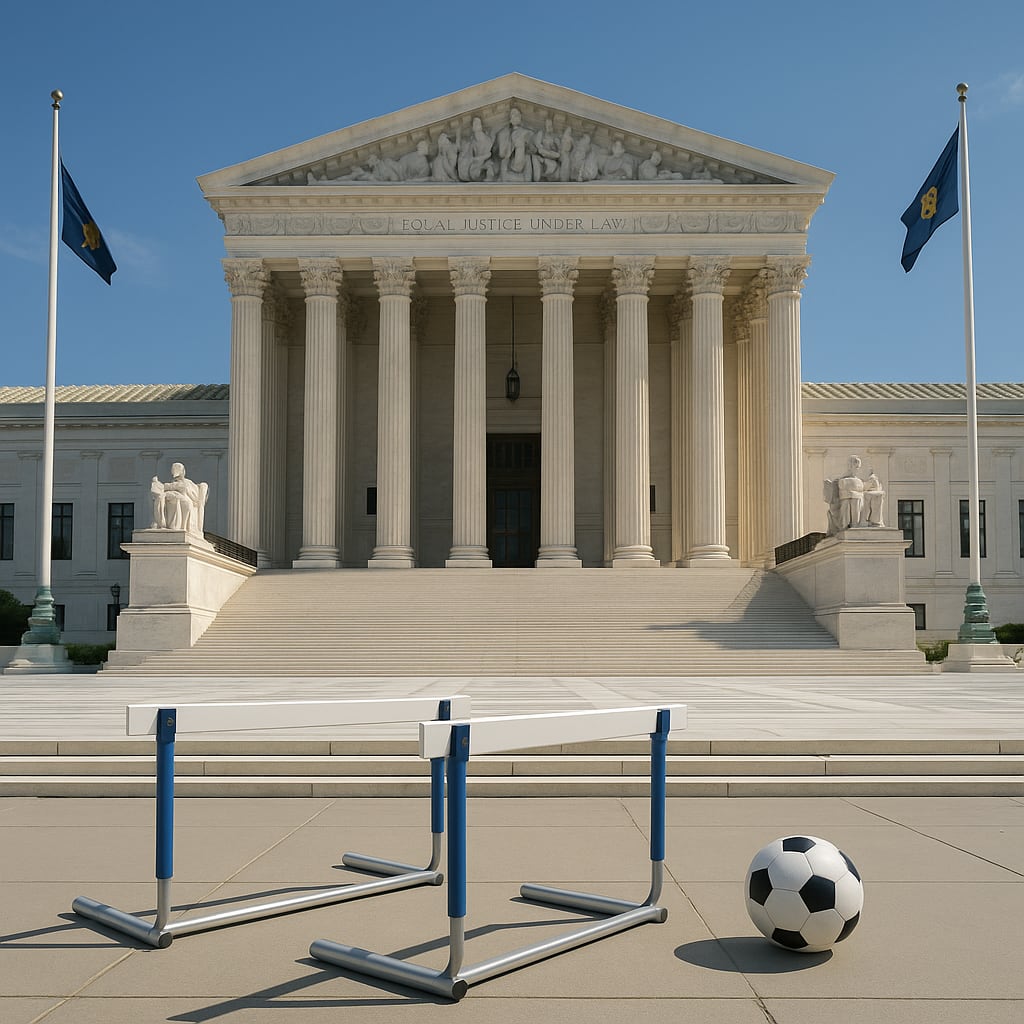
US Supreme Court upholds state bans on transgender girls and women competing on female school teams
Narrative Snapshot
- Across outlets, there is agreement that the Court upheld West Virginia’s and Idaho’s laws and overturned lower-court rulings that had favored trans student challengers (The Guardian; Fox News).
- The legal framing diverges: Fox News characterizes the decision as a new nationwide precedent aligned with Title IX and “allowing states to protect women’s sports,” while The Hindu stresses what remains unresolved—ongoing suits in states that allow participation consistent with gender identity (Fox News; The Hindu).
- Vote count and scope are inconsistently reported: Fox News repeatedly describes a 6–3 outcome, while Al Jazeera and RT report a unanimous decision and an explicit finding that the bans do not violate Title IX (Fox News; Al Jazeera; RT).
- Reactions split sharply. Trump and women’s-sports advocates celebrate a “big win,” while the ACLU calls the ruling “heartbreaking,” and trans youth athletes say they will keep playing and contesting restrictions (Fox News; Clarin; The Guardian).
What Happened
On June 30, 2026, the US Supreme Court upheld laws in West Virginia and Idaho that restrict girls’ and women’s school sports teams to participants whose sex assigned at birth is female, reversing lower-court decisions that had permitted trans students to compete (The Guardian). The cases were West Virginia v. B.P.J. and Little v. Hecox. West Virginia and Idaho were supported by Alliance Defending Freedom; the trans student plaintiffs were represented by the ACLU and Cooley (Fox News). Outlets differ on the vote tally—some report 6–3, others 9–0—and on whether the Court explicitly found no conflict with Title IX (Fox News; Al Jazeera; RT). Public reactions were immediate: Trump hailed a “big win,” while civil rights advocates criticized the ruling (Fox News; Clarin).
Why It Matters
The decision strengthens states’ latitude to regulate scholastic athletics under sex-based classifications and influences how Title IX is interpreted in school sports contexts (Fox News; Al Jazeera; RT). It also consolidates a patchwork: The Guardian notes the ruling bolsters similar restrictions in 25 other states, while a Fox News opinion piece argues it effectively upholds laws in 27 states (The Guardian; Fox News). At the same time, The Hindu underscores that the outcome leaves unresolved litigation in states that permit participation consistent with gender identity, maintaining ongoing legal uncertainty across jurisdictions (The Hindu). For education authorities, athletic associations, and civil rights litigators, the ruling shifts the baseline for future challenges, implementation, and compliance strategies across districts and states.
Diverging Narratives
Coverage diverges on core elements of the ruling’s contours and implications. Fox News frames the outcome as a 6–3 “new nationwide precedent” that aligns with Title IX and validates state protections for women’s sports (Fox News). Al Jazeera and RT report a unanimous decision and emphasize the Court’s conclusion that state bans do not violate Title IX (Al Jazeera; RT). On scope, The Hindu highlights that cases in states permitting trans participation remain unsettled, signaling that the ruling does not close the national debate (The Hindu). The Guardian emphasizes the exclusionary effect on trans girls and women and its “far-reaching” impact on trans rights, while a series of Fox News pieces elevate celebratory reactions from women athletes and advocacy groups (The Guardian; Fox News). Reactions also split: the ACLU calls the ruling “heartbreaking,” and trans youth vow continued participation and advocacy, while Trump and “Save Women’s Sports” allies describe a landmark victory (Fox News; The Guardian; Clarin).
What Happens Next
- Litigation trajectory: The Hindu points to ongoing suits in states that allow participation by gender identity; the ACLU says it will continue to pursue equal access claims (The Hindu; Fox News). Analysts should watch filings and appellate calendars in Connecticut, California, and elsewhere for tests of how this ruling constrains or channels future claims.
- State policymaking: Fox News reporting and opinion anticipate additional state action; the ruling “allows states to protect women’s sports,” and advocates urge holdout states to legislate (Fox News). Track legislative sessions, bill introductions, and executive guidance in states without explicit restrictions.
- Implementation and compliance: The Guardian notes that similar laws in 25 states are “boosted,” suggesting school districts and athletic associations will adjust enforcement. Monitor district-level policies, eligibility rules, and any new administrative guidance that could trigger further legal challenges (The Guardian).
- Movement responses: Trans athletes and civil liberties groups signal continued participation and advocacy; women’s-sports advocates signal consolidation of gains (The Guardian; Fox News). Watch for targeted cases involving individual athletes and sports with distinct safety or competitive-balance claims, which could shape the next wave of litigation strategies.