
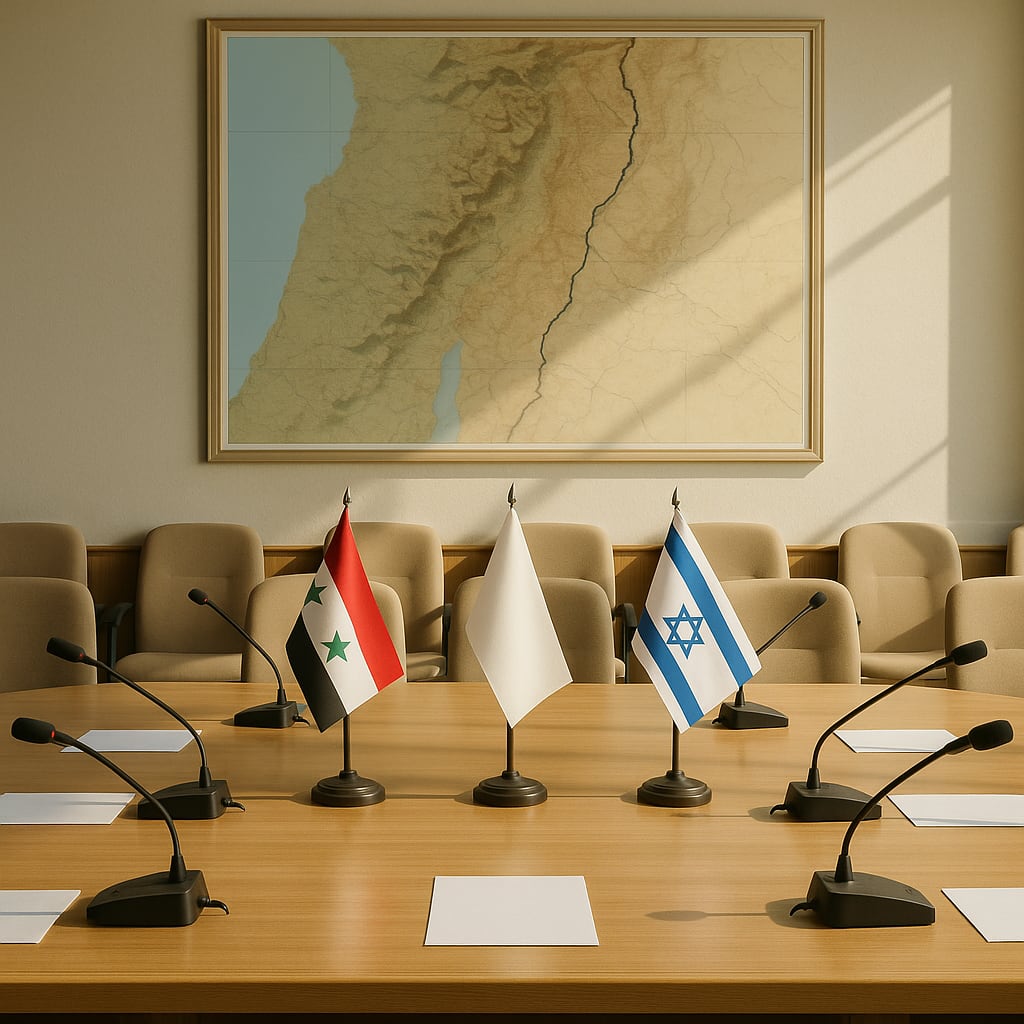
Syria’s al-Sharaa says Damascus is pursuing a security agreement with Israel that could open a path to comprehensive peace, without ceding the Golan
Narrative Snapshot
Across outlets, there is broad alignment that President Ahmed al-Sharaa framed a security-focused track with Israel as a precursor to wider peace, while simultaneously reiterating Syria’s claim to the Golan Heights. Israeli publications emphasize process and practicalities: The Times of Israel highlights al-Sharaa’s assertion that talks are ongoing and could culminate in a comprehensive deal, and notes his rejection of Donald Trump’s urgings to deploy Syrian forces against Hezbollah in Lebanon. Haaretz underscores that Damascus will not intervene militarily in Lebanon, characterizing Syria’s role as assisting the Lebanese government’s efforts.
Regional and international outlets stress sovereignty and guardrails. Al Jazeera and Middle East Eye foreground that any security arrangement would not compromise Syria’s rights to the Israeli-occupied Golan Heights and that multiple countries are involved in facilitating discussions. Russia’s TASS amplifies two red lines—avoiding conflict with Israel and refusing to cede the Golan—while noting work “with the assistance from friendly countries.” Serbia’s Politika emphasizes that “Golan is part of Syria” and relays al-Sharaa’s concern about conflict spillover.
A parallel frame comes from Telesur, which situates the moment in a legal-compliance context: the UN Secretary-General will present a report to the Security Council on Israeli violations in Syria and has urged strict adherence to the 1974 Disengagement of Forces Agreement. Japan Times distills the core claims—pursuit of a security deal and non-compromise on the Golan—without additional conditions.
What Happened
In a July 26 interview with Al Jazeera, Syrian President Ahmed al-Sharaa said Damascus is working toward a security agreement with Israel, describing the effort as a step that could enable a comprehensive peace between the two countries. He stressed that Syria has no interest in conflict with Israel, while stating that the Golan Heights remains Syrian and will not be ceded, positions reported by Al Jazeera, TASS, Politika, Middle East Eye, and Japan Times. Israeli outlets reported additional elements from the interview: The Times of Israel said al-Sharaa described talks with Israel as ongoing, and both it and Haaretz noted his stance on Lebanon—offering support to the Lebanese government but refusing military intervention to dismantle Hezbollah. The Times of Israel also reported that al-Sharaa again rejected urgings from Donald Trump to send Syrian troops into Lebanon. Separately, Telesur reported that the UN Secretary-General will submit a report to the Security Council on Israeli violations in Syria and has called for strict compliance with the 1974 Disengagement of Forces Agreement.
Why It Matters
A security-first channel between Syria and Israel engages foundational regional arrangements and constraints. It intersects with the 1974 Disengagement of Forces Agreement that structures the Golan ceasefire line and UNDOF’s mandate, which the UN Secretary-General has just spotlighted through a forthcoming Security Council report and a call for compliance, as reported by Telesur. Al-Sharaa’s insistence that the Golan remains Syrian, echoed across TASS, Politika, Middle East Eye, and Japan Times, preserves the sovereignty issue even as he opens a path to de-escalation. The Lebanon dimension—Haaretz’s account of non-intervention against Hezbollah and The Times of Israel’s note on rejecting Trump’s urgings—signals the boundaries Damascus is setting around any regional quid pro quos. References to work with “friendly” or “several” countries, carried by TASS and Middle East Eye, point to third-party facilitation without naming sponsors, suggesting a structured process whose contours matter for governments and international organizations gauging near-term stability and the parameters of any eventual peace framework.
Diverging Narratives
Outlets converge on the existence of a Syrian initiative for a security agreement and on Syria’s non-cession stance regarding the Golan, but they diverge in emphasis and framing. Israeli reporting accentuates the operational track—ongoing talks and a potential comprehensive outcome—while also highlighting the Lebanon angle and the refusal to use Syrian forces against Hezbollah, including the specific reference by The Times of Israel to Trump’s urgings. Arab and regional sources emphasize that any deal will not prejudice Syrian rights to the occupied Golan, framing the initiative as compatibility between security arrangements and sovereignty claims, as reflected by Al Jazeera and Middle East Eye. TASS and Politika stress de-escalation alongside invariants on territorial claims, underlining that Damascus seeks to avoid war but will not compromise on the Golan. Telesur introduces a compliance lens centered on alleged Israeli violations and UN oversight of the 1974 disengagement regime. Across sources, the content and scope of the proposed “security agreement” remain undefined—whether it addresses border incident management, force postures, or verification mechanisms is not specified—leaving open key questions about how, and how far, a security track can advance without touching core sovereignty disputes.
What Happens Next
The first decision point is whether Syria and Israel can translate “working toward” and “ongoing talks,” reported by Al Jazeera, TASS, and The Times of Israel, into a defined security document. Signals to watch include explicit references by either side to terms, verification, or third-party roles, given mentions of “friendly” or “several” countries by TASS and Middle East Eye. A second pivot is how the process handles the Golan question: reiterated non-cession across TASS, Politika, Middle East Eye, and Japan Times suggests any agreement must ring-fence sovereignty issues; analysts should monitor whether public statements continue to decouple security steps from territorial negotiations. A third track concerns Lebanon and Hezbollah: Haaretz reports Syrian non-intervention and The Times of Israel notes rejection of Trump’s urgings; watch for consistent messaging from Damascus that reinforces or revises these boundaries. Finally, the UN sequence flagged by Telesur—the Secretary-General’s report and calls to adhere to the 1974 Disengagement Agreement—will shape the international environment, particularly any Security Council language on compliance that could condition or constrain security arrangements on the ground.