
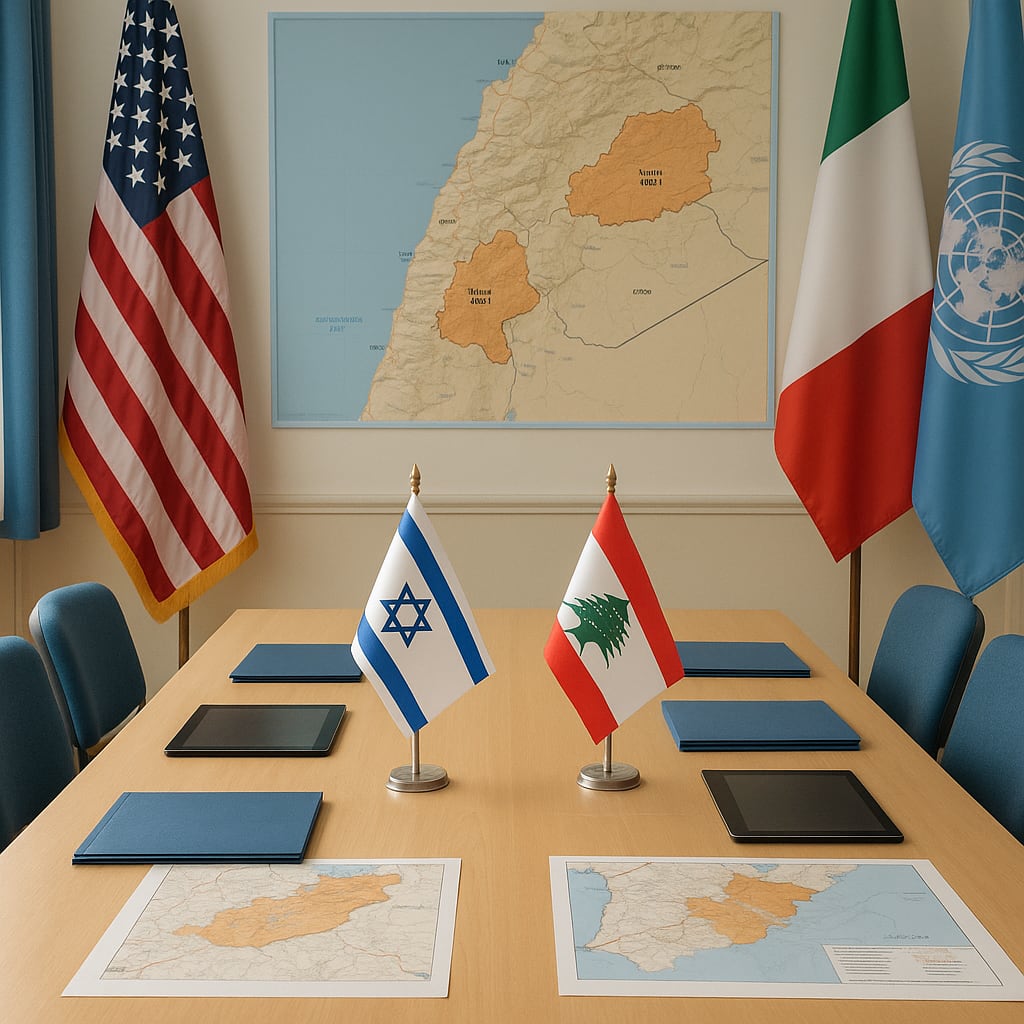
Rome talks advance plan for Israeli pullback from two southern Lebanon ‘pilot zones,’ with conditions and timelines unresolved
Narrative Snapshot
Across outlets, there is broad acknowledgment that U.S.-mediated talks in Rome yielded movement toward implementing initial Israeli withdrawals from designated “pilot zones” in southern Lebanon, but accounts diverge on preconditions, timing, and political readiness. Israeli and U.S. reporting puts verification and sequencing at the center: Haaretz quotes Israel’s envoy conditioning any pullback on Hezbollah’s removal from the areas and the Lebanese Armed Forces assuming control, with follow-on technical talks to operationalize the June 26 framework. The Times of Israel emphasizes the absence of a fixed timetable and discussion of mechanisms to confirm Hezbollah’s clearance.
Lebanese and regional outlets underline uncertainty on authority and scope. Middle East Eye cites Deputy Prime Minister Tarek Mitri saying the framework still lacks government approval and contains no timeline, while France24 and Al Jazeera set cautious expectations even as Beirut seeks progress toward withdrawal. International wire and state-backed coverage, including the Associated Press (via the Toronto Star), The Hindu, and CGTN, largely relay U.S. officials’ characterization of “progress” and next steps, while noting the lack of joint statements from the parties and continued negotiations.
Reporting on the ground remains mixed. UNIFIL publicly calls the situation “fragile” despite a reduction in violence since late June and says it is expanding its presence as some families return, while Middle East Eye notes intermittent Israeli artillery fire despite the talks. Separate MEE reporting attributes a temporary curtailment of “sensitive operations” to American pressure and flags IDF preparations for initial withdrawals, echoing Israeli media references to an imminent drawdown. An RT write-up citing Axios adds a U.S. domestic angle, reporting President Trump urged Prime Minister Netanyahu to redeploy from Lebanon and Syria—an account not echoed in the mainstream sources here but consistent with broader depictions of active U.S. pressure.
What Happened
U.S.-brokered negotiations between Lebanon and Israel concluded in Rome after a sixth round focused on implementing the June 26 framework through “pilot zones” in southern Lebanon. U.S. officials said the sides made progress and agreed to move into technical talks to develop a mechanism for Israeli withdrawal from the first two zones and for transferring control to the Lebanese army, with additional negotiations planned (Haaretz; Al Jazeera; Toronto Star/AP; CGTN). Israeli envoy Yechiel Leiter stated any withdrawal depends on Hezbollah’s removal from those areas and the Lebanese Armed Forces’ ability to take control (Haaretz). The talks were hosted at the U.S. Embassy in Rome, and there was no joint statement from the parties (Middle East Eye; The Hindu). Earlier, a U.S. military/CENTCOM delegation met the Lebanese army in Beirut to discuss implementation steps ahead of the Rome session (Middle East Eye; The Hindu).
Why It Matters
If realized, the pilot-zone approach would begin to translate a headline ceasefire framework into security arrangements on the ground, testing whether U.S. mediation can coordinate a phased Israeli pullback while elevating the Lebanese army’s role in southern Lebanon. Progress here has immediate implications for escalation dynamics along the border and for managing the Israel–Hezbollah confrontation through sequenced, verifiable steps, rather than a comprehensive deal at once (Haaretz; Al Jazeera; Toronto Star/AP). The process also highlights institutional capacity constraints: UNIFIL describes conditions as “fragile” even amid reduced violence and is expanding its presence to consolidate stability, suggesting any handover will need careful deconfliction with peacekeepers (Middle East Eye/UNIFIL). Domestically, questions over Lebanese cabinet approval of the framework and the absence of a timeline underscore political and operational risks to implementation (Middle East Eye). For Washington, CENTCOM’s involvement signals a hands-on role in security sector coordination.
Diverging Narratives
Israeli and U.S. readouts stress conditionality and process. Haaretz reports Israel’s readiness to advance withdrawals from two pilot zones contingent on Hezbollah’s removal and the Lebanese army’s deployment, with State Department assessments that the talks were productive and now shift to technical implementation. The Times of Israel underscores a positive tone paired with no fixed timeline and an emphasis on verification mechanisms to ensure Hezbollah has been cleared from designated areas.
Lebanese and regional coverage spotlights authorization gaps and continuing insecurity. Middle East Eye quotes Deputy Prime Minister Tarek Mitri stating the June 26 framework is divisive and lacks formal government approval or a withdrawal timetable, and separately reports intermittent Israeli artillery despite a supposed ceasefire. UNIFIL’s “fragile” assessment, even with some returns of displaced families, points to the limits of current calm (Middle East Eye/UNIFIL). International outlets hew to U.S. officials’ accounts of progress while noting the absence of joint statements by the parties (Toronto Star/AP; The Hindu; CGTN). An RT article citing Axios adds that President Trump urged Prime Minister Netanyahu to redeploy from Lebanon and Syria—an assertion aligned with themes of U.S. pressure in some regional reporting but not corroborated across the other sources here.
What Happens Next
Three decision points will shape the trajectory. First, verification and control in the pilot zones: Israeli officials tie withdrawal to confirming Hezbollah’s removal and the Lebanese army’s ability to assume control; technical talks are meant to codify this. Movement on agreed verification procedures and visible LAF deployments would signal traction, while delays or disputes over these conditions would slow the rollout (Haaretz; Times of Israel).
Second, Lebanese political endorsement: Mitri’s statement that the framework lacks cabinet approval raises a procedural hurdle. Formal approval would clarify mandates; continued ambiguity could complicate handovers (Middle East Eye).
Third, security conditions and U.S. pressure: UNIFIL’s “fragile” warning and reports of intermittent fire indicate how quickly ground dynamics could disrupt sequencing, even amid claims of reduced Israeli operations under American pressure and an “imminent drawdown” narrative in Israeli media (Middle East Eye; Times of Israel). Analysts should watch for a published technical annex or timeline, coordinated LAF-UNIFIL posture in pilot areas, and any official joint communiqués confirming phased steps.