
DR Congo Ebola cases surpass 2,000 as WHO flags unknown transmission chains and strikes strain response
Narrative Snapshot
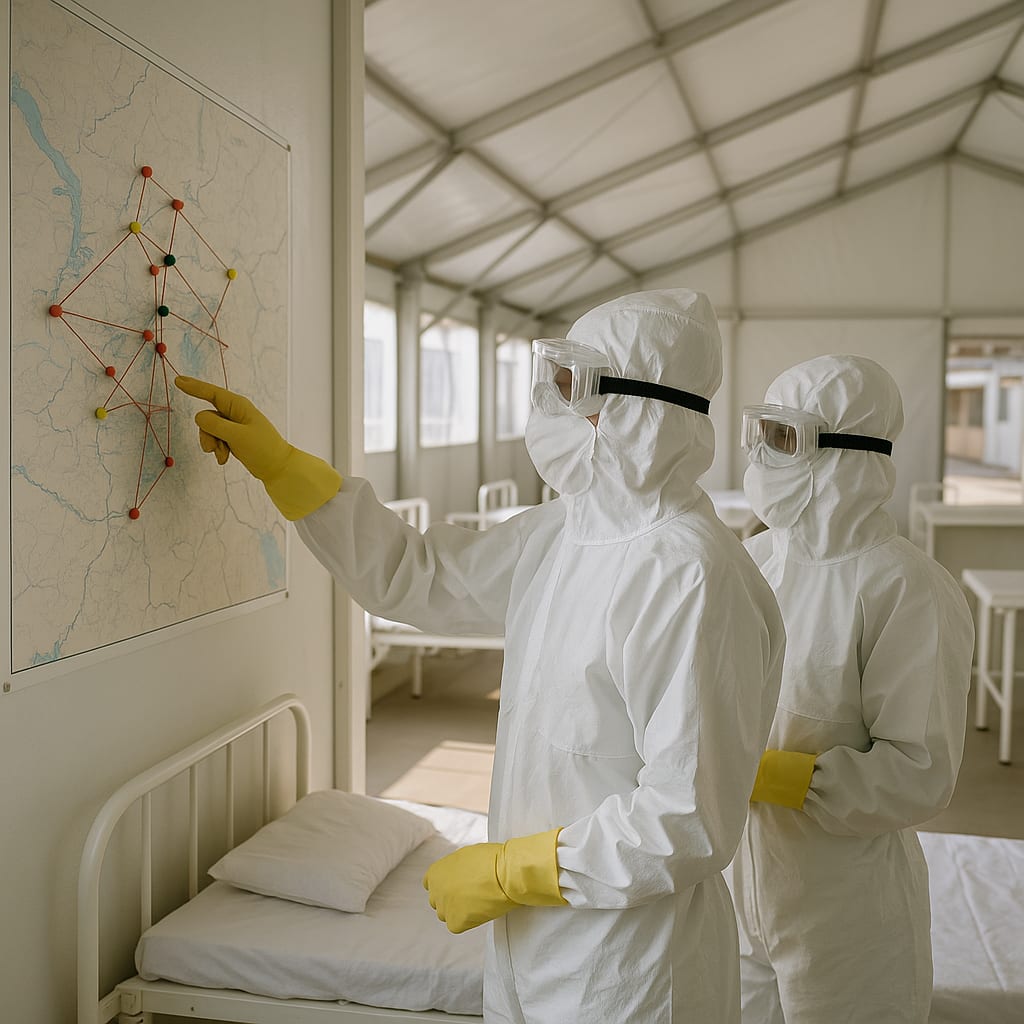
Across outlets, there is alignment on the scale and pace of the outbreak but divergence in what each sees as the most consequential operational failure. Latin American and Balkan reporting stresses epidemiological uncertainties: Clarín highlights the World Health Organization’s warning that infections are occurring through transmission chains of unknown origin, and Politika quantifies the problem by noting that at least 80 percent of new cases stem from untraced links. By contrast, French, Qatari, and Canadian coverage foreground workforce disruption in Ituri, with France24, Al Jazeera English, and CBC centering strikes over unpaid wages at Bunia General Hospital as a proximate threat to continuity of care.
A second divide lies in how outlets situate the outbreak historically. CGTN relays WHO’s characterization of the crisis as the third-largest Ebola outbreak on record and underscores the Bundibugyo strain, while France24 labels it the fastest-growing on record and Clarín calls it the fastest-growing in Africa. Telesur English and Sky News anchor their framing in government-reported totals and geographic spread, emphasizing confirmed cases, deaths, and that five provinces are affected.
Finally, AllAfrica’s two dispatches push beyond the day’s case counts. One carries UNICEF’s call for stronger collective action and a faster response after a visit to Ituri, while another, citing RFI, conveys the WHO emergencies chief’s assessment that true infections are at least double and possibly four times the official tally. That emphasis on under-ascertainment reframes the crisis as a data and surveillance gap as much as a surge in transmission.
What Happened
Government figures cited by France24, Sky News, Telesur English, and CBC put confirmed Ebola cases in the Democratic Republic of the Congo at roughly 2,011 with 754 deaths by mid-July, with spread documented across five provinces. CGTN, referencing WHO data through July 11, reported 1,926 confirmed infections and 702 deaths and identified the causative Bundibugyo strain. WHO officials, quoted by Clarín and Politika, warned that infections are increasingly occurring through transmission chains of unknown origin, with Politika reporting that at least 80 percent of new cases lack known links. Concurrently, health workers at Bunia General Hospital in Ituri went on strike over unpaid wages, part of a broader wave of stoppages described by France24, Al Jazeera, and CBC. UNICEF, via AllAfrica, called for stronger collective action and a faster response, while RFI reporting carried by AllAfrica relayed a WHO warning that true cases may be at least double, possibly four times, official counts.
Why It Matters
The picture that emerges is of a response facing concurrent surveillance and labor shocks. Unknown transmission chains at the scale described by Politika and highlighted by Clarín indicate contact tracing and case investigation are not keeping pace, challenging a core epidemic-control modality. Simultaneous strikes in Ituri over unpaid wages, reported by France24, Al Jazeera, and CBC, show how financing and workforce management can directly degrade operational capacity at an epicenter. CGTN’s note that this is the third-largest Ebola outbreak on record, alongside claims of record growth speed in Clarín and France24, raises questions about adequacy of surge mechanisms within national systems and multilateral partners. UNICEF’s call for stronger collective action and a faster response, carried by AllAfrica, and WHO’s insistence that “now is not the time to drop the ball,” per CGTN, point to the need for rapid resource mobilization, data transparency, and sustained field operations as decision-relevant priorities for governments and international organizations.
Diverging Narratives
Outlets differ on risk framing and metrics. France24 characterizes the crisis as the fastest-growing outbreak on record, while Clarín limits that superlative to the African continent and CGTN situates it historically as the third-largest to date. Case and death totals vary by reporting window: CGTN cites WHO figures through July 11 that are lower than the mid-July government totals used by France24, Sky, Telesur, and CBC, reflecting rapid growth and reporting lags rather than contradiction. On drivers of spread, Clarín and Politika emphasize unknown transmission chains, with Politika specifying that at least 80 percent of new cases lack known links, whereas France24, Al Jazeera, and CBC focus on labor stoppages and unpaid wages as immediate response constraints. AllAfrica’s RFI-based report introduces a different contour: under-ascertainment potentially doubling or quadrupling the true caseload, which, if correct, reframes apparent control metrics and resource needs. CGTN’s identification of the Bundibugyo strain adds etiologic context absent from most other coverage, while Telesur’s and CGTN’s references to five affected provinces underscore geographic dispersion as a distinct operational challenge.
What Happens Next
Several decision points will shape trajectories. First, wage resolution for health workers in Ituri, highlighted by France24, Al Jazeera, and CBC, will determine whether facilities like Bunia General Hospital can maintain staffing; a settlement would stabilize clinical operations, while prolonged arrears risk further walkouts at the epicenter. Second, scaling case investigation to reduce the share of unlinked infections flagged by Politika and Clarín will hinge on deploying additional tracers and analysts; analysts should watch for changes in the proportion of cases with known exposure histories. Third, UNICEF’s call for stronger collective action and a faster response, reported by AllAfrica, and WHO’s warning not to ease efforts, per CGTN, set expectations for external support; concrete signals include announcements of surge funding, expanded field teams, or reinforced provincial operations across the five affected provinces noted by Telesur and CGTN. Finally, the WHO emergencies chief’s undercount warning via AllAfrica/RFI suggests monitoring for major data revisions or wider testing that narrows the gap between official and estimated burdens.