
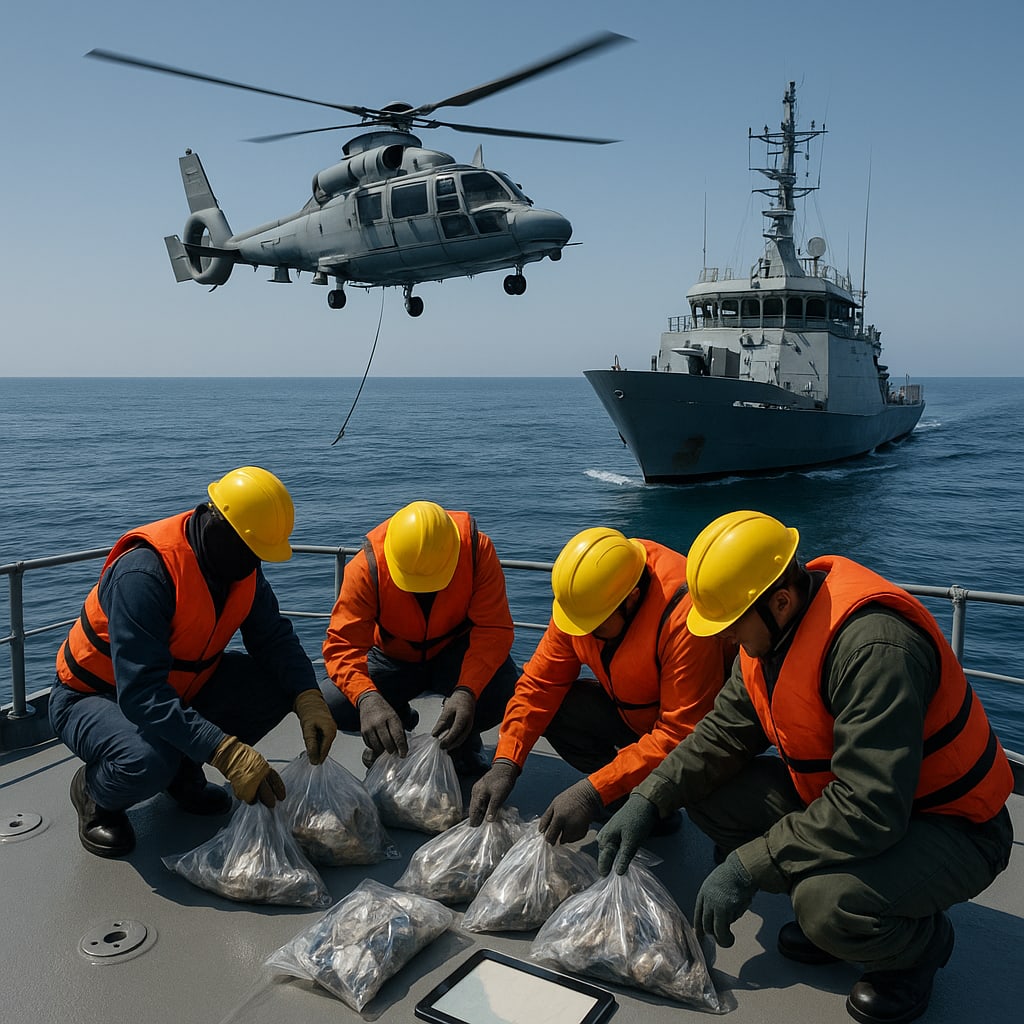
Wreckage found as Pakistan searches Arabian Sea for missing K2 Airways Boeing 737 crew
Narrative Snapshot
- Outlets converge on a core sequence: a Sharjah–Karachi K2 Airways 737 freighter reported a navigation/navigational-system fault, then descended rapidly before contact was lost; what differs is precision and emphasis. CGTN attributes detailed timing and headings to Pakistan Airports Authority statements, while the Guardian leans on Flightradar24’s altitude profile; Fox News and SCMP anchor location to Ormara with specific distances.
- Status language tracks publication timing more than interpretation: NHK, Al Jazeera, The Hindu, and Bangkok Post frame an active “missing” case; DW, Folha, SCMP, NBC, and Fox report wreckage recovery with the crew still unaccounted for.
- Several outlets center governance and capacity: Japan Times highlights Prime Minister Shehbaz Sharif’s order to accelerate SAR, and CGTN underscores multi-agency coordination. Others foreground aircraft characteristics (a 27‑year‑old, converted 737) without assigning cause (Guardian, DW, Japan Times; The Hindu explicitly says the cause is unknown).
- Human-impact framing varies: Fox News reports the release of crew names; most other sources keep identification at the level of numbers and operator.
What Happened
K2 Airways’ Boeing 737 cargo aircraft departed Sharjah for Karachi and reported a navigation/navigational-system problem around 9:18–9:21 p.m. local time Tuesday, according to Pakistan’s aviation authorities cited by CGTN and multiple international outlets. Karachi Area Control Center provided guidance, but minutes later the aircraft showed a rapid descent and sharp heading change before radar and radio contact were lost approximately 155 nautical miles west of Karachi, near Ormara (CGTN; Bangkok Post; Al Jazeera; Guardian). Pakistan activated a coordinated sea search involving the navy and civilian agencies (CGTN; SCMP). By Wednesday, rescuers had located and recovered wreckage off Pakistan’s coast, including about 53 miles south of Ormara (DW; Folha; SCMP; NBC; Fox News). The search for the five crew members continued into Thursday and a second day overall (Fox News; Politika). Some outlets also reported the plane’s age as 27 years and converted for cargo (DW; Guardian; Japan Times; The Guardian).
Why It Matters
- Maritime–air corridors linking Gulf logistics hubs to Pakistan’s coast are critical for regional trade; multiple reports stress the Sharjah–Karachi routing and the loss of contact over the Arabian Sea (CGTN; SCMP; Fox News; Al Jazeera). The episode highlights operational risk on heavily used approach corridors to Karachi.
- Pakistan’s capacity for coordinated maritime SAR is central: the activation of rescue coordination and the involvement of the navy, maritime agencies, and civil aviation indicate multi-agency reliance for offshore crises (CGTN; SCMP; Folha), with prime ministerial direction to accelerate efforts signaling high-level oversight (Japan Times).
- Coverage underscoring a 27‑year‑old, converted Boeing 737 raises attention to the aging freighter segment without attributing cause (DW; Guardian; Japan Times), while several outlets explicitly note that the cause remains unknown (The Hindu). This combination—transparency on aircraft profile, restraint on causal claims—shapes how safety authorities and policy audiences weigh near-term risk communication.
- Early use of open-source flight data (Guardian via Flightradar24) shows how commercial telemetry informs public understanding before official technical findings are available.
Diverging Narratives
- Terminology and timing: Some reports continued to frame the aircraft as “missing” amid active SAR (NHK; Al Jazeera; The Hindu; Bangkok Post), while others reported “wreckage found” with crew still missing (DW; Folha; SCMP; NBC; Fox News). This reflects update cadence rather than opposing claims.
- Geolocation references vary. CGTN, citing Pakistan Airports Authority, places loss of contact roughly 155 nautical miles west of Karachi after a sharp heading change. Fox News specifies wreckage about 53 miles south of Ormara, and SCMP/Folha cite recovery off Pakistan’s coast. These are compatible but anchor on different reference points (Karachi vs Ormara) and stages (loss of contact vs wreckage recovery).
- Data framing differs. The Guardian leans on Flightradar24’s sharp altitude changes and steep final descent; official statements relayed by CGTN emphasize controller guidance, radar-observed rapid descent, and activation of a rescue coordination center. The Hindu, meanwhile, underscores that the cause is not immediately known.
- Human dimension and identification: Fox News reports the release of crew names, adding a personal and legal-identification layer. Most other outlets keep focus on aggregate figures, operational details, or institutional actions (NHK; Al Jazeera; CGTN; SCMP).
What Happens Next
- Search posture and tempo: With the prime minister directing acceleration (Japan Times) and multi-agency operations underway (CGTN; SCMP; Folha), watch for additional asset deployments or expanded search grids announced by Pakistan’s aviation and maritime authorities. Continued daily updates would indicate sustained SAR priority; confirmation of further recoveries would clarify the operation’s status.
- Public information releases: Fox News reports the naming of crew members. Further official statements identifying recovered items or remains—and by whom—will signal inter-agency roles and the maturity of the operation, while maintaining The Hindu’s noted caution on cause.
- Technical narrative: Authorities have already shared timing and radar-loss parameters (CGTN). Additional official details on the aircraft’s final track or ATC interactions, and reconciliations with open-source flight data highlighted by the Guardian, will shape how the sequence of events is understood pending any formal determinations.
- Regional coordination indicators: Because the flight originated in the UAE (SCMP; Fox News; CGTN), any mention of foreign liaison or assistance in statements from Pakistan would signal cross-border information-sharing around the flight’s operations and cargo, even as SAR remains nationally led in reporting so far.