
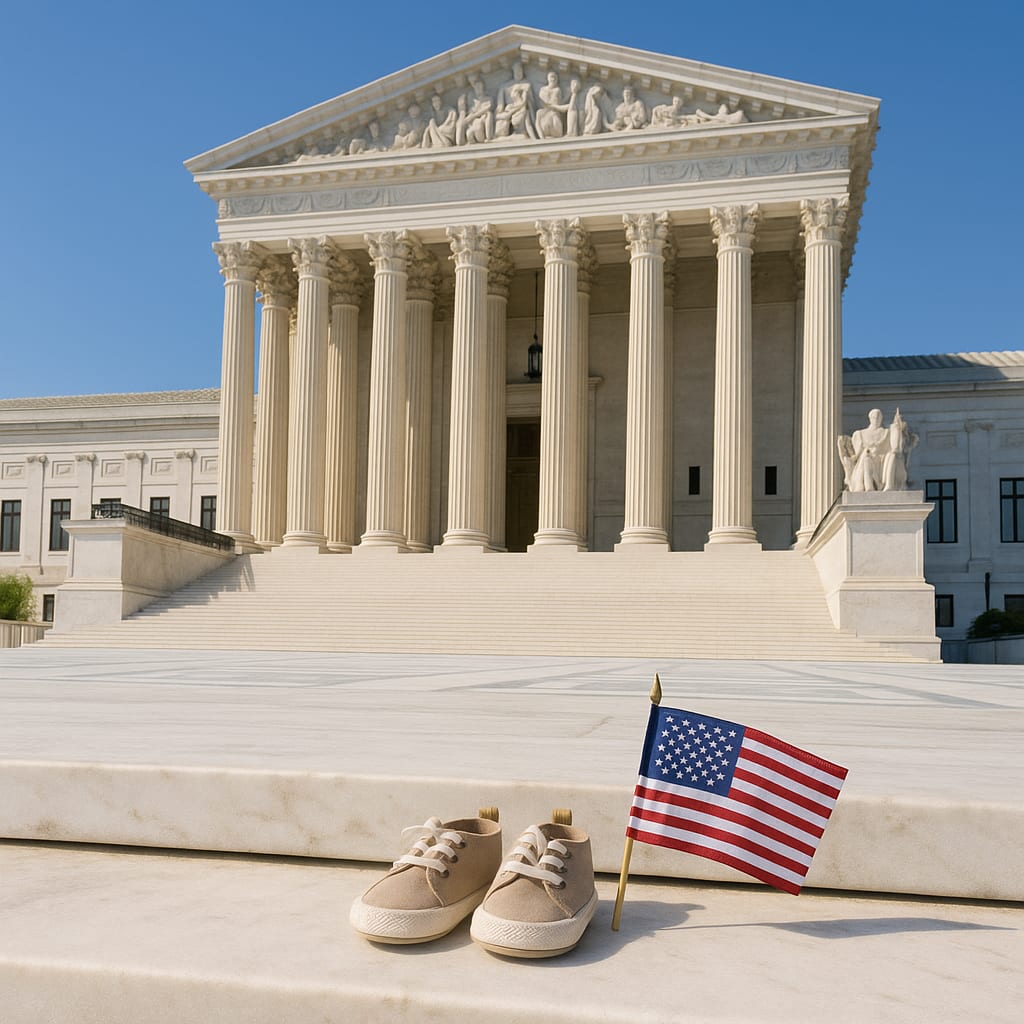
Supreme Court upholds birthright citizenship, rejecting Trump’s bid to restrict it
Narrative Snapshot
- Broad agreement: coverage notes the Court preserved the long-standing interpretation that most children born in the United States are automatically citizens, including those born to parents unlawfully or temporarily present (Fox News, New York Times; ANSA underscores maintaining ius soli).
- Emphasis splits: U.S. outlets focus on the policy mechanism and scope (executive order; children of undocumented and some temporary visitors per the New York Times), while ANSA and Middle East Eye foreground the Court’s rejection of Trump’s effort to abolish or limit the principle.
- Stakes and signals: Fox News frames the ruling as a major setback for Trump’s immigration agenda and highlights Justice Alito’s dissent warning of national security risks, including “birth tourism” (Fox News, 1 Jul). Al Jazeera stresses the 6-3 divide and suggests the issue could return to the Court.
What Happened
The Supreme Court rejected President Donald Trump’s attempt to restrict birthright citizenship, striking down his executive order aimed at ending automatic citizenship for children born in the United States to parents who are unlawfully or temporarily present (Fox News, 30 Jun; New York Times). The ruling, reported as 6-3 (Al Jazeera; Fox News, 1 Jul), preserves the long-standing constitutional interpretation that most children born on U.S. soil are citizens (Fox News, 30 Jun). International coverage described the outcome as maintaining ius soli and turning back Trump’s effort to abolish the right by birth (ANSA; Middle East Eye). Fox News identified the case as Trump v. Barbara and characterized the decision as a major setback for Trump’s immigration agenda (Fox News, 30 Jun; Fox News, 1 Jul).
Why It Matters
The decision stabilizes a foundational rule of U.S. nationality law that has structured immigration and citizenship policy for generations: automatic citizenship for most people born in the country (Fox News, 30 Jun; New York Times). It immediately blocks a centerpiece of Trump’s immigration agenda, preventing executive reinterpretation that would have excluded children of undocumented immigrants and some temporary foreign visitors (New York Times; Fox News, 30 Jun). The 6-3 split indicates a contested legal landscape, with Al Jazeera suggesting the issue could return to the Court. Justice Alito’s dissent frames potential national security implications, particularly around children born to “birth tourists” and temporary visitors, signaling lines of argument that could shape future litigation or political debate (Fox News, 1 Jul). For policymakers, the ruling constrains executive action in this domain absent a change in judicial posture (Al Jazeera; Fox News, 1 Jul).
Diverging Narratives
- Scope and framing: The New York Times centers the policy’s reach—children of undocumented immigrants and some temporary visitors—while Fox News underscores the ruling as a significant defeat for a core Trump initiative (New York Times; Fox News, 30 Jun).
- Stability vs. revisitation: Several outlets emphasize preservation of a long-standing interpretation (Fox News, 30 Jun), but Al Jazeera highlights the 6-3 split as a sign the question could return to the Court, framing the outcome as durable but not necessarily final.
- Security vs. rights framing: Justice Alito’s dissent, featured by Fox News, warns of national security consequences from extending citizenship to children of illegal entrants and “birth tourists” (Fox News, 1 Jul). Other coverage emphasizes the Court’s rejection of Trump’s effort and the maintenance of ius soli without centering security risks (ANSA; Middle East Eye).
- Contextual stakes: DW situates the case in terms of what would change if birthright citizenship were removed and notes its importance to Trump, indicating the decision’s policy salience beyond a single order (Deutsche Welle).
What Happens Next
- Litigation posture: A 6-3 majority stands, but Al Jazeera reports signals the issue could return. Analysts should watch for new cases that test edge scenarios highlighted in the dissent, including “birth tourism” and children born to short-term visitors (Al Jazeera; Fox News, 1 Jul).
- Executive strategy: With the order struck down, near-term executive avenues are constrained. Any renewed attempt to alter automatic citizenship would likely face immediate legal challenge under the reasoning that prevailed here (New York Times; Fox News, 30 Jun).
- Judicial signals: Track separate writings by the dissenters for criteria that might narrow birthright citizenship in future litigation (Fox News, 1 Jul). Indicators include petitions invoking national security or temporary-status fact patterns.
- International and domestic messaging: Coverage frames the ruling as maintaining ius soli (ANSA) and as a major setback for Trump’s agenda (Fox News, 30 Jun). Continued political emphasis on this issue would suggest sustained efforts to revisit the question through the courts (Al Jazeera; Fox News, 1 Jul).