
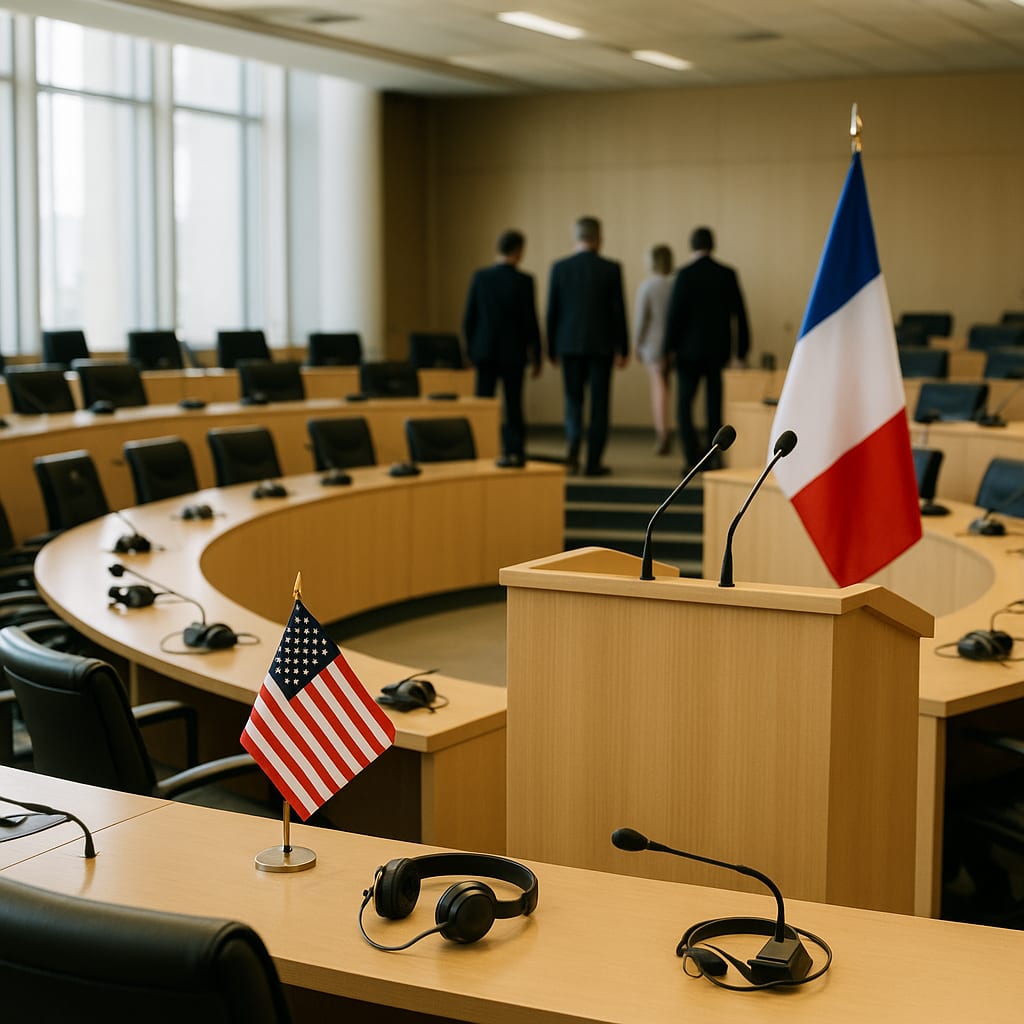
US walks out of UN Security Council session during France’s remarks after clash over human rights chief’s renewal
Narrative Snapshot
Across outlets, there is alignment that the walkout occurred mid-remarks by France at a Security Council meeting and followed an unusually sharp French public rebuke of Washington over its vote against extending UN human rights chief Volker Türk’s mandate. France24 and Al Jazeera situate the incident inside a meeting on Ukraine and link it directly to France’s comparison of the US position to Russia, North Korea, and other authoritarian states. The Toronto Star (AP) and the South China Morning Post highlight the US response, reporting that American diplomats denounced France’s criticism as “disingenuous grandstanding” before exiting.
Where coverage diverges is in framing. Fox News foregrounds the French mission’s social media post—“The US used to be a beacon of human rights. Not anymore… Today, it stands alongside North Korea, Nicaragua, Mali & Russia… #AmericaAlone”—and pairs it with prior reporting that cast the US as isolated in recent UN decisions. France24 and SCMP emphasize allied friction inside core multilateral venues; SCMP notes Türk’s reappointment received “overwhelming support,” including from France, underscoring the US break with partners. NHK stresses the procedural abnormality of a mid-speech exit in the Security Council, while Serbia’s Politika underscores the demonstrative nature of the departure. The stakes these accounts collectively surface are less about the specific mandate vote than about alliance management on human rights and the credibility of Western coordination inside UN institutions.
What Happened
US diplomats walked out of a UN Security Council meeting as France was speaking, a move multiple outlets tie to France’s sharp criticism of Washington’s vote against renewing UN High Commissioner for Human Rights Volker Türk for another four years. France24 reports the walkout occurred during a Ukraine-focused session, after France publicly likened the US stance to those of Russia and North Korea. Fox News highlights the French mission in Geneva’s post on X declaring the US “used to be a beacon of human rights” but “not anymore,” adding “#AmericaAlone” and listing North Korea, Nicaragua, Mali, and Russia. The Toronto Star (AP) reports the US called France’s critique “disingenuous grandstanding” and exited as Paris spoke. SCMP notes Türk’s reappointment won overwhelming support, including from France. NHK and Politika describe the departure as an unusual, demonstrative protest inside the Council.
Why It Matters
This episode exposes a fault line within a core Western alliance about how to engage the UN human rights machinery and sustain credibility on rights norms while prosecuting other multilateral priorities. SCMP’s note that Türk’s reappointment drew overwhelming support—including from France—underscores that Washington’s stance on the High Commissioner put it at odds with partners whose backing it routinely seeks in UN forums. France24 and Al Jazeera place the rupture inside a Security Council session on Ukraine, highlighting a practical risk: public contention among allies during Council proceedings can dilute message discipline on files where coordination is central. Fox News’ amplification of the French “#AmericaAlone” framing illustrates how procedural votes at Geneva or New York can be leveraged into narratives of isolation, with potential downstream effects on diplomatic bargaining power. For decision-makers, the immediate issue is not the mandate outcome—which is settled—but how to manage operational engagement with OHCHR and maintain allied cohesion in future Council debates.
Diverging Narratives
France’s official messaging in Geneva casts the US as having forfeited human rights leadership, explicitly grouping Washington with Russia, North Korea, Nicaragua, and Mali over the Türk vote, per Fox News and France24. US officials counter that France engaged in “disingenuous grandstanding” by attacking Washington’s human rights record, as reported by the Toronto Star (AP) and echoed by SCMP, which specifies the criticism as targeting the Trump administration’s record. France24 and Al Jazeera frame the clash as an escalation of a public dispute between longtime allies within the Security Council chamber, with the immediate trigger rooted in a Geneva mandate decision. SCMP adds institutional context by noting the breadth of support for Türk’s reappointment, sharpening the perception gap: Paris highlights US isolation; Washington challenges the propriety and substance of France’s rebuke. NHK emphasizes the procedural anomaly of a mid-remarks exit, while Politika focuses on the demonstrative character of the walkout itself. Unresolved in the coverage are the modalities of US engagement with OHCHR post-vote and whether either side will recalibrate public messaging to restore routine Council coordination.
What Happens Next
Two decision points emerge from the reporting. First, allied coordination at the Security Council: France24 and Al Jazeera place the walkout during a Ukraine session, so watch whether US and French missions resume standard in-chamber engagement during each other’s interventions and whether joint statements or aligned talking points reappear. Sustained walkouts or pointed floor statements would signal continued rupture; a return to routine protocol would indicate de-escalation. Second, operational relations with OHCHR after Türk’s reappointment, which SCMP says passed with overwhelming support. Analysts should track US participation and tone in human rights debates in Geneva and New York, including references to the High Commissioner’s office. Strong engagement would suggest compartmentalization of the vote outcome; visible distancing would reinforce the narrative, highlighted by multiple outlets, of a policy divergence with key allies. Public messaging—such as any follow-up from the French mission or US diplomats—will be the near-term indicator of trajectory.