
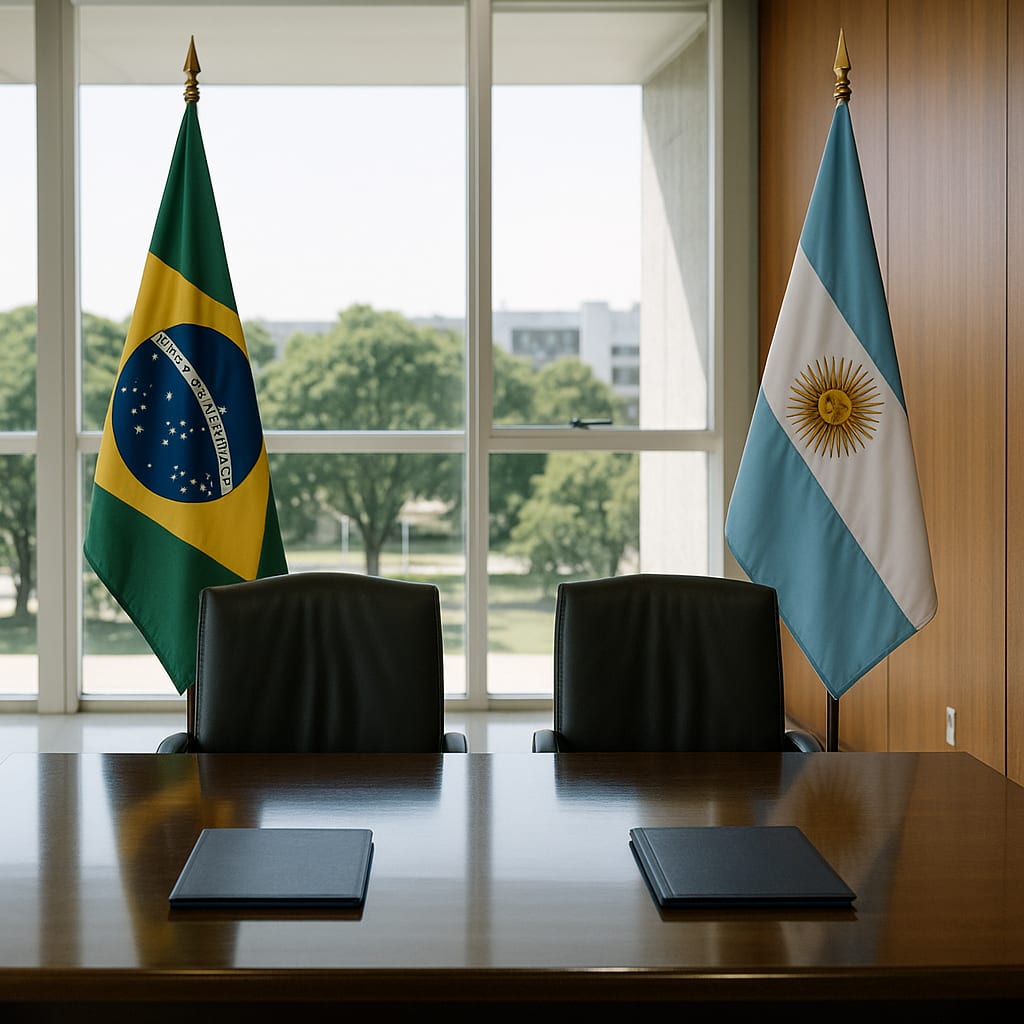
Brazil recalls envoy and summons Argentina’s ambassador after Milei insults Lula and Brazil’s Supreme Court justice in São Paulo
Narrative Snapshot
Across outlets, there is consensus on the basic facts and on the gravity of Brazil’s response. Brazilian and international reporting align that the Foreign Ministry recalled its ambassador to Argentina and summoned Argentina’s envoy in Brasília after President Javier Milei, speaking at a Liberal Party rally launching Flávio Bolsonaro’s campaign in São Paulo, called President Luiz Inácio Lula da Silva a “thief” and a “convict,” and attacked Supreme Federal Court justice Alexandre de Moraes (Folha de S.Paulo; BBC; Deutsche Welle; France24; Le Monde; Politika). The agreement extends to the judgment that Brasília treated the episode as a formal diplomatic matter, not simply campaign rhetoric.
The points of emphasis diverge by vantage. Brazilian coverage centers on institutional process and escalation, detailing both the recall of Ambassador Julio Bitelli and the summons of Argentine Ambassador Daniel Raimondi for explanations (Folha de S.Paulo; Telesur English, 26 Jul). Argentine coverage spotlights domestic political costs: opposition leaders condemned Milei’s remarks as irresponsible toward a priority relationship and a longstanding diplomatic tradition of giving Brazil primacy (Clarín, both pieces). From the left-leaning regional lens, Telesur stresses that Lula’s government had already dismissed Milei’s trip as far-right political theater carrying no diplomatic weight (Telesur English, 25 Jul). European outlets widen the aperture, noting the remarks came amid a Brazilian campaign launch and, in Le Monde’s account, alongside jabs at Mexico and the US Democratic Party (BBC; France24; Le Monde).
What is at stake differs by frame. For Brazilian institutions, safeguarding the presidency and the Supreme Court from a foreign leader’s attack demanded visible diplomatic tools. For Argentina’s opposition, the concern is erosion of a pragmatic bilateral anchor. For international observers, the episode illustrates cross-border campaign interventions and ideological messaging that test standard non-interference norms.
What Happened
At a Liberal Party event in São Paulo on Saturday, July 25, formally launching right-wing candidate Flávio Bolsonaro’s presidential campaign, Argentina’s President Javier Milei called Brazil’s President Luiz Inácio Lula da Silva a “thief” and a “convict,” and directed insults at Supreme Federal Court justice Alexandre de Moraes (BBC; France24; Politika; Folha de S.Paulo). On Sunday, Brazil’s Foreign Ministry recalled its ambassador to Argentina, Julio Bitelli, for consultations and separately summoned Argentina’s ambassador in Brasília, Daniel Raimondi, for explanations, escalating its response to the remarks (Telesur English, 26 Jul; Folha de S.Paulo, both pieces). Telesur reported that prior to the rally the Lula government had already framed Milei’s trip as far-right political theater with no diplomatic standing (Telesur English, 25 Jul). In Argentina, opposition figures publicly criticized Milei’s statements as jeopardizing a strategic relationship with Brazil (Clarín).
Why It Matters
The recall-and-summon sequence signals Brasília’s defense of two core norms: protection of the Brazilian head of state and judiciary from foreign disparagement, and a boundary against external actors intervening in domestic electoral contests. The measures, described in detail by Folha de S.Paulo and Telesur, indicate that Brazil treated the episode as a state-to-state issue, not a partisan spat. Clarín’s analysis underscores the structural stakes for Argentina, where maintaining a constructive relationship with Brazil has been a durable principle of foreign policy. The incident also exemplifies how transnational campaign forays and ideological rhetoric—amplified by the Bolsonaro campaign setting and, per Le Monde, Milei’s broader targets—complicate regional diplomacy. For decision-makers in both capitals, the episode tests institutional capacity to separate electoral theater from bilateral management and to use calibrated diplomatic tools to contain political spillovers.
Diverging Narratives
Brazilian institutional reporting emphasizes process and proportionality. Folha de S.Paulo details sequential steps—recalling Ambassador Julio Bitelli and summoning Ambassador Daniel Raimondi—framing them as formal diplomatic reactions to insults aimed at both the presidency and the Supreme Court’s Alexandre de Moraes. This framing elevates the matter from partisan provocation to a defense of constitutional authorities.
Argentine coverage in Clarín concentrates on domestic accountability: opposition leaders condemned Milei’s language and warned that antagonizing Brazil breaks with a long-standing prioritization of the bilateral relationship. The through-line is state interest over ideological confrontation.
Telesur positions the São Paulo appearance as “far-right political theater,” noting Lula’s government saw the trip as lacking diplomatic status even before the remarks and then moved to recall its envoy afterward. The emphasis is on de-legitimizing the visit’s diplomatic relevance while documenting the subsequent punitive steps.
International outlets streamline the episode to its most salient internationally legible elements: the setting at Flávio Bolsonaro’s campaign launch, the “thief” and “convict” epithets, and the recall as a clear diplomatic downgrade (BBC; Deutsche Welle; France24). Le Monde adds that Milei’s rhetoric also targeted Mexico and the US Democratic Party, suggesting a broader ideological posture beyond the bilateral frame.
What Happens Next
Three decision points follow from the reported steps. First, the outcome of Brazil’s consultations with recalled Ambassador Julio Bitelli will indicate whether Brasília views the measures as temporary signaling or a prelude to sustained diplomatic downgrading; watch for any public communique on his return timeline or conditions (Telesur English, 26 Jul). Second, the content and tone of Argentina’s response during Ambassador Daniel Raimondi’s summons—in particular whether clarifications or assurances are offered—will shape Brazil’s next moves (Folha de S.Paulo, 26 Jul). Third, monitor whether Milei re-engages in Brazilian campaign events or further comments on Brazilian institutions; repetition would test Itamaraty’s threshold for additional measures, while restraint could facilitate re-normalization. In Argentina, the opposition’s criticism reported by Clarín is a domestic constraint; sustained internal pressure would be a signal of potential recalibration in presidential rhetoric toward Brazil.