
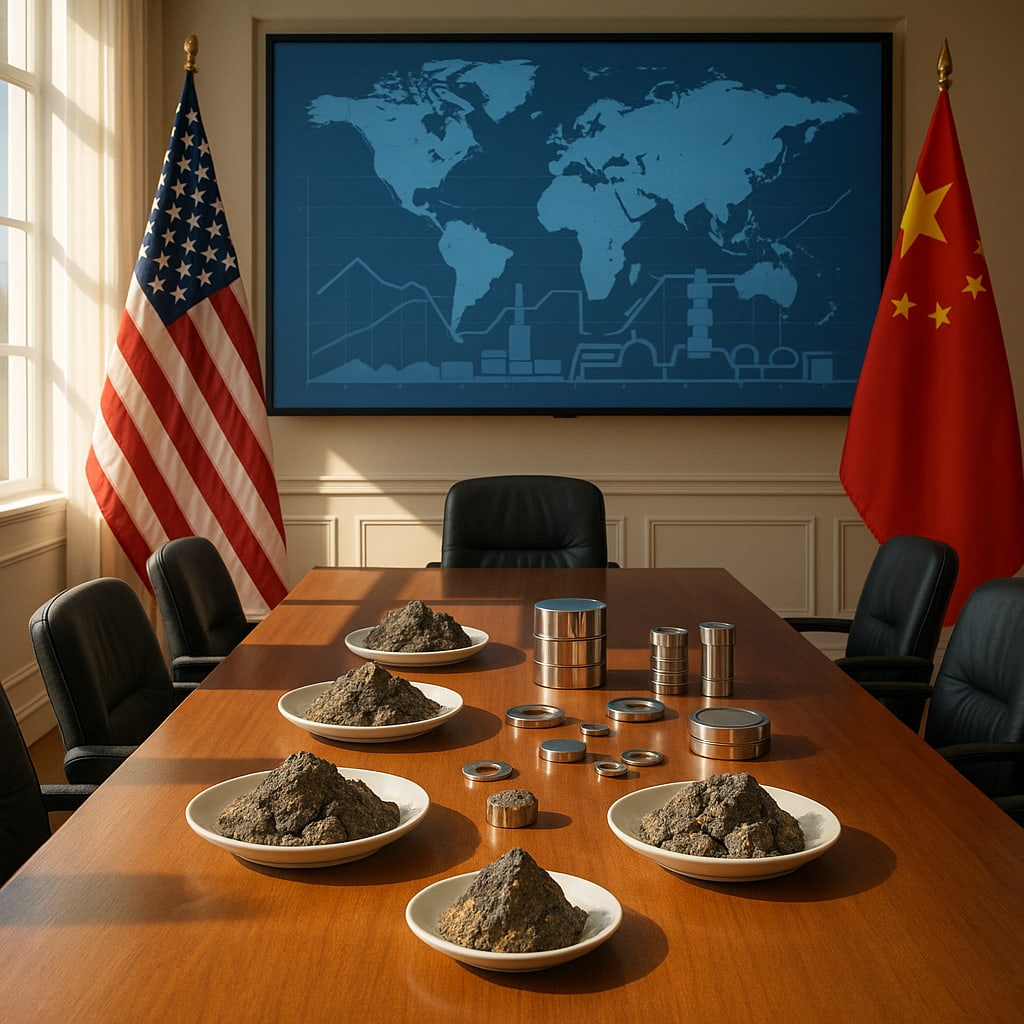
China imposes export controls on 10 U.S. firms, hitting rare earth miners, after Pentagon blacklist
Narrative Snapshot
- Asian outlets center geopolitics and truce management: South China Morning Post links Beijing’s move to a fragile U.S.-China “truce” reached in Busan and recently reaffirmed, and flags rare earths firms MP Materials and USA Rare Earth as targets; Japan Times emphasizes China’s dual-use export prohibitions.
- U.S. and Latin American coverage stresses supply-chain exposure: New York Times highlights the impact on two magnet-focused manufacturers central to the Trump administration’s domestic rebuild; Folha de S.Paulo frames the action as striking at U.S. efforts to stand up a rival rare earths chain.
- Al Jazeera foregrounds tit-for-tat logic, tying Beijing’s step to a Pentagon blacklist that included prominent Chinese tech firms.
- Fox News presents a countervailing thread: U.S.-backed cobalt and copper projects in the DRC as a strategic gain against China in critical minerals, suggesting an external hedge to China-centric supply risks.
What Happened
China’s Ministry of Commerce placed 10 U.S. entities on its export control list, barring them from purchasing Chinese exports with civilian-military dual uses, according to Japan Times and South China Morning Post. The targets include rare earth players MP Materials and USA Rare Earth, alongside technology firms such as motor maker Aveox and drone companies Red Cat and Teal Drones (SCMP). Al Jazeera reports the move followed a U.S. Department of Defense blacklist that named major Chinese companies, including Alibaba and Baidu. The Hindu situates the decision roughly a month after U.S. President Donald Trump’s visit to Beijing, where he sought to stabilize ties in talks with Xi Jinping. New York Times notes the action strikes at two U.S. manufacturers pivotal to the administration’s effort to rebuild a domestic supply chain for critical magnets. SCMP characterizes the step as a major escalation testing a previously reached truce.
Why It Matters
The measures concentrate pressure on critical raw materials and components—rare earths and permanent magnets—where U.S. defense and industrial policies seek rapid reconstitution of domestic capacity (New York Times; SCMP). SCMP adds that the Pentagon now faces a restocking rush, highlighting near-term exposure of U.S. defense procurement to supply disruptions. Regionally, SCMP’s coverage of Quad dynamics underscores that U.S.-India fissures could slow collective efforts to dilute China’s minerals dominance, complicating alliance-based hedging. Al Jazeera’s account of reciprocal blacklists indicates deeper normalization of export controls as policy instruments, with implications for dual-use trade governance. Fox News points to the Trump administration’s push into African critical minerals—supporting Virtus Minerals in the DRC under the “Washington Accord”—as an external diversification play; taken together, the reporting depicts a tightening link between minerals strategy, great-power bargaining, and defense-industrial resilience.
Diverging Narratives
Sources agree on the core facts—10 U.S. firms targeted, including MP Materials and USA Rare Earth, in response to a Pentagon blacklist—but differ in emphasis and framing. Japan Times specifies a prohibition on accessing Chinese dual-use items, while Al Jazeera uses the broader language of an export ban, creating ambiguity about scope and licensing. SCMP focuses on the step as one of the most significant escalations since a Busan truce, testing fragile stabilization efforts; The Hindu anchors this against President Trump’s recent Beijing visit aimed at calming tensions. New York Times foregrounds supply-chain vulnerability for U.S. magnet manufacturing, warning of a potential trade clash. Folha de S.Paulo aligns with this economic-security lens, highlighting the hit to U.S. plans to rival China in rare earths. Fox News, by contrast, spotlights U.S.-backed mining projects in the DRC as evidence of strategic gains in the broader minerals contest, offering a counterpoint to narratives of U.S. dependence.
What Happens Next
- U.S. policy response: Watch for whether Washington doubles down on the Pentagon blacklist or seeks off-ramps. Indicators include Defense Department guidance on restocking and contractor sourcing (SCMP) and any adjustments to U.S. designations that prompted China’s move (Al Jazeera).
- Supply-chain adaptation: Monitor operational impacts on MP Materials and USA Rare Earth now that they are barred from buying Chinese dual-use exports (SCMP; Japan Times). Company statements on input sourcing and any reported workarounds will signal the near-term resilience of U.S. magnet plans (NYT).
- Truce management: Track follow-on diplomatic engagement after Trump’s Beijing visit (The Hindu) amid SCMP’s warning that tit-for-tat steps strain the Busan understanding. Additional reciprocal controls would indicate erosion.
- Alliance coordination: SCMP’s reporting on Quad strains suggests watching U.S.-India interactions for implications on collective critical-minerals initiatives.
- External hedges: Fox News’ DRC thread makes progress on the “Washington Accord” projects and associated offtake or financing deals a key indicator of how quickly the U.S. can diversify away from China-centric inputs.