
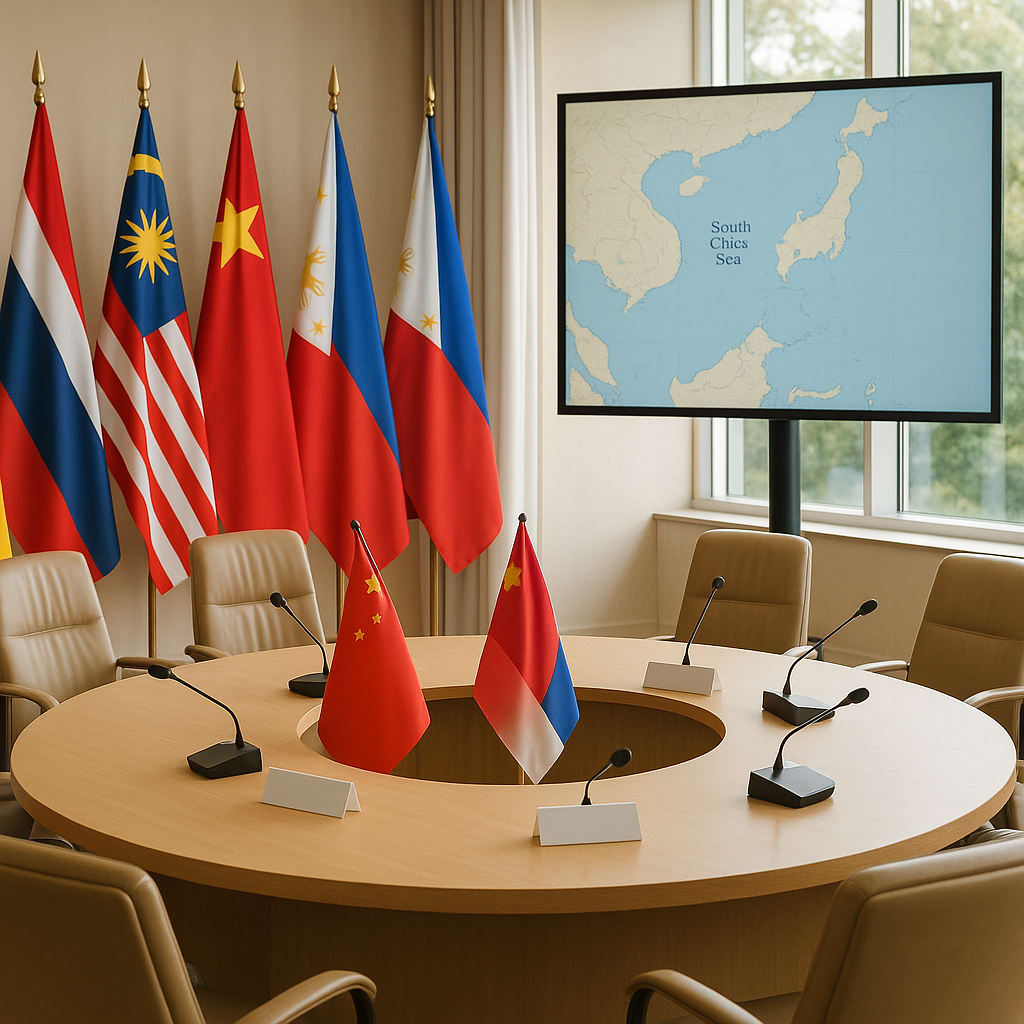
China and Philippines trade protests after clash at Second Thomas Shoal as ASEAN ministers meet in Manila
Narrative Snapshot
Across outlets there is broad agreement that a confrontation at Second Thomas Shoal led both Beijing and Manila to summon each other’s ambassadors and trade formal protests, with reports of at least one injured Philippine serviceman. European and regional reporting converges on the unusual character of the encounter: several accounts emphasize close-quarters scuffling using sticks, oars, or poles rather than firearms, highlighting a calibrated but hazardous form of coercion at sea. The timing is consistently framed as sensitive, overlapping with ministerial meetings in Manila.
Chinese state and state-adjacent coverage stresses a law-enforcement narrative and the role of “external forces.” CGTN and China News Service relay claims that Philippine personnel carried out “deliberate provocations,” including ramming and attacks on China Coast Guard crews near Ren’ai Jiao, and amplify messages from Foreign Minister Wang Yi about safeguarding regional stability through China–ASEAN mechanisms. By contrast, Japanese public broadcaster NHK reports Manila’s formal protest that a Philippine soldier was struck and injured by China Coast Guard crew, a point also underscored by The Diplomat’s account from the Philippine side. France24 and The Hindu situate the incident within Beijing’s expansive claims over the waterway and the region’s trade significance.
Regional diplomacy is a second axis of coverage. Deutsche Welle frames the sea clash as an immediate stressor on the ASEAN agenda in Manila. South China Morning Post reports dueling tones in Beijing’s outreach—calls with Manila to “reduce the risk of miscalculation,” alongside Wang’s warning of “bitter consequences” if the Philippines seeks leverage from other countries. Parallel great‑power engagements at the ASEAN sidelines are prominent: SCMP and Bangkok Post note a Wang–Rubio meeting that addressed both the South China Sea and President Xi Jinping’s planned visit to the United States, while TASS previews Sergey Lavrov’s participation to raise “militarization” risks. An ECNS interview argues the South China Sea code of conduct should be negotiated by China and ASEAN “without external interference,” echoing a theme running through Chinese official messaging.
What Happened
Following a confrontation at Second Thomas Shoal—referred to by China as Ren’ai Jiao—China and the Philippines summoned each other’s ambassadors and lodged formal protests. Philippine media-facing accounts cited by NHK say Manila protested that a Philippine soldier was struck with sticks by China Coast Guard personnel, causing injury, a detail also reported by The Diplomat. Chinese outlets ECNS and CGTN countered that Philippine personnel “rammed” a Chinese law‑enforcement vessel and “attacked” China Coast Guard crews, prompting Beijing’s protest.
As ASEAN foreign ministers convened in Manila, Chinese Foreign Minister Wang Yi met ASEAN’s secretary-general and his Philippine counterpart, accusing elements in the Philippine security services of provocations that serve “external forces,” while SCMP reports he warned Manila of “bitter consequences” if it seeks outside backing. SCMP also notes both sides cited the need to reduce miscalculation. NHK reports the two foreign ministers reaffirmed a goal of concluding a South China Sea “code of conduct” within the year. Parallel meetings included a Wang–Marco Rubio bilateral that discussed the sea clash and Xi’s planned US visit, and Russia’s Sergey Lavrov’s participation to raise militarization concerns, per Bangkok Post, SCMP, and TASS.
Why It Matters
The incident intersects directly with the still-unfinished South China Sea code of conduct negotiations between China and ASEAN, which NHK and The Hindu note have stretched nearly a decade; the two foreign ministers’ stated aim to conclude the code within the year provides a near‑term test of ASEAN’s convening capacity under stress. Chinese official and state media repeatedly advocate ASEAN‑led processes “without external interference,” as reflected in ECNS’s interview and CGTN’s coverage of Wang’s remarks, while US, Russian, and Japanese ministerial engagement at the same venue underscores the dispute’s entanglement with wider power competition.
The clash’s close‑quarters nature—described by Corriere della Sera and Politika as involving oars and poles—signals a pattern of controlled but escalatory maritime risk that can outpace crisis‑management norms. For decision‑makers, the combination of sharpened bilateral rhetoric, great‑power diplomatic overlays, and an ambitious code‑of‑conduct timeline raises questions about whether regional mechanisms can absorb acute incidents without externalized escalation or process breakdown.
Diverging Narratives
The core factual dispute centers on cause and conduct. Philippine officials, as reported by NHK and The Diplomat, assert that China Coast Guard personnel assaulted and injured a Philippine serviceman with sticks at Second Thomas Shoal. Chinese government and state media accounts (CGTN, ECNS) allege that Philippine personnel committed “deliberate provocations,” including ramming a Chinese law‑enforcement vessel and attacking Chinese crews near Ren’ai Jiao. France24 and The Hindu frame the episode against Beijing’s expansive maritime claims, while Chinese outlets emphasize sovereignty, law‑enforcement prerogatives, and the destabilizing role of “external forces.”
Diplomatic messaging also diverges in tone. SCMP reports simultaneous emphasis on avoiding “miscalculation” in Wang Yi’s meeting with his Philippine counterpart and a warning that Manila would face “bitter consequences” if it sought outside support. DW highlights the incident’s proximity to the ASEAN meetings, amplifying its regional stakes. On process, NHK reports a shared aim to conclude a code of conduct by year-end, whereas The Hindu underscores that nearly ten years of talks have yet to yield an agreement—an implicit caution about deliverability. ECNS’s expert interview presses for a China–ASEAN‑only track, while Bangkok Post and SCMP detail US–China discussions that keep major‑power involvement proximate, not peripheral.
What Happens Next
Three decision points emerge from the reporting. First is China–Philippines crisis handling: SCMP’s account of Wang’s warning and both sides’ reference to reducing miscalculation sets a fork between more formalized risk‑reduction channels and further confrontations at sea. Indicators include whether Manila and Beijing publicize incident protocols or, conversely, escalate diplomatic protests and maritime operations around Second Thomas Shoal.
Second is the code of conduct track. NHK’s reporting on a year‑end target contrasts with The Hindu’s reminder of protracted talks, and ECNS’s preference for negotiations “without external interference.” Analysts should watch ASEAN and China statements in Manila and subsequent drafts for concrete timelines, scope of applicability, and enforcement mechanisms.
Third is major‑power diplomacy at the margins. Bangkok Post and SCMP confirm a Wang–Rubio discussion that included the sea clash; TASS previews Lavrov’s focus on militarization; Japan Times raises a possible China–Japan encounter. Follow‑on readouts that reference the South China Sea will signal whether external actors lean into de‑escalation messaging or reinforce competing security framings.