
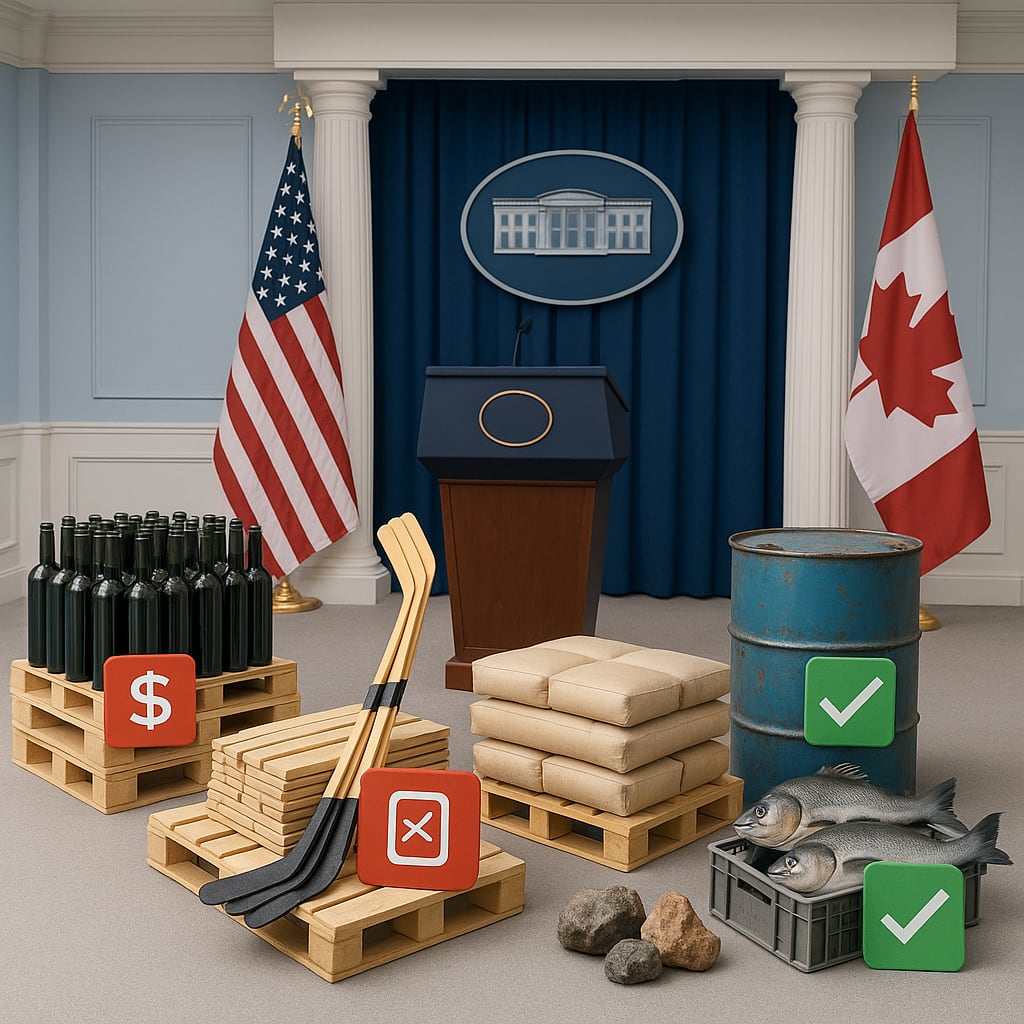
U.S. imposes 50% tariffs on a wide range of Canadian goods, citing discriminatory treatment of autos, alcohol and dairy
Narrative Snapshot
Across outlets there is broad agreement on the core architecture of the move: a blanket 50% rate applied to many Canadian imports, a 30-day runway before entry into force, and carve-outs for select sectors. Multiple international desks foreground the White House’s stated rationale of “discriminatory” Canadian treatment of U.S. autos, alcohol and dairy as the trigger, while also flagging the potential for renewed trade friction. The scope is framed variously as “most” goods with exemptions or “some” goods with emblematic examples, reflecting differences in emphasis rather than contradictions.
Coverage diverges on legal framing and breadth. The New York Times highlights the use of an “untested legal provision,” while CGTN names Section 338 of the Tariff Act of 1930 and notes the president signed three proclamations authorizing the action. France24 and TASS lean into the list of exemptions, while The Guardian and South China Morning Post stress the macroeconomic risks, including inflation and further strain in a once tightly woven bilateral relationship.
Sectoral focus also varies. U.S. broadcast reporting centers the headline categories—dairy, alcohol and autos—while Al Jazeera and The Hindu provide concrete examples such as wine, hockey sticks and cement, drawing on a White House fact sheet. Domestic mitigation surfaces in Latin American coverage: Clarín reports New York launched a $30 million program to support farmers affected by the tariffs, a downstream effect largely absent from other accounts.
What Happened
On July 20, 2026, the White House announced 50% tariffs on many Canadian imports, to take effect in 30 days. Officials said the action responds to what they called Canada’s discriminatory treatment of U.S. automobiles, alcohol and dairy products. Outlets cite a White House fact sheet listing affected goods that include wine, hockey sticks and cement, while exemptions cover energy products, potash, critical minerals and seafood. The New York Times reports the administration is invoking an untested legal provision; CGTN identifies it as Section 338 of the Tariff Act of 1930, under which the president signed three proclamations. Toronto Star notes the measures apply to goods covered by the Canada‑U.S.‑Mexico Agreement. NBC News reports the administration is also considering additional tariffs in connection with Canadian wildfires. Clarín reports New York state announced a $30 million fund to aid farmers hit by the tariffs.
Why It Matters
The decision reintroduces large, unilateral tariffs into a North American marketplace organized around the Canada‑U.S.‑Mexico Agreement, where integrated trade had reduced barriers and institutionalized dispute management. Applying a 50% rate to CUSMA‑covered goods brings domestic U.S. trade authorities—specifically a nearly century‑old statute—into direct interplay with a regional framework, testing how far treaty partners can absorb unilateral measures while core sectors are carved out. Several outlets link the move to wider structural risks: Deutsche Welle frames it as the latest escalation with a close neighbor, Folha de S.Paulo warns it could rekindle a trade war dynamic, and The Guardian and South China Morning Post flag inflationary pressures and the fraying of deeply intertwined bilateral economic ties. Subnational responses, such as New York’s farm support program reported by Clarín, underscore exposure along supply chains beyond the headline sectors singled out by Washington.
Diverging Narratives
The administration’s cause narrative is consistent across reports: Canada is said to be discriminating against U.S. autos, alcohol and dairy, justifying the new duties. Where outlets part ways is in depicting the scale and legal posture. The Guardian and SCMP describe tariffs on “most” Canadian goods, whereas France24, The Hindu and Al Jazeera emphasize “some” goods and illustrate with product examples, all while noting significant exemptions. Legal framing ranges from the New York Times’ characterization of an “untested” legal basis to CGTN’s explicit naming of Section 338, which permits up to 50% tariffs on specific countries, and the procedural detail that three proclamations were signed.
The focus of impact also splits. NBC News spotlights the three headline categories—dairy, alcohol and cars—and adds that further tariffs tied to Canadian wildfires are under consideration. TASS, Japan Times and Clarín emphasize exemptions for energy, potash, critical minerals and seafood, pointing to a calibrated approach shielding key inputs. Meanwhile The Guardian and SCMP stress macroeconomic risks, including potential inflation and broader bilateral strain, and DW and Folha frame the step within an escalatory trade context.
What Happens Next
The 30‑day window before the tariffs take effect is the immediate implementation horizon. Analysts will be watching for the final scope as detailed in White House materials—both the range of covered products, illustrated by wine, hockey sticks and cement, and the durability of exemptions for energy, potash, critical minerals and seafood reported by France24, TASS, Japan Times and Clarín. A second decision point is whether the administration proceeds with additional tariff measures linked to Canadian wildfires, as reported by NBC News; movement here would signal an intent to widen the dispute beyond the initial rationale. A third indicator is domestic mitigation: Clarín’s report on New York’s $30 million farm support program shows subnational exposure and policy response. The balance between broad coverage and carve‑outs, and whether further measures materialize, will determine whether the step remains contained or evolves toward the escalatory dynamic flagged by DW, Folha and Al Jazeera.