
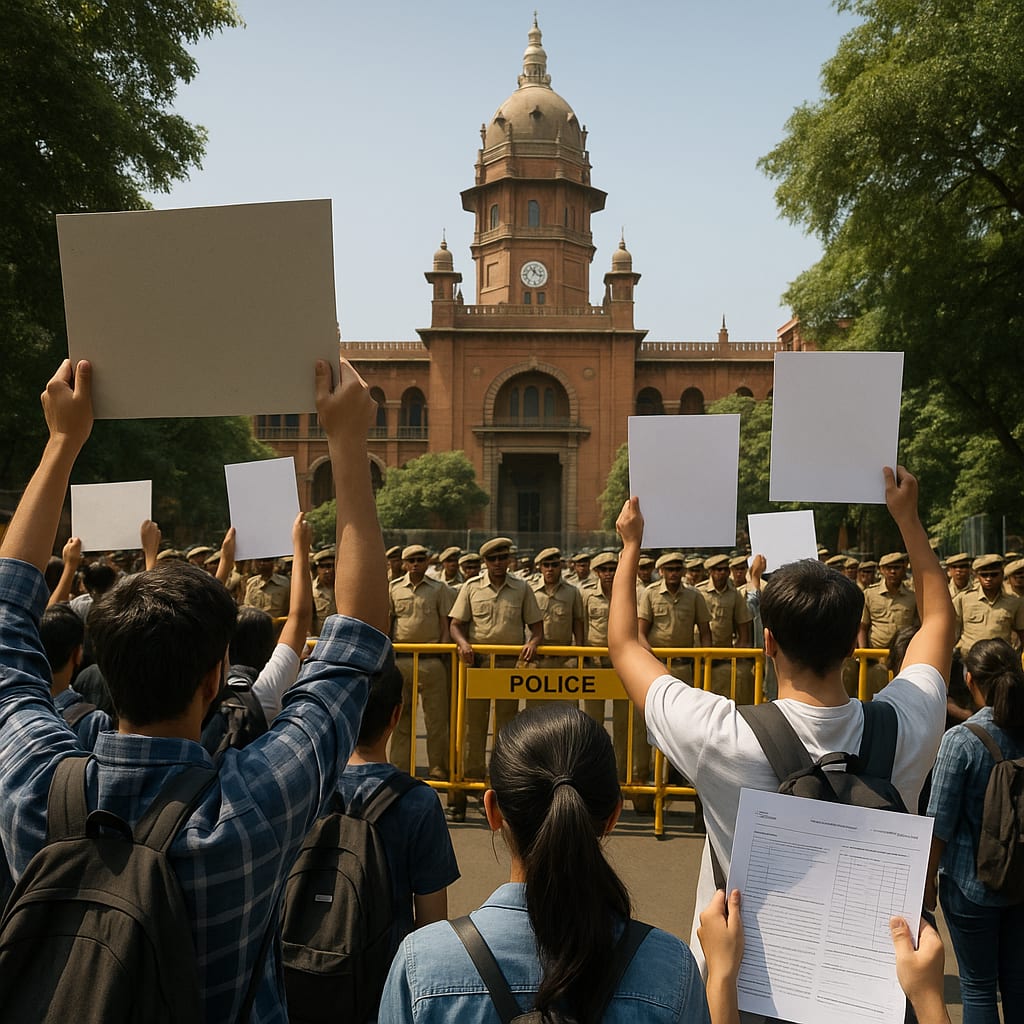
India’s youth-led ‘Cockroach’ protests escalate over exam leaks as opposition mobilizes and Modi orders fast-track courts
Narrative Snapshot
Across outlets, there is broad agreement that a youth-driven protest wave—branded the “Cockroach” or Cockroach Janta Party (CJP) movement—has burst beyond outrage over repeated exam paper leaks into a larger confrontation about accountability, jobs, and the credibility of institutions. International reporting converges on two anchor dynamics: persistent, mostly student-led mobilization despite police restrictions, and a sharpening political response as opposition parties amplify the core demand for Education Minister Dharmendra Pradhan’s resignation (BBC News; Deutsche Welle; Japan Times; France 24; Toronto Star; The Diplomat; The Guardian).
Where coverage diverges is in emphasis. Some outlets foreground on-the-ground force and resistance, documenting tear gas, batons, and water cannons in Delhi and Raipur, as well as allegations of pellet-gun use (Al Jazeera English; CBC News; Al Jazeera English 23 Jul). Others focus on political openings—Congress’s demonstrations outside the prime minister’s residence and the forcible removal or detention of Rahul Gandhi and Priyanka Gandhi Vadra—as indicators that the movement is reshaping opposition strategy (BBC News; South China Morning Post). A third strand centers on state response: Pradhan’s defense of reform efforts and Prime Minister Narendra Modi’s pledge to establish fast-track courts to punish leak-related corruption, framed as his first public remarks directly addressing the issue (Deutsche Welle; France 24; The Guardian).
What is most at stake, per the cross-border lens, is not just the future of standardized testing but whether India’s largest demographic cohort sees redress through process reforms or through personnel accountability and constraints on policing. France 24’s reporting that the Supreme Court declined to hear a police-brutality petition underscores contested avenues for remedy, while the BBC’s look at protest memes highlights a digital narrative battleground that is sustaining momentum even after crackdowns.
What Happened
A satirical online campaign launched in May as the Cockroach Janta Party crystallized into mass protests after repeated leaks of competitive exam papers, including medical entrance tests (Japan Times; France 24). On July 20, thousands defied a police ban to march toward India’s Parliament in New Delhi; police used tear gas and batons to disperse crowds, and organizers later reclaimed a dismantled protest site while canceling a subsequent march but maintaining a sit-in (The Guardian; CBC News; Deutsche Welle). Demonstrations spread, with water cannons deployed against student protesters in Raipur (Al Jazeera English). Opposition leaders rallied behind demands for Education Minister Dharmendra Pradhan’s resignation; Rahul Gandhi and Priyanka Gandhi Vadra were forcibly removed during a lawmakers’ gathering, and Congress staged a protest outside the prime minister’s residence (South China Morning Post; BBC News). Amid allegations of pellet-gun use by police, Prime Minister Narendra Modi announced fast-track courts to punish those involved in exam leaks, and Pradhan reiterated commitment to reform (Al Jazeera English; Deutsche Welle; France 24; The Guardian).
Why It Matters
The episode tests multiple layers of India’s governance architecture: the integrity of nationwide examinations that gatekeep access to higher education and public-sector jobs; the responsiveness of executive institutions facing youth discontent; and the capacity of courts to provide remedies in contentious protest-policing disputes. The government’s fast-track court pledge signals a process-first remedy aimed at deterrence and institutional repair, but it exists alongside a political demand for ministerial accountability that opposition figures have elevated to calls for the prime minister to step down (The Guardian; France 24). France 24’s report that the Supreme Court declined to hear a police-brutality petition places added pressure on other oversight channels at a moment when force deployment is being contested (France 24; Al Jazeera English; CBC News). For decision-makers, the movement’s decentralized, digitally fluent organization—evident in the BBC’s coverage of meme-based counternarratives—complicates traditional crowd-control and co-optation strategies, while international attention broadens the reputational stakes for how exam governance and protest management are handled.
Diverging Narratives
Government statements emphasize fixing systems over changing personnel. Pradhan has addressed the protests while stressing commitment to reform, and Modi’s move to set up fast-track courts frames leaks as criminal malfeasance demanding swift punishment rather than a political failure necessitating resignations (Deutsche Welle; France 24; The Guardian). Protest organizers and supporters counter that repeated leaks reflect “zero accountability” and institutional erosion that process tweaks alone cannot remedy; they maintain the education minister should go (The Diplomat; Japan Times; France 24).
There is also divergence in representations of coercive force. Several outlets document tear gas, batons, and water cannons, while Al Jazeera English reports videos alleging pellet-gun use, a claim not uniformly echoed elsewhere (Al Jazeera English; CBC News). Legal recourse is unsettled: France 24 reports the Supreme Court refused to hear a police-brutality petition, signaling a hurdle for rights-based challenges even as protesters insist on remaining at their sit-in (France 24). Politically, the South China Morning Post frames the moment as a rare opening for the opposition, reinforced by Congress’s street actions and the removal of Rahul and Priyanka Gandhi during a lawmakers’ gathering, whereas other coverage keeps the focus on the movement’s youth-led, nonparty origins and its social-media-driven identity (SCMP; BBC News; BBC News feature).
What Happens Next
Three decision points emerge from the reporting. First, whether the government’s process remedies satisfy public anger: watch the design, scope, and pace of the promised fast-track courts, and whether early prosecutions materialize and are linked to recent leaks, as Modi pledged to “not spare” those harming youths’ futures (Deutsche Welle; The Guardian). Second, personnel accountability: if Pradhan remains, the opposition is likely to keep consolidating around his removal; a resignation would signal a political concession to youth pressure that could de-escalate immediate demands but invite further calls for systemic change (BBC News; France 24; Japan Times). Third, policing and legal oversight: pay attention to independent verification of alleged pellet-gun use, any internal inquiries, and whether courts accept new petitions on protest policing after the earlier refusal reported by France 24. Sustained logistics at sit-ins and spread beyond Delhi, including deployments like Raipur’s water cannons, will indicate whether mobilization is stabilizing or broadening (Al Jazeera English; France 24; Deutsche Welle).