
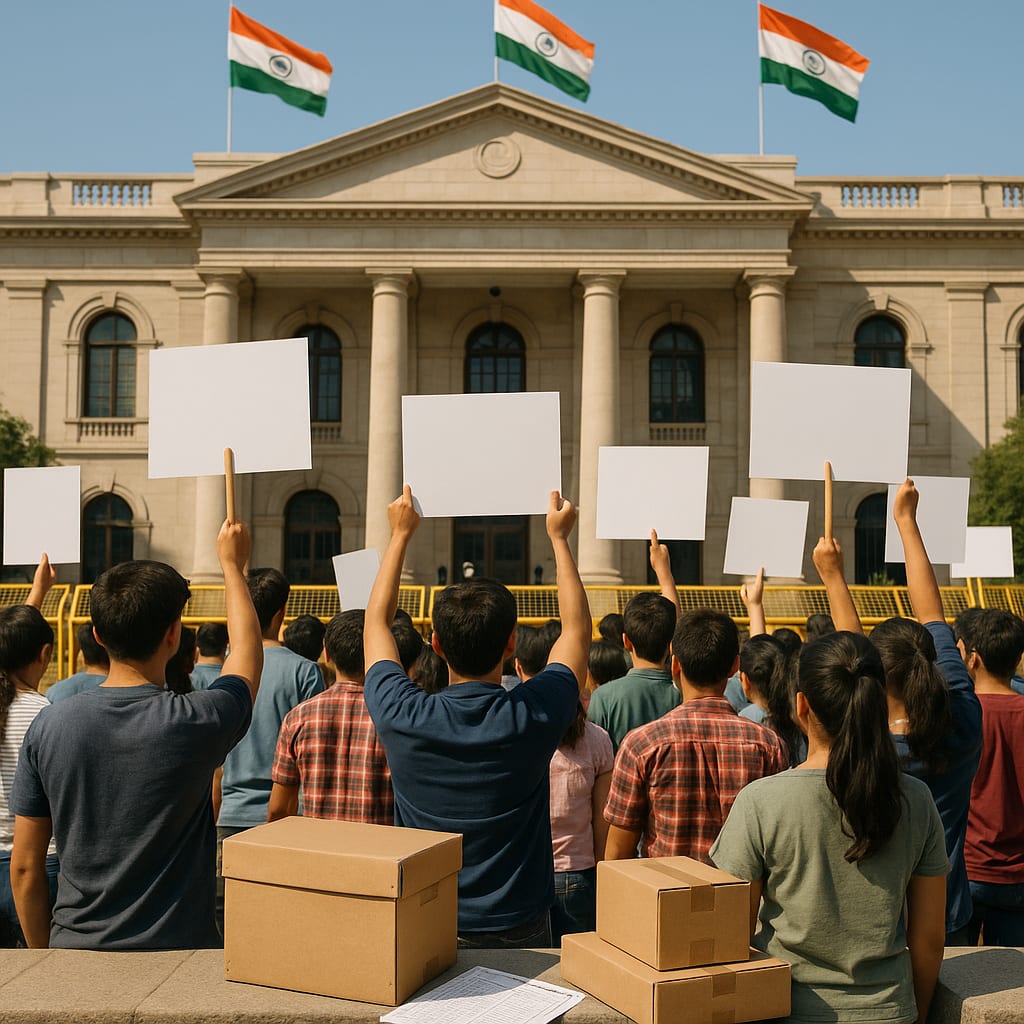
Modi pledges swift punishment over exam leaks as youth-led ‘Cockroach’ protests widen
Narrative Snapshot
Across outlets, there is broad agreement that Narendra Modi’s first direct intervention centered on punitive action against those implicated in exam fraud, with promises of “fast track courts” and “stringent punishment” anchoring the government’s response. The Guardian, Bangkok Post, Folha de S.Paulo and Politika all frame the announcement as the prime minister’s initial public move after days of youth-led mobilization, while France 24 pairs the pledge with the movement’s spread beyond Delhi to Mumbai and Bengaluru and its explicit demand for the education minister’s resignation.
Where coverage diverges is in emphasis on state response and protester tactics. France 24 reports a heavy-handed police crackdown and notes the Supreme Court’s refusal to hear a police brutality petition, while Al Jazeera English highlights video evidence alleging pellet gun use by police. In contrast, DW and France 24 devote significant space to the movement’s online-to-street trajectory, charting how the satirical Cockroach Janta Party amassed millions of followers and tens of thousands of sign-ups since May, and to creative protest repertoires such as the Mumbai “Viking Row” recast as a call to “resign,” as reported by Al Jazeera.
Another through-line is the protest frame: institutional fairness and youth futures. France 24 underscores that leaks forced the cancellation of a medical entrance exam affecting roughly 2.2 million candidates, while the Japan Times details perceptions of “betrayal” by a system seen as stacked against students. DW connects the mobilization to anger over corruption and high youth unemployment. Meanwhile, opposition actors scale up the political stakes: Politika, Folha, and DW note calls for the education minister to go, and France 24 reports Rahul Gandhi demanding Modi’s resignation over the crackdown.
What Happened
A satirical online collective, the Cockroach Janta Party, evolved into a street movement after repeated leaks in India’s National Eligibility cum Entrance Test for undergraduates, prompting the exam’s cancellation for roughly 2.2 million candidates, according to France 24. As protests expanded beyond Delhi to Mumbai and Bengaluru, France 24 reported, police mounted a forceful response; on July 22, France 24 also noted the Supreme Court declined to hear a police brutality petition. On July 23, Modi issued his first public response, promising “fast track courts” and “stringent punishment” for those behind the leaks, per the Guardian, Bangkok Post, Folha de S.Paulo, and Politika. Protesters and opposition parties continued to demand Education Minister Dharmendra Pradhan’s resignation; he has asserted commitment to reform, France 24 reported. DW said the Cockroach Janta Party called nationwide protests for July 24. Meanwhile, activist Sonam Wangchuk ended a 26-day hunger strike after negotiations, citing a desire to avert possible violence, per the BBC and the New York Times.
Why It Matters
The episode tests India’s core institutions that underpin social mobility and public trust: standardized examinations, policing, and judicial gatekeeping. The cancellation of a test affecting millions of medical aspirants heightens scrutiny of exam governance and anti-cheating safeguards, as underscored by France 24 and the Japan Times. The promise of fast-track courts signals an expedited justice posture, while the Supreme Court’s decision not to hear a brutality petition and reports of police crackdowns shape perceptions of accountability and restraint, per France 24 and Al Jazeera English. DW links the movement to deeper currents of youth discontent and unemployment, suggesting a broader constituency than single-issue grievance. For decision-makers, the mix of digital mobilization, sustained street presence, and opposition escalation—Rahul Gandhi’s call for the prime minister to resign—raises the salience of policy credibility and procedural integrity in education reform, as well as the political costs of perceived institutional drift.
Diverging Narratives
Government messaging centers on retribution and process: Modi’s vow of “stringent punishment” and fast-track courts, carried by the Guardian, Bangkok Post, Folha, and Politika, positions the state as guardian of merit and youth futures. Education Minister Dharmendra Pradhan’s stated commitment to reform, reported by France 24, advances a continuity-and-fix agenda without conceding to resignation demands. Protest leaders and many students, by contrast, frame the core issue as systemic accountability rather than isolated corruption, encapsulated in Al Jazeera English’s reporting that “our fight is to fix the system,” and in sustained calls for Pradhan to step down across DW, France 24, Folha, and Politika.
Accounts of state response differ in focus. France 24 emphasizes a police crackdown and the Supreme Court’s refusal to hear a brutality petition, while Al Jazeera reports videos showing alleged pellet gun use against protesters. There is also tension over scale and trajectory: DW and France 24 point to momentum beyond Delhi, with a formal call for nationwide protests on July 24; the South China Morning Post characterizes the mobilization as the biggest youth-led challenge to Modi’s government, even as the government highlights targeted enforcement and reform to contain fallout. The personal intervention of Sonam Wangchuk—ending a 26-day fast to avert “possible violence,” per the BBC and New York Times—adds a counterpoint narrative of de-escalation through dialogue amid intensifying street pressures.
What Happens Next
Three decision points emerge from the reporting. First, on accountability, analysts should watch for concrete steps to operationalize fast-track courts and for visible prosecutions of alleged leak networks; Modi’s pledge (Guardian, Folha, Politika, Bangkok Post) sets an expectation that will be tested by cabinet actions, notifications, and cases filed. Second, on personnel responsibility, the education minister’s status is pivotal: protesters and opposition groups are explicitly tying continued mobilization to his resignation (France 24, DW, Folha, Politika). A resignation or reshuffle would address that demand; its absence keeps the trigger for nationwide actions intact, including the July 24 call flagged by DW. Third, on protest-state dynamics, indicators include police posture and any judicial engagement with alleged brutality (France 24) and independent verification of pellet-gun claims (Al Jazeera). Whether channels of negotiation widen, as suggested by Wangchuk’s account of talks (BBC, New York Times), will shape the mix of confrontation and dialogue.