
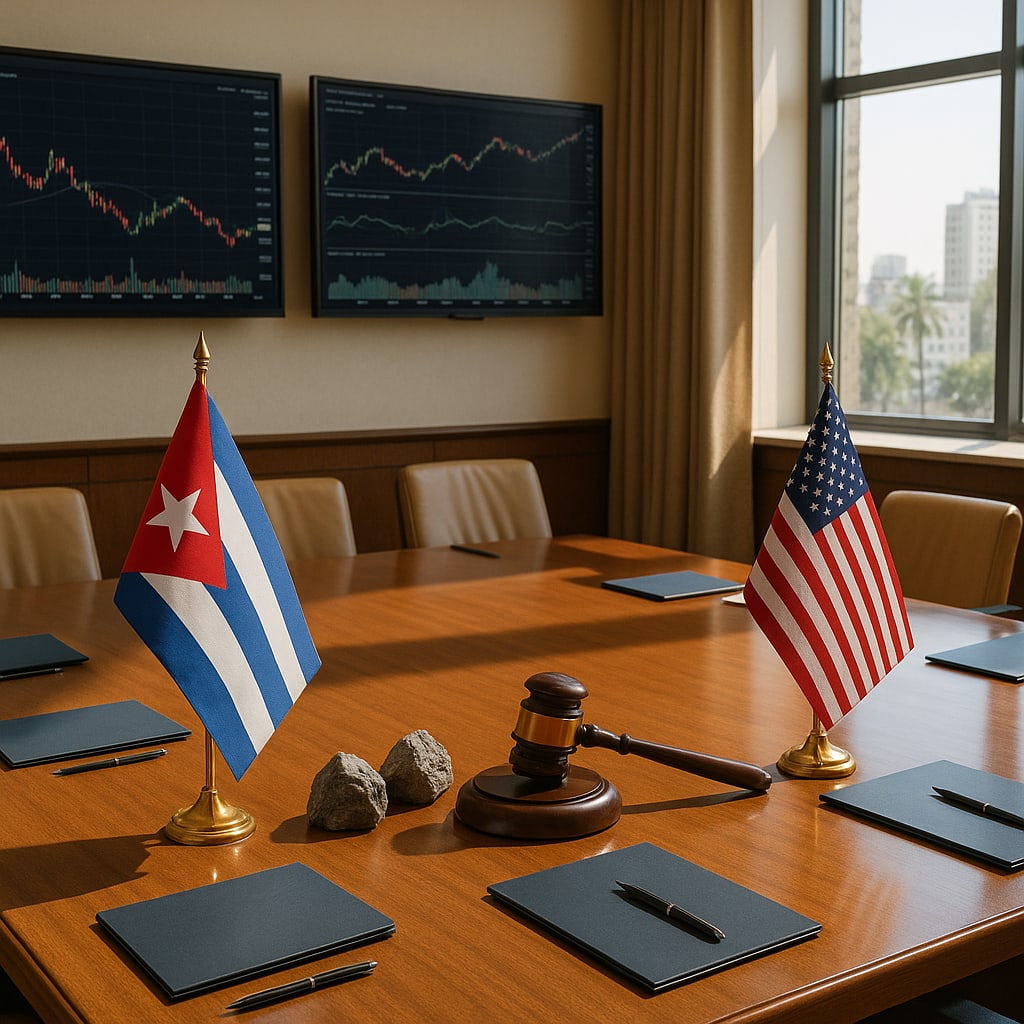
U.S. escalates sanctions and legal pressure as Cuba adopts its largest market reforms since 1959
Narrative Snapshot
- Most outlets agree Cuba has approved its most far-reaching pro-market reforms since the revolution, under acute economic distress, while Washington simultaneously intensified coercive measures. Where they diverge is on the depth and intent of Havana’s shift and the efficacy and human impact of U.S. pressure.
- U.S.-focused reporting emphasizes sanctioning revenue streams tied to Cuba’s state-military conglomerate GAESA and enabling property claims in U.S. courts (Fox News; New York Times; Al Jazeera). European and Latin American coverage stresses that Washington dismisses the reforms as insufficient and has even raised military threats (Le Monde), while analysts warn new sanctions will chill investment and deepen the crisis (CBC; Clarín).
- Strategic framings split: SCMP links mining sanctions to U.S. critical-minerals supply-chain aims and China exposure; TASS relays Cuba’s argument that measures worsen humanitarian conditions; a Fox News op-ed by Sen. Peter Welch warns of war risks; Folha’s editorial calls the reforms both overdue and forced by U.S. pressure.
What Happened
On June 18, Cuba’s parliament approved a sweeping package to open the economy to private and international capital and reduce the state’s directive role—the largest shift since 1959, undertaken amid severe crisis and “unprecedented U.S. pressure” (Folha de S.Paulo; The Hindu). Le Monde reports Washington has branded the steps “superficial” and threatened military intervention. On June 23, U.S. Secretary of State Marco Rubio announced sanctions on five Cuban entities, including three linked to GAESA, the state-owned miner GeoMinera, and one member of the extended Castro family (Fox News; South China Morning Post; Clarín). CBC notes analysts expect the measures to spook foreign investors and worsen the downturn. Cuba’s UN representative Ernesto Soberon Guzman said the sanctions “have nothing to do with supporting Cuban people” and aggravate humanitarian harm (TASS). The same day, the U.S. Supreme Court allowed Exxon Mobil to pursue compensation for assets seized in 1960 (New York Times; Al Jazeera).
Why It Matters
- Sanctions now target linchpin revenue and input nodes—GAESA-linked firms and the mining sector—aligning with a broader U.S. effort to rewire critical-minerals supply chains away from geopolitical competitors, with implications for China-linked ventures in Cuba (South China Morning Post).
- The Supreme Court ruling lowers barriers for U.S. firms to seek redress for expropriations, raising Cuba’s litigation exposure and complicating sovereign risk assessments for investors just as Havana seeks external capital (New York Times; Al Jazeera; CBC).
- Washington’s dismissal of the reforms and reported threats of force (Le Monde), alongside domestic criticism warning of escalation (Fox News op-ed), highlight a sharper U.S. coercive posture in the Caribbean. This tests regional crisis-management norms and raises costs for multilateral actors navigating sanctions’ humanitarian externalities (TASS; CBC).
- Commentary in Asia frames the U.S. track as regime-change–oriented, posing diplomatic choices for partners with historic ties to Havana, such as Vietnam (South China Morning Post, opinion).
Diverging Narratives
- Reform substance: Brazilian and Indian coverage describes a watershed market opening driven by economic necessity (Folha de S.Paulo; The Hindu). Le Monde reports Washington’s view that the steps are “superficial,” signaling that policy change in Havana has not met U.S. benchmarks.
- Sanctions purpose and impact: U.S. officials cast the designations as cutting funds to a “repressive security apparatus,” with GAESA labeled the regime’s “financial muscle” (Fox News). Cuba’s UN envoy argues the measures deepen humanitarian suffering (TASS), and CBC relays analyst expectations of an investor pullback and a worsening crisis. SCMP emphasizes a parallel goal: reshaping strategic supply chains via a hit on GeoMinera.
- Coercion risks: Le Monde reports threats of military intervention; a Fox News opinion by Sen. Peter Welch warns the administration is steering toward “another reckless war” and describes an oil blockade’s effects. Those critiques contrast with enforcement-first framing in U.S. policy coverage (Fox News; Clarín).
- Legal venue shift: The Supreme Court decision is described as making compensation claims easier (New York Times; Al Jazeera), but the scale of follow-on litigation and its interaction with sovereign defenses remain open questions, with potential to constrain Cuba’s reform financing just as Havana seeks foreign participation (CBC).
What Happens Next
- U.S. sanctions trajectory: State/treasury listings under E.O. 14404 could expand to additional GAESA-linked or sectoral nodes; indicators include successive designation tranches and sectoral guidance (Fox News; SCMP).
- Reform implementation in Cuba: Folha anticipates a slow transition; investor interest will hinge on enabling regulations, clarity on private ownership, and partner screening amid U.S. sanctions. Watch for implementing decrees, joint venture approvals, and whether GAESA’s commercial footprint changes (Folha de S.Paulo; Le Monde; CBC).
- Litigation cascade: After Exxon’s green light, monitor new filings by other U.S. firms, court rulings on jurisdiction and damages, and executive branch positions affecting case scope (New York Times; Al Jazeera).
- External actors and supply chains: Assess responses from foreign partners in mining ventures overseen by GeoMinera, especially those with China links; look for JV suspensions, financing withdrawals, or attempts to ring-fence operations from sanctions (SCMP; CBC).
- Escalation signals: Track U.S. rhetoric and posture regarding the use of force (Le Monde) and domestic pushback articulated by critics (Fox News op-ed). Concrete indicators would include shifts from financial measures toward overt coercive steps or, conversely, moves to pair sanctions with diplomatic off-ramps.