
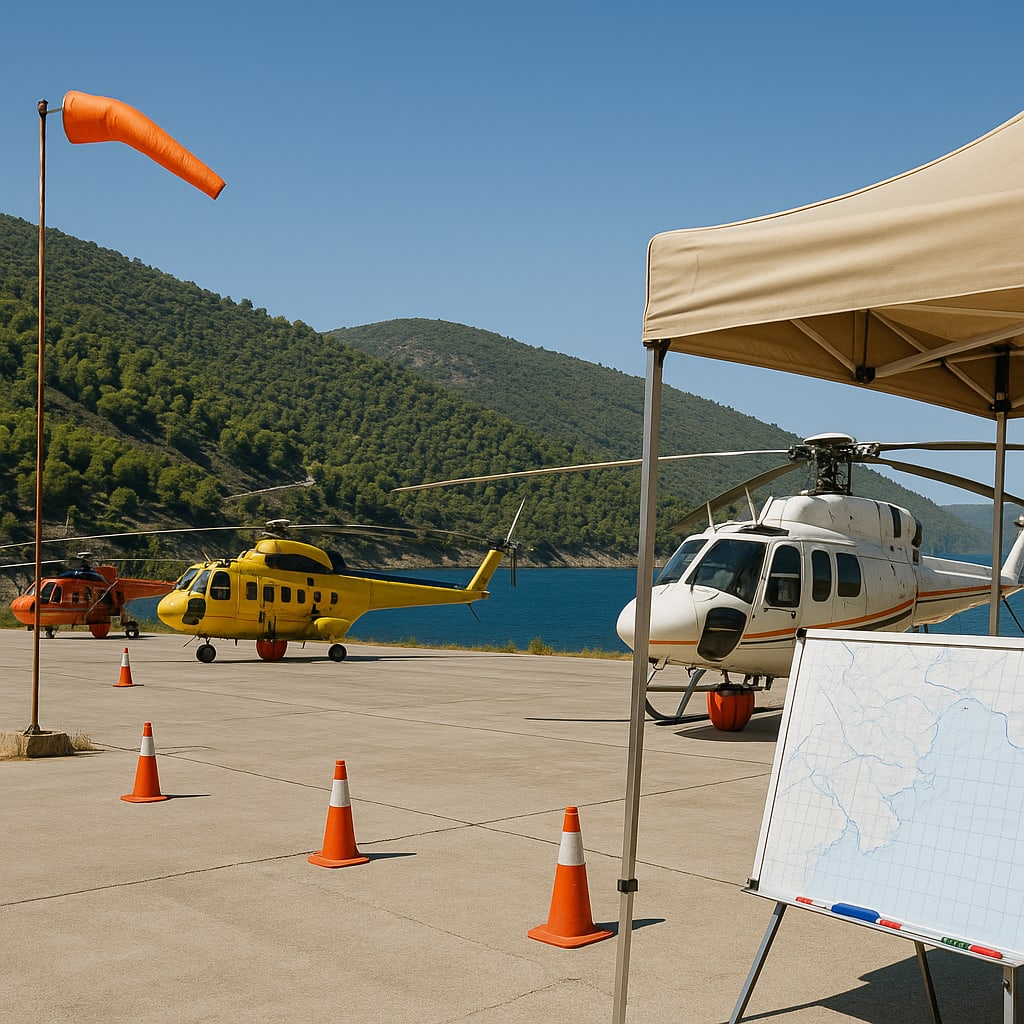
Two firefighting helicopters collide near Athens amid Greece’s wildfire emergency
Narrative Snapshot
Across outlets, the core facts are consistent: two firefighting helicopters operating west of Athens collided midair near Psatha/Porto Germeno, with widely circulated video showing one aircraft striking the other’s rotor before a fireball and crash. Broadcasters and wires emphasize different facets. BBC, NBC, Al Jazeera, and Corriere della Sera foreground the dramatic footage and immediate operational details, while Deutsche Welle, The Hindu, NHK, and Japan Times situate the incident within a wider European wildfire emergency, citing an expert’s “megafire” characterization and a record heatwave.
Timing and emphasis shape divergences in casualty reporting and operational framing. Early dispatches highlighted a large search-and-rescue near Psatha with four crew recovered, two unconscious (SCMP, NBC, Clarín, DW). Subsequent updates confirmed two fatalities (TASS, CBC, ANSA). SCMP quantified the western Attica response at nearly 500 firefighters and 23 aircraft; RT added that gale-force winds hampered water-scooping and cited a nationwide tally of 220 fires over the past week, figures not uniformly echoed elsewhere. Only CGTN reported nationalities of the crew—identifying a Danish pilot and a Greek firefighting coordinator among the dead, and a British pilot and another Greek coordinator among the survivors—based on a Fire Service briefing.
What Happened
During aerial firefighting operations west of Athens on August 2, two helicopters collided near the coastal area of Psatha/Porto Germeno. Video published by multiple outlets shows one helicopter strike the other’s rotor, after which one aircraft ignited and crashed while the other made an emergency landing (BBC; TASS; Japan Times). A large search-and-rescue followed; four crew members were recovered, with two later confirmed dead, according to the Greek Fire Service (SCMP; CBC; ANSA). CGTN, citing Fire Service spokesperson Vassilis Vathrakogiannis, reported the fatalities as a Danish pilot and a Greek firefighting coordinator, and the survivors as a British pilot and a Greek coordinator, one injured. The collision occurred amid an intense wildfire front in western Attica, where nearly 500 firefighters and 23 aircraft were deployed (SCMP). High winds complicated air operations, including water collection from the sea, according to RT.
Why It Matters
The collision highlights operational risks in Europe’s peak wildfire season, where high temperatures and winds compress airspace and raise complexity for multi-ship drops near populated coastlines. Greek authorities face immediate pressure to reconcile an urgent aerial campaign—scaled to nearly 500 firefighters and dozens of aircraft on the main front—with safety assurances for crews (SCMP). Prime Minister Kyriakos Mitsotakis warned of “extremely difficult” days ahead as experts invoked a “megafire,” underscoring sustained strain on command-and-control and aircraft deconfliction under volatile conditions (DW). CGTN’s account of mixed-nationality crews points to internationalized aviation support, bringing interoperability, training, and contract oversight into focus. For European and national agencies managing heatwave-driven fire regimes (NHK; The Hindu), the incident raises decision-relevant questions about sortie density, wind thresholds for scooping and drops, and whether current aviation safety protocols are calibrated for the intensifying wildfire environment described across coverage.
Diverging Narratives
Outlets differ mainly by reporting window and framing rather than on core facts. Early reports stressed an ongoing search with two unconscious crew members recovered (SCMP, NBC, Clarín, DW), while later updates confirmed two deaths (CBC, TASS, ANSA). Visual accounts converge on the mechanical sequence—one helicopter striking the other’s rotor before a fireball and crash (BBC; Japan Times)—but no outlet asserts a definitive cause. Politika reports investigators are testing four scenarios, including pilot misjudgment despite both pilots being highly experienced, indicating that attribution remains open.
Contextual emphasis also splits coverage. DW, The Hindu, NHK, and Japan Times cast the incident as symptomatic of Europe’s wider wildfire emergency, employing terms like “megafire” and linking to a record heatwave. SCMP highlights the operational surge in western Attica, while RT layers on scale metrics—such as 220 fires nationwide over the past week and wind-driven evacuations by boat—not broadly repeated elsewhere. Only CGTN details the crew’s nationalities from an official briefing, a specificity absent in many initial accounts, reflecting uneven access to or timing of official confirmations.
What Happens Next
Greek authorities have opened a formal investigation. Politika reports four hypothesized scenarios under review, one being pilot misjudgment; forthcoming briefings will indicate whether investigators prioritize human factors, coordination, or mechanical failure. Analysts should watch for interim findings, the degree of reliance on flight-data and video evidence, and whether the Fire Service issues procedural updates.
Operationally, authorities must balance tempo against safety as western Attica’s campaign continues. Mitsotakis’s warning of “extremely difficult” days (DW) and reports of gale-force winds impeding water-scooping (RT) point to decision thresholds on sortie rates and weather minima. Shifts in aircraft tasking or temporary constraints on scooping operations would be consequential signals. If CGTN’s identification of multinational crews is sustained in official reports, subsequent statements on training, airspace deconfliction, and contractor oversight will be important indicators of how Greece aligns aviation safety with intensified wildfire demands under the heatwave conditions described by NHK and The Hindu.