
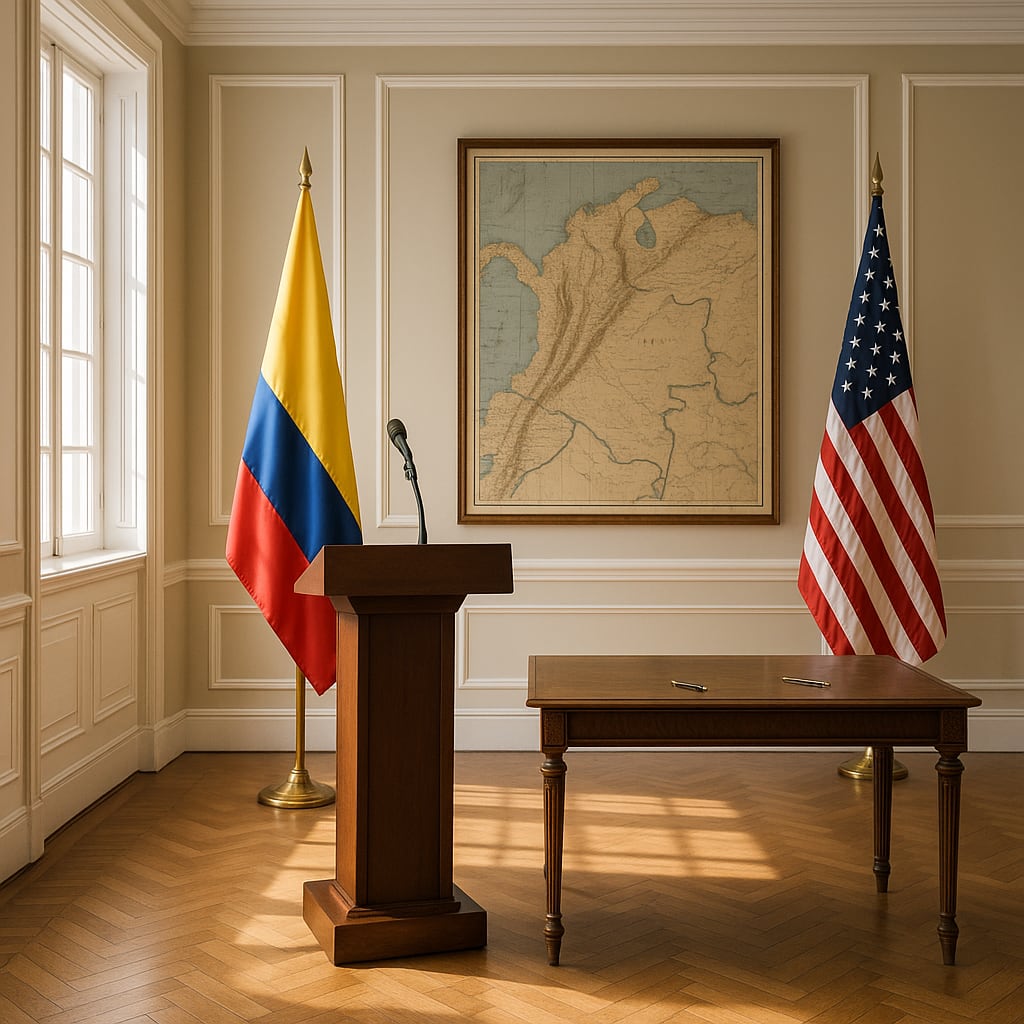
Colombia’s De la Espriella sworn in in Cali, pledges hardline security and austerity as Washington announces $1bn in aid
Narrative Snapshot
Across outlets with different editorial lineages, there is broad agreement on the scale and direction of the policy shift. Coverage consistently centers on Abelardo de la Espriella’s security-first agenda, his promise of fiscal retrenchment, and a deliberate realignment toward Washington. International reporting also converges on the unusual staging: an inauguration in Cali, not Bogotá, with a pronounced military backdrop.
Where outlets diverge is in framing and emphasis. Left-leaning Latin American sources highlight the explicit termination of peace dialogues and contrast it with Gustavo Petro’s “people-first” legacy. European and U.S. reporting foreground the announced $1 billion in U.S. security assistance and De la Espriella’s alignment with Donald Trump. Several Asia-based outlets and regional press stress the austerity program—shrinking the state by as much as 40%—and plans to revive oil and gas, reading the turn as part of a wider rightward realignment in Latin America.
Another axis of contrast lies in the tools and tone signaled for the security push. Some outlets underscore pledges to build “mega prisons” and bomb jungle cocaine labs, while Brazilian reporting zeroes in on a public order to the military for “definitive combat” paired with promises of legal protections. This mix—muscular tactics and legal shielding—features prominently in Latin American and European coverage, while Chinese state media and Japan-based reporting emphasize technocratic austerity and the ceremony’s protocol.
What Happened
Abelardo de la Espriella was sworn in as Colombia’s president on Friday in the city of Cali, at the Arena USC of Universidad Santiago de Cali, after narrowly winning June’s runoff as an independent backed by the far-right Defenders of the Homeland movement. In a speech delivered before ranks of military personnel, he ordered “definitive combat” against armed groups and pledged “all legal guarantees” to security forces. He vowed to “crush” narco‑terrorism, end ongoing peace dialogues, bomb jungle cocaine labs, and build mega‑prisons, while committing to fiscal austerity, shrinking the state by up to 40%, and reviving oil and gas. Washington announced $1 billion in security assistance shortly after the ceremony. Foreign dignitaries in attendance included Spain’s King Felipe VI and the presidents of Argentina, Chile, and Ecuador, as reported from the venue.
Why It Matters
The inauguration crystallizes a sharp policy turn from negotiation-based “Total Peace” to coercive counterinsurgency and anti-narcotics operations, resetting the state’s posture toward armed actors and potentially reshaping implementation of Colombia’s existing peace frameworks. The immediate U.S. pledge of $1 billion in security assistance signals a renewed bilateral compact on counternarcotics and security sector cooperation, with implications for regional dynamics and for how multilateral actors engage on human rights and rule-of-law safeguards during expanded operations. Domestically, the administration’s promise to shrink the state and restore extractive growth reorients fiscal and energy policy away from Petro-era social expansion and decarbonization aims, with budgetary, subnational, and sectoral consequences. Regionally, international coverage situates Colombia’s shift within a broader rightward movement across Latin America, affecting alignments among hemispheric leaders and the tenor of security and migration cooperation.
Diverging Narratives
Outlets differ on the central frame of the moment. For Telesur and Argentina’s Clarín, the defining act is the burial of peace negotiations, contrasted with Petro’s welfare-oriented tenure. European coverage by Le Monde and the Guardian positions the event within renewed U.S.–Colombia security ties, emphasizing Washington’s $1 billion commitment and De la Espriella’s personal alignment with Donald Trump. U.S. conservative media highlights reversal of Petro’s agenda amid a continent-wide rightward shift, while Deutsche Welle and Al Jazeera center the anti–drug gang crackdown without elaborating on the fiscal program.
Descriptions of the security toolkit vary in specificity. The South China Morning Post details plans to bomb cocaine labs and construct mega‑prisons, while Brazil’s Folha de S.Paulo spotlights the public order to the military and promised legal shields for operators. Asian outlets like the Japan Times and The Hindu emphasize austerity and state shrinkage targets and the intent to revive oil and gas. Chinese state media foregrounds the hardline security stance and spending cuts, and provides ceremony logistics. There is less reporting consensus on the design of legal guarantees for the security forces, the status of each negotiating channel after the speech, and the operational contours or oversight of the promised U.S. assistance.
What Happens Next
Three decision points emerge. First, institutionalization of the security shift: watch for decrees or legislation operationalizing “definitive combat,” legal protections for security forces, and the announced end to dialogues, including dissolution of negotiating teams and budgets. Concrete steps toward bombing labs or building mega‑prisons would appear in procurement, rules of engagement, and prison construction authorizations reported by national authorities. Second, fiscal consolidation: monitor the first budget package and restructuring plans to assess movement toward the promised state shrinkage, alongside signals on social program retrenchment. Third, energy policy reversal: look for licensing decisions and regulatory changes to revive oil and gas consistent with campaign pledges. On the external front, track the rollout and conditionality of the $1 billion U.S. security assistance and whether joint operations or training upticks are announced; these will shape the tempo and scope of early enforcement actions.