
France and Spain order mass evacuations as ‘monster’ wildfires threaten Bordeaux and central Spain, with another heatwave looming
Narrative Snapshot
Across outlets, the scale of displacement is the shared reference point. European, North American and Asian coverage converge on six-figure evacuations and shelter-in-place orders, with The Guardian describing one of the largest peacetime civilian evacuation operations in France and multiple outlets placing totals above 300,000 people across both countries. The lived impacts are also consistent: the New York Times and France 24 capture smoke-choked skies and respiratory distress around Bordeaux, while the Bangkok Post and South China Morning Post highlight overflowing shelters as authorities race the clock before another heatwave.
Where many reports link the fires to successive heatwaves and drought, some go further on structural drivers. France 24’s expert interviews and CGTN’s drought reporting foreground climate change as the threat multiplier and stress long-standing prevention gaps; France 24 explicitly raises post-fire restoration and governance reform. In France and Italy’s press, political and state responses are more salient: Corriere della Sera emphasizes the army’s deployment, President Emmanuel Macron’s unity message and reconstruction pledge, and the continued threat to Bordeaux. Spanish- and Latin American–focused coverage also tracks the political discourse, with Clarín noting climate denialist commentary surfacing amid the crisis.
A minority narrative introduces capability constraints not echoed elsewhere. RT alleges EU sanctions on Russia hampered Spain’s access to certain helicopters, a claim absent from other international and regional outlets that instead focus on heat, wind, and dryness as the primary operational challenges. Tally discrepancies persist across reports—some count formal evacuations, others those told to seek shelter—but all situate the operations as historic in scale, with the near-term risk shaped by the timing and intensity of the next heatwave.
What Happened
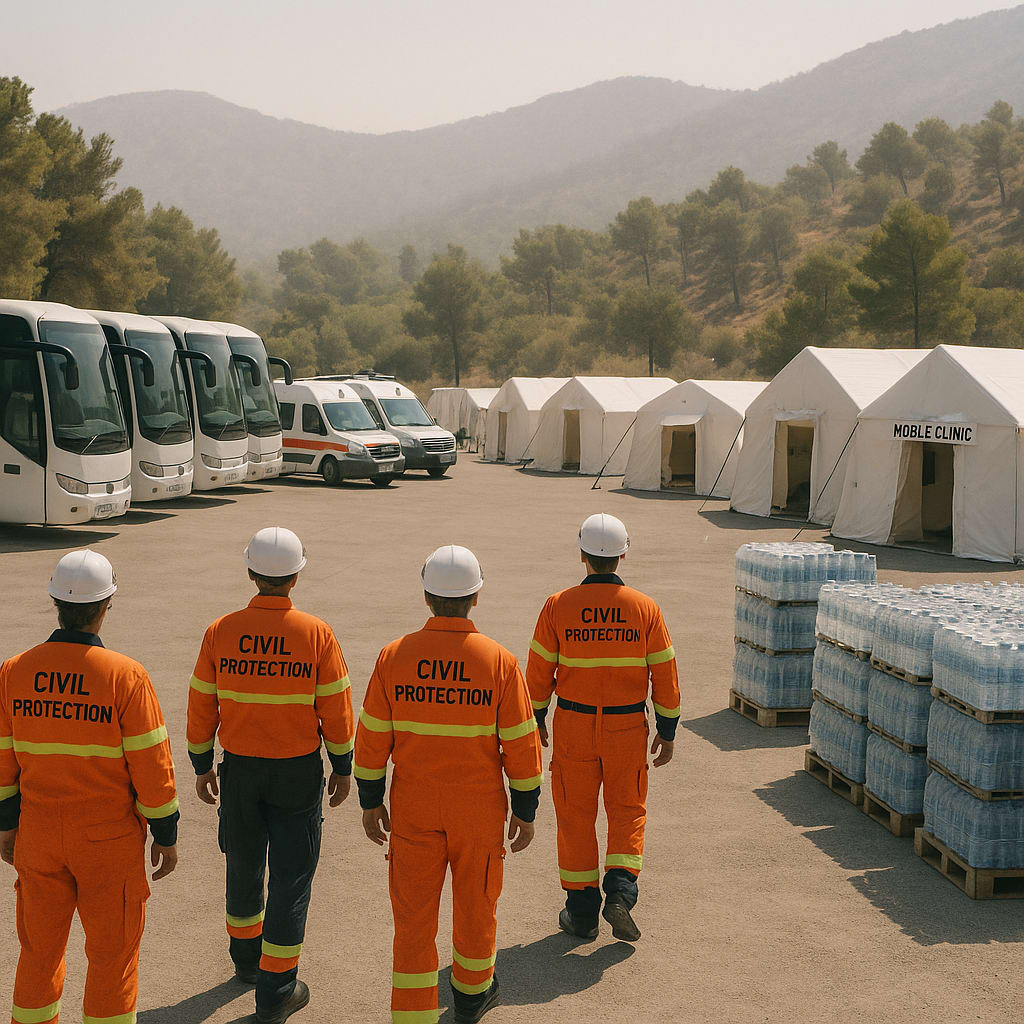
Wildfires in southwest France and central Spain forced mass evacuations and shelter-in-place orders as heat, drought and shifting winds drove rapid fire spread. Authorities cleared towns and tourist areas around Bordeaux, including parts of Gironde near Lège-Cap-Ferret, while smoke blanketed the region and residents reported breathing difficulties. In Spain, blazes around Toledo and the Madrid region escalated, with Al Jazeera reporting at least 14 deaths and two fires merging into a single large complex. Multiple outlets placed total displacement above 300,000 people across both countries, with the Japan Times citing roughly 220,000 evacuated in France and around 100,000 told to seek shelter in Spain. Firefighters reported exhaustion after days of continuous work, French forces received military support, and officials warned that a new heatwave could intensify conditions even as brief cooler intervals allowed tactical gains.
Why It Matters
The operations stress-test national and local civil protection systems at a scale European outlets describe as exceptional, with the Guardian and the Toronto Star/AP characterizing the evacuations as among the continent’s most extensive in recent memory. Health systems and urban administrations face acute air-quality crises, illustrated by Bordeaux’s smoke impacts reported by the New York Times and France 24. The structural drivers are not transitory: France 24 and CGTN report that repeated heatwaves and climate change–intensified drought have shifted Europe’s wildfire and water-risk baselines, increasing the frequency and intensity of extreme events. France 24’s expert analysis argues that prevention, land management, and governance failures compound climate pressures, while France 24 also flags the post-fire agenda—CO2 emissions from fires and landscape restoration—as a near-term policy frontier. For decision-makers, the episode underscores capacity, coordination, and adaptation gaps that will recur with each heatwave unless prevention and resilience measures are scaled.
Diverging Narratives
Causal framing diverges in emphasis. France 24’s reporting and expert interviews present climate change and insufficient prevention as intertwined drivers, while CGTN’s drought coverage situates the fires within a region-wide water scarcity pattern aggravated by heat. By contrast, Clarín documents climate denialist rhetoric entering Spain’s public debate, indicating that consensus on cause is not universal. Operationally, most outlets stress meteorology and fuel dryness as the central constraints; only RT advances a sanctions-based capability shortfall, asserting that EU measures limited Spain’s access to certain Russian helicopters. No other source in this set corroborates that claim, and other international outlets do not raise equipment embargoes as an explanatory factor.
There are also discrepancies in reported figures and categories of movement. The Guardian and Times of Israel cite totals above 300,000–325,000 displaced, while the Japan Times differentiates between approximately 220,000 formally evacuated in France and around 100,000 in Spain told to seek shelter. Al Jazeera alone specifies a confirmed death toll, reporting at least 14 fatalities in Spain, whereas much European coverage concentrates on evacuation scale, smoke, and the threat to Bordeaux. French and Italian reporting prioritizes state response and symbolism—Macron’s unity and reconstruction pledge, army deployment—while Spanish- and global outlets place more weight on the coming heatwave as the main variable shaping firefighting strategies.
What Happens Next
Two decision points will determine the short-term trajectory. First, the heatwave’s timing and intensity relative to current containment lines: SCMP and France 24 report authorities are trying to capitalize on brief favorable weather to subdue fronts before temperatures rise again. If heat and winds strengthen, officials signal more evacuations and extended shelter-in-place orders, especially around Bordeaux and central Spain; if cooler, calmer conditions persist, firefighters can deepen containment and shift resources to priority perimeters. Second, the scope of state support and post-crisis commitments: Corriere della Sera notes military deployment and presidential pledges to rebuild, while France 24’s expert commentary and coverage on restoration pose explicit choices on prevention-oriented land management once flames subside. Analysts should watch civil protection advisories on air quality, evacuation thresholds, and resource surges, meteorological bulletins for wind and heat cues, and whether governments articulate concrete prevention and restoration measures beyond emergency response.