
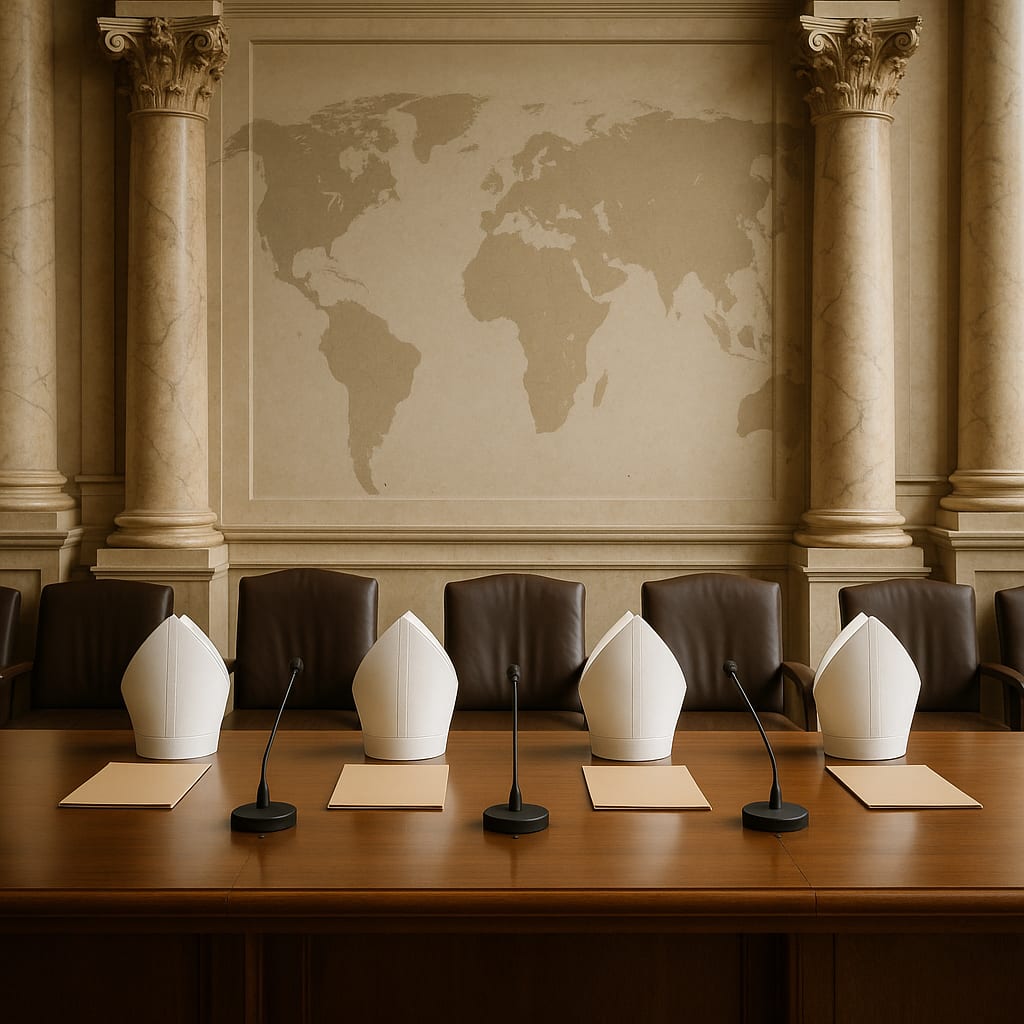
SSPX ordains four bishops without papal consent; Vatican declares schism and imposes excommunications
Narrative Snapshot
- Broad alignment that the consecrations at Ecône were performed without papal mandate and carry canonical consequences; outlets differ on how far those consequences reach. The Guardian and Japan Times report sweeping excommunications of members, while Le Monde, DW, and the South China Morning Post specify six bishops (the consecrators and the four newly ordained).
- Coverage splits between theological-procedural frames and movement profiling. Al Jazeera centers apostolic authority and the licitness of sacraments; Le Monde foregrounds SSPX’s ideological program and scale (circa 600,000 faithful) and its rejection of Vatican II.
- Descriptive texture varies: the BBC highlights thousands in attendance and the symbolism of the Alpine setting; The Guardian details nationalities of the new bishops and the livestreamed rite; RT amplifies rupture language (“worst rift in decades”) and quotes SSPX’s “sacred duty” rationale.
- Stakes are cast either as a canonical-ecclesial crisis for a new pontificate (The Guardian calls it Pope Leo’s first crisis) or as the latest escalation in a long-running dispute over authority and tradition (DW, Le Monde).
What Happened
On 1 July, the Society of Saint Pius X (SSPX) consecrated four bishops at its seminary in Ecône, Switzerland, despite a last-minute appeal from Pope Leo XIV to cancel the rite (DW; Folha, 1 Jul; The Guardian, 1 Jul). The ceremony, streamed online, drew thousands, and the new bishops include one Swiss, one French, and two Americans (BBC; The Guardian, 1 Jul). SSPX framed the act as a “sacred duty” and said any sanctions would be borne as such (The Guardian, 1 Jul; RT).
On 2 July, the Vatican’s Dicastery for the Doctrine of the Faith, led by Cardinal Víctor Manuel Fernández, declared the consecrations an “act of a schismatic nature” and announced excommunications under canon law (The Guardian, 2 Jul; DW, 2 Jul; SCMP). Some outlets report excommunication specifically of six bishops (SCMP; Le Monde, 2 Jul; DW, 2 Jul); others report that priests and lay members “in schism” or who “formally adhere” are also excommunicated (Japan Times; Folha, 2 Jul; The Guardian, 2 Jul). Al Jazeera notes the Vatican’s emphasis that only the pope approves episcopal consecrations and that SSPX sacraments are deemed illicit.
Why It Matters
The episode tests the Vatican’s capacity to enforce central oversight of episcopal succession—a core mechanism for safeguarding apostolic continuity and hierarchical unity (Al Jazeera). The Holy See’s resort to automatic excommunication affirms canonical red lines and signals how the Dicastery under Cardinal Fernández will manage disciplinary breaches early in Pope Leo XIV’s tenure (The Guardian, 2 Jul; DW, 2 Jul). It also reopens long-standing fault lines over Vatican II’s reforms; Le Monde underscores SSPX’s explicit rejection of post-conciliar developments and its traditionalist social vision, positioning this as a structural rather than episodic dispute.
For policy and multilateral actors engaging the Holy See, this is a stress test of Rome’s institutional coherence and agenda-setting bandwidth. With a transnational flock cited at roughly 600,000 (Le Monde, 2 Jul), the ruling bears on the Church’s internal governance across multiple jurisdictions and on the Vatican’s near-term diplomacy and messaging priorities.
Diverging Narratives
- Scope of sanction: Several outlets say six bishops are excommunicated (Le Monde, 2 Jul; SCMP; DW, 2 Jul), implying the consecrators plus the four newly ordained. Others report broader reach—to priests and lay Catholics “who are part” of the group or “formally adhere”—effectively treating the SSPX as in schism (Japan Times; Folha, 2 Jul; The Guardian, 2 Jul). The SCMP bridges these by naming six bishops and warning that lay adherents would incur the same penalty if they “formally adhere.”
- Nature of the rupture: The Vatican labels the act “schismatic” (SCMP; The Guardian, 2 Jul). Pre-judgment headlines elsewhere hedged as “fears” or warnings of schism before the decree (BBC; The Guardian, 1 Jul), while RT characterizes it as the “worst rift in decades,” accentuating crisis language not uniformly present in other reporting.
- SSPX’s self-understanding vs. Rome’s: SSPX cast the consecrations as a “sacred duty” to defend the faith and discounted prospective penalties (The Guardian, 1 Jul; RT). The Holy See counters that only the pope may approve consecrations to preserve apostolic succession, and it deems SSPX sacraments illicit (Al Jazeera).
- Movement framing: Most outlets focus on procedure and penalty; Le Monde extends to ideology (rejection of Vatican II; patriarchal/theocratic ideal) and scale (circa 600,000), while La Repubblica profiles leadership dynamics, noting Superior General Davide Pagliarani—SSPX’s first Italian leader—did not preside and is not among the new bishops.
What Happens Next
- Clarification of sanction breadth: Watch for a formal, text-specific clarification from the Dicastery on whether excommunication applies strictly to six bishops (Le Monde, 2 Jul; SCMP; DW, 2 Jul) or more broadly to priests and lay members “in schism” or who “formally adhere” (Japan Times; Folha, 2 Jul; The Guardian, 2 Jul). Indicators: a published decree text, diocesan guidance, or follow-up communiqués specifying categories.
- SSPX posture: The group’s stated resolve—consecrations as “sacred duty” and willingness to bear penalties (The Guardian, 1 Jul; RT)—suggests further public positioning. Indicators: statements from Superior General Davide Pagliarani (La Repubblica), decisions on episcopal ministry by the four new bishops (RT’s note that they are auxiliaries without jurisdiction), and any signals about additional ordinations.
- Vatican enforcement and teaching: The Holy See has underscored papal authority over consecrations and sacramental licitness (Al Jazeera). Indicators: additional DDF instructions on sacramental participation, papal addresses situating the decrees within Vatican II’s ecclesiology, and whether Rome frames this as Pope Leo XIV’s early governance test (The Guardian, 2 Jul).