
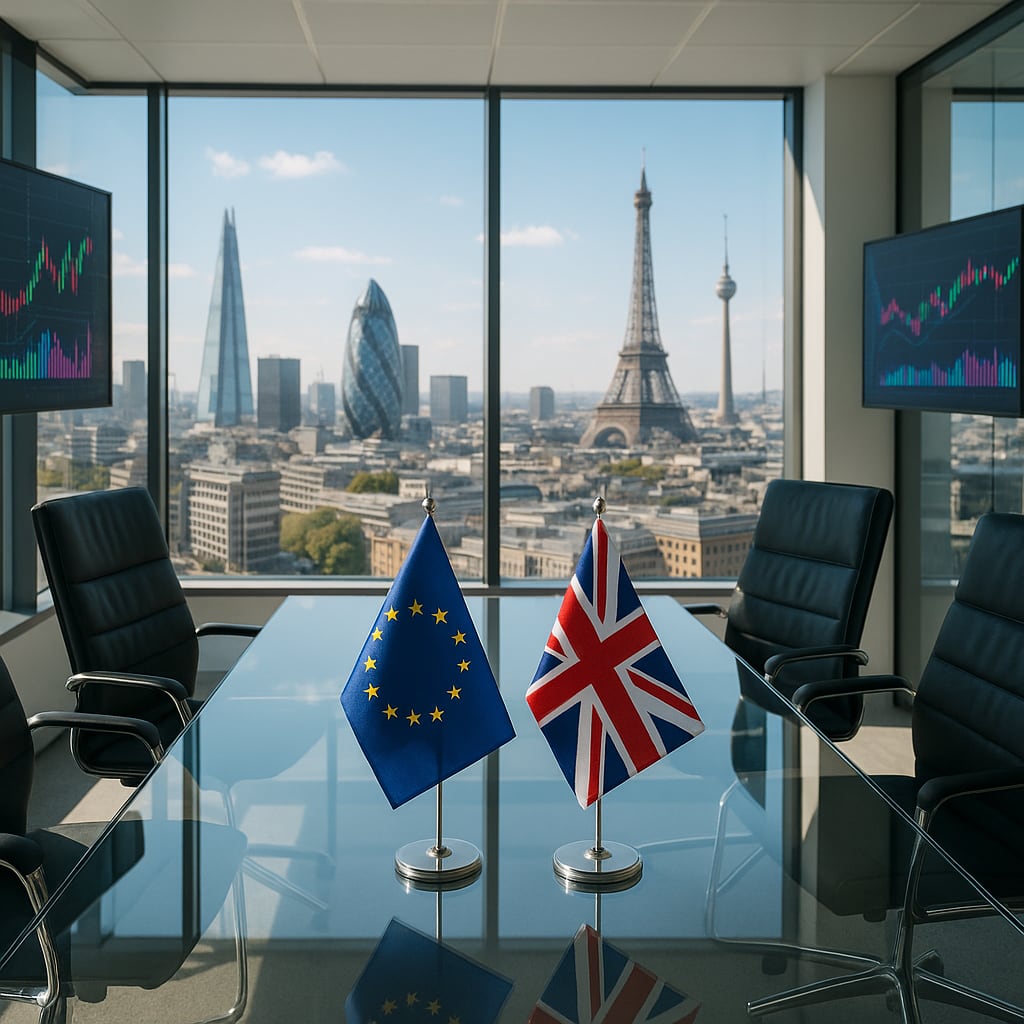
Ten years after the Brexit vote, coverage converges on costs and frictions but diverges on adaptation and the UK’s path back toward Europe
Narrative Snapshot
- Economic baseline: Several outlets emphasize persistent costs and frictions (New York Times on lower trade and investment; the Guardian on consumer-facing expenses; Al Jazeera’s data-led overview), while Le Monde details the City’s post‑Brexit resilience and sectoral growth, and simultaneously notes Paris’s gains without London’s displacement.
- Politics and identity: Le Monde links immigration governance to an identity‑driven nationalist surge benefiting Reform UK’s Nigel Farage, while Italian outlets surface rejoin debates (“Brientro”) and London’s mayor explicitly urges reversing course; the Guardian reports strong pro‑rejoin sentiment among Gen Z.
- Statecraft: Deutsche Welle describes UK–Germany ties strengthening but vulnerable amid leadership change, and Le Monde reports limited results from London’s broader EU rapprochement so far.
- Lived impacts: Reporting spans elderly British residents in Spain struggling with care access, UK farms dependent on Central Asian seasonal workers, and local UK communities revisiting disillusionment a decade on.
What Happened
On 23 June 2016, the UK voted to leave the EU. Subsequent years saw repeated changes of prime minister (ANSA; La Repubblica) and a formal exit that introduced new trade frictions and daily‑life costs, from customs paperwork to roaming and pet‑travel rules (the Guardian). Analysts broadly judge the UK economy smaller than it would have been absent Brexit, due to lower trade and investment (New York Times). Politically, Le Monde highlights how discontent over immigration governance has fed identity‑based nationalism and aided Reform UK’s Nigel Farage. Internationally, ties with Germany are being rebuilt (Deutsche Welle), while London’s effort to tighten relations with Brussels has delivered limited results over two years (Le Monde). Finance adapted unevenly: London rebounded in insurance and fintech (Le Monde), Paris expanded market activities but did not dethrone the City (Le Monde). Human‑level effects range from aging UK expats’ care challenges in Spain (Japan Times) to farms relying on workers from Central Asia (New York Times).
Why It Matters
The reports collectively stress structural consequences for Europe’s political economy. Economic frictions—documented as lower trade and investment (New York Times) and higher consumer transaction costs (the Guardian)—shape regulatory choices around standards, customs, and mobility that now sit outside EU institutional coordination. Financial sector relocation patterns matter for how supervisory regimes and capital‑markets integration evolve: London’s resilience in insurance/fintech and Paris’s partial gains (Le Monde) recalibrate, but do not replace, the City’s systemic role. Diplomatically, UK–EU ties remain constrained despite intent to deepen cooperation (Le Monde), while bilateral channels, notably with Germany, have reopened yet face leadership uncertainty (Deutsche Welle). Domestic politics intersect with foreign policy: identity‑driven nationalism (Le Monde), civic discourse strains (Al Jazeera), and a generational rejoin impulse (the Guardian) bear on mandates for any future re‑engagement. Cross‑border social policy issues—from UK expats’ access to care in Spain (Japan Times) to seasonal labor schemes (New York Times)—require technical fixes outside prior EU frameworks.
Diverging Narratives
Economic assessment converges on a growth penalty (New York Times) and consumer‑level costs (the Guardian; Al Jazeera), yet financial‑sector coverage is more mixed: Le Monde depicts a City that lost EU‑facing activities but then expanded in insurance and fintech, while also noting Paris’s growth in market activities without dislodging London. Political interpretations differ in emphasis. Le Monde foregrounds immigration management as a catalyst for identity nationalism aiding Reform UK’s Farage; Al Jazeera centers the social and political normalization of hateful discourse since 2016. Italian outlets elevate a potential “Brientro” debate (Corriere della Sera) and profile national instability (La Repubblica; ANSA), while Sadiq Khan explicitly advocates rejoining the EU (La Repubblica). In contrast, Le Monde judges the UK’s attempted rapprochement with Brussels to have yielded limited results to date, and Deutsche Welle underscores the fragility of restored ties with Germany amid an impending change of UK prime minister. Lived‑experience reporting amplifies uneven outcomes: the Guardian’s revisited constituencies voice regret or frustration; La Repubblica’s Boston, Lincolnshire reportage echoes disillusionment; the Japan Times and New York Times recount reliance on non‑EU labor and expat care strains that were not central in macro‑economic tallies.
What Happens Next
- UK leadership transition: Deutsche Welle reports that the stability of UK–Germany ties will be tested as Keir Starmer is to be replaced as prime minister. Watch the successor’s stated EU policy, tone with Berlin, and early diplomatic priorities for signals on continuity or retrenchment.
- Scope of UK–EU re‑engagement: Le Monde notes limited progress despite intentions to tighten links. Indicators include concrete technical proposals from London and Brussels, uptake of sectoral agreements, and whether Italian‑press “Brientro” debates and Sadiq Khan’s rejoin advocacy translate into party platforms or parliamentary initiatives (Corriere della Sera; La Repubblica).
- Financial geography: Le Monde’s findings suggest a stable yet shifting equilibrium. Track firm relocations, EU market‑access rules, and UK regulatory changes to gauge whether Paris’s gains consolidate or London’s insurance/fintech edge deepens.
- Labor and social policy: UK agriculture’s dependence on Central Asian seasonal workers (New York Times) and elderly UK expats’ care access in Spain (Japan Times) point to administrative adjustments ahead. Watch visa scheme calibrations, bilateral social‑care arrangements, and local service‑delivery measures.
- Domestic political vectors: Le Monde’s far‑right advance, the Guardian’s Gen Z pro‑rejoin polling, and Al Jazeera’s discourse concerns suggest contested mandates. Monitor polling trends, Reform UK’s performance, and issue salience in local and national campaigns.