
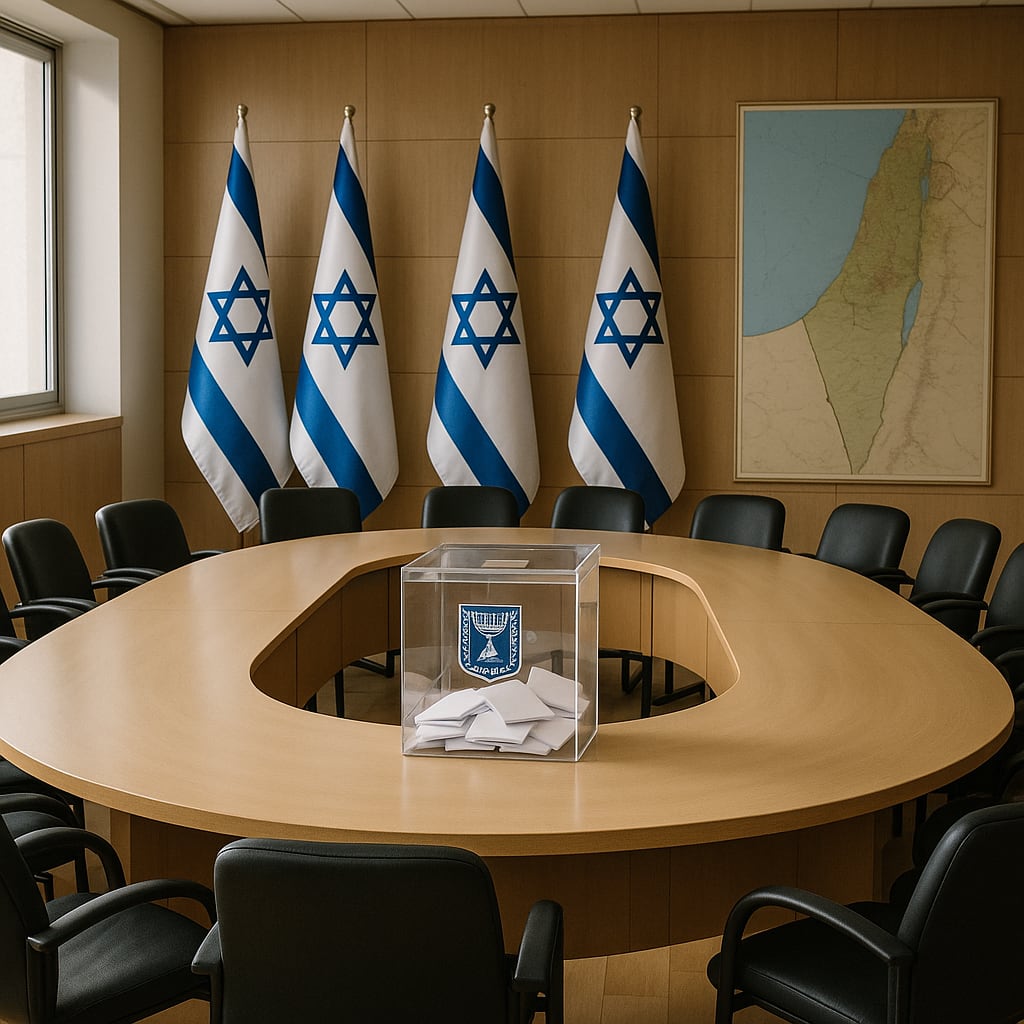
Israel sets October 27 election date as Netanyahu runs again
Narrative Snapshot
Across outlets, there is clear alignment on the basic contours: the Knesset fixed October 27 as the election date, the latest permitted by law, and Prime Minister Benjamin Netanyahu will seek another term. Domestic and wire reporting emphasize the procedural milestone. The Times of Israel notes it will be the first vote held on schedule in roughly four decades and the first government to complete a full term in half a century, while TASS similarly stresses that elections have not occurred on schedule since 1988. That framing puts institutional regularity at the center of the story.
International and regional coverage foregrounds the war context and leadership test. France24 frames the vote as widely seen as a referendum on Netanyahu’s stewardship since the Gaza war began and reports he intends to “win” another term, while Al Jazeera highlights his status as Israel’s longest-serving prime minister and confirms his candidacy. South China Morning Post and Folha de S.Paulo both situate the election in the wake of the Gaza war; Folha extends that frame to concurrent fighting involving Lebanon and Iran, underscoring how foreign-policy stakes are interwoven with the campaign.
The competitive map is portrayed through coalitional arithmetic rather than a single frontrunner. Haaretz reports that Gadi Eisenkot’s Yashar leads Likud by one seat but that Jewish opposition parties remain three seats short of a government absent cooperation with Arab parties—an interpretation consistent with SCMP’s point that both Netanyahu’s camp and the opposition could struggle to secure a majority. Politika and the Japan Times accent candidate lineups and public personas—naming Eisenkot, Naftali Bennett, Yair Lapid, and Avigdor Lieberman as principal challengers and sketching their profiles—reflecting a coverage strand focused on who could capitalize on the moment rather than on institutional timing or the war frame.
A sharper normative register appears in opinion content. Middle East Eye publishes an op-ed arguing that what it terms the Gaza “genocide” has ended “liberal Zionism,” signaling a reading of the electoral context through moral critique of the war. Separate MEE reporting on a name change by Netanyahu’s son draws attention to the personalization of politics around the premier’s family, a feature largely absent from the news-driven accounts elsewhere.
What Happened
Israel’s parliament set October 27 for national elections, the latest date allowed under law, after earlier options had been discussed. The Times of Israel reports the vote will be the first held on schedule in roughly 40 years and that Netanyahu’s government will be the first in about 50 years to complete its full term; TASS likewise notes it is the first on-schedule election since 1988. Netanyahu confirmed he will run again, with France24 quoting him as seeking to “win” another term and Al Jazeera underlining his status as Israel’s longest-serving leader. Polling cited by Haaretz shows Gadi Eisenkot’s Yashar party edging Likud by a single seat, but Jewish opposition parties remain three seats short of a majority without Arab-party cooperation. SCMP adds that surveys suggest both blocs may struggle to assemble a governing majority. Folha emphasizes this will be the first election since the 2023 Hamas attack and ensuing wars in Gaza, Lebanon, and against Iran. Politika and the Japan Times profile Eisenkot, Bennett, Lapid, and Lieberman as main challengers.
Why It Matters
The on-schedule vote and a government completing its full term mark an institutional departure from Israel’s recent pattern of political churn, a point underscored by the Times of Israel and TASS. That procedural regularity intersects with coalition mathematics that Haaretz and SCMP describe as finely balanced: absent cooperation with Arab parties, Jewish opposition lists are several seats short, making cross-bloc bargaining structurally pivotal. France24’s “referendum on leadership” framing and Folha’s linkage to concurrent fighting involving Gaza, Lebanon, and Iran place foreign and security policy at the electoral core, suggesting that the outcome will shape crisis management, deterrence postures, and diplomatic bandwidth. For governments and multilateral actors engaging Israel, the configuration of the next coalition—not merely which party finishes first—will determine negotiating room on wartime policy, the viability of Arab-party inclusion in governance, and the stability of decision-making in a high-tempo regional environment.
Diverging Narratives
Coverage differs less on facts than on emphasis. The Times of Israel and TASS prioritize the procedural milestone of an on-schedule vote and a rare full government term, signaling institutional continuity as the headline development. France24, Al Jazeera, SCMP, and Folha cast the election through the prism of wartime leadership, with France24 calling it widely seen as a referendum on Netanyahu’s conduct of the Gaza war and Folha explicitly situating it amid hostilities involving Lebanon and Iran. On competitiveness, Haaretz offers the most granular polling readout—Yashar narrowly ahead of Likud, but the Jewish opposition three seats shy without Arab-party support—aligning with SCMP’s broader caution that neither bloc appears poised for a straightforward majority. Politika and the Japan Times stress the roster and profiles of challengers, emphasizing who could assemble credibility and coalitions. Middle East Eye’s op-ed advances a normative critique, describing the Gaza war as “genocide” and arguing it has ended “liberal Zionism,” a frame distinct from the institutional and horse-race angles elsewhere; MEE’s separate focus on a personal move by Netanyahu’s son highlights a personalization thread absent from most hard-news accounts.
What Happens Next
The pivotal decision point is coalition strategy. Haaretz’s seat arithmetic positions Arab-party cooperation as a potential hinge for an opposition-led government; if Jewish opposition factions eschew such cooperation, their path remains constrained, whereas engagement could unlock a majority. For Netanyahu, SCMP’s assessment of tight polling implies reliance on disciplined alliance maintenance and turnout to reach 61 seats; defections or fragmentation among traditional partners would complicate that path. Candidate consolidation is another lever: Politika and the Japan Times identify Eisenkot, Bennett, Lapid, and Lieberman as key challengers, and whether any coalesce or coordinate lists will shape post-election bargaining power. Analysts should watch formal slate registrations, pre-election alliance announcements, and explicit statements on Arab-party cooperation. Given France24’s and Folha’s war-centered framing, track how campaigns weight security messaging and how that interacts with public polling trends reported by Haaretz and SCMP, as these cues will signal negotiating positions heading into coalition talks.