
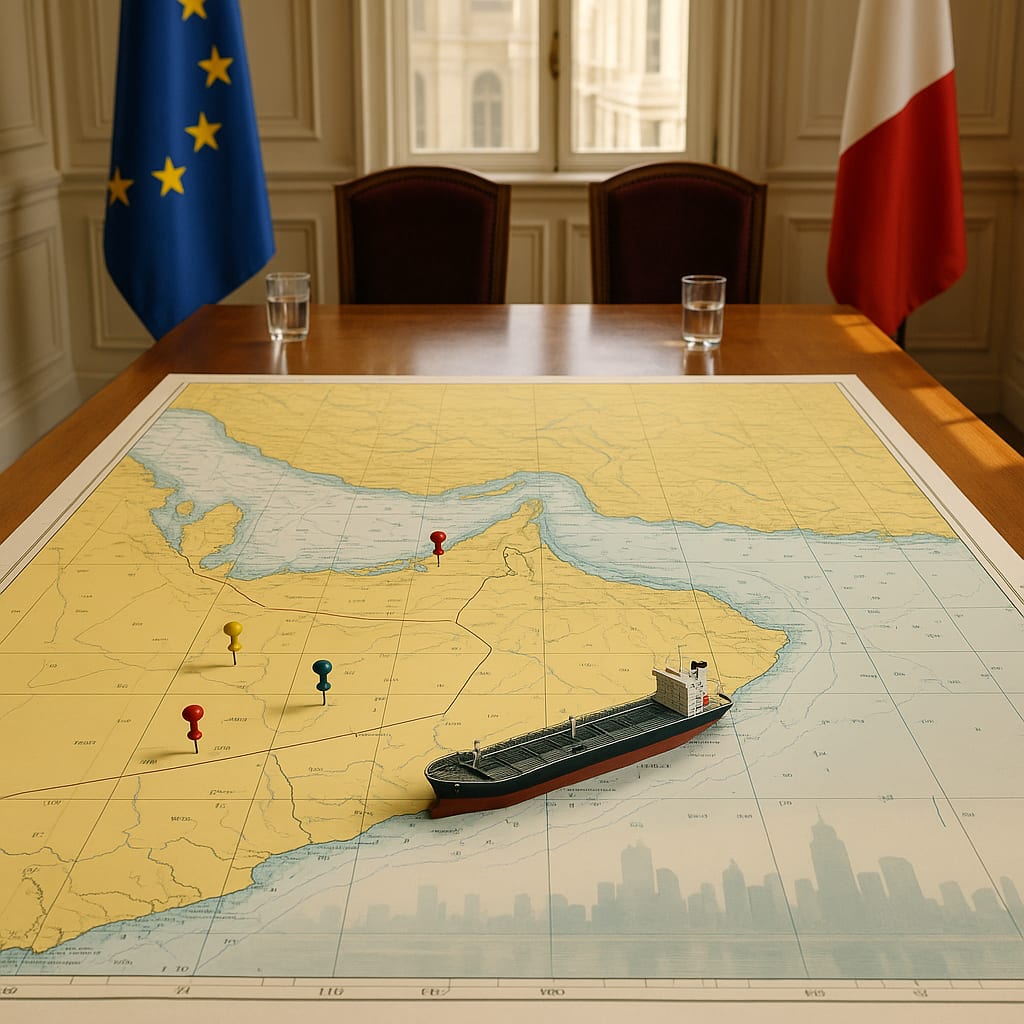
The War That Started With Smoke and Ended at Sea
In late February, two black columns rose above central Tehran. Sirens, then flashes, then the smear of smoke where government buildings should be. Within minutes, the US president appeared in a red baseball cap to declare the start of “major combat operations” and urged Iranians to take over their government. Reporters on the ground counted strikes near the supreme leader’s compound; by the end of the weekend, the death of Ayatollah Ali Khamenei was widely reported. The opening gamble seemed to promise finality. Instead, the first certainties to collapse were the ones about endings.
A Decapitation Strike That Didn’t Decide the War
The immediate shock was real. European outlets parsed the footage frame by frame. Le Monde assembled verified videos to map strikes across Tehran and beyond, confirming hits on multiple sites and the breadth of the operation. An Italian wire carried the first terse image that morning — “Attacco preventivo all’Iran” — and noted the dark plumes above the capital. The Guardian described explosions near the leader’s offices and relayed that Iran was preparing a “crushing retaliation.” Sky News drew a sweeping map of air corridors, missile arcs and carrier groups, while also stating that Khamenei had been killed.
Legal and strategic scaffolding buckled almost as fast as the first buildings. European voices argued the attack violated the UN Charter’s prohibition on the use of force; Deutsche Welle singled out Article 2(4). La Repubblica questioned not just international law, but US constitutional constraints, doubting a president could launch a massive operation without Congress. The label “preemptive,” embraced in Jerusalem and picked up by ANSA, sat uneasily beside the European language of illegality.
Yet the state in Tehran did not fracture along with the cityscape. Iran moved quickly to frame the terms of the counterpunch. Retaliatory strikes landed on US positions in the Gulf. Within days, the fight spilled out of the capital and into a narrow sea.
The Strait Tightens and Prices Rise
The war’s axis rotated from palaces and ministries to cables and anchor chains. The Revolutionary Guard threatened to bottle up the Strait of Hormuz. The price of oil surged past $100 a barrel; American drivers saw pump prices jump 27 cents in a week to an average of $3.25, The Guardian reported, and White House staff scrambled for ways to soften the spike. Hungary wielded the shock as a political cudgel in Brussels, the Kyiv Independent noted, arguing the Iran war proved the folly of sanctions on Russia. In Moscow, Le Monde observed, the Kremlin offered Tehran little more than words — “impotent,” the paper wrote — even as it stood to benefit from dearer hydrocarbons. It was a telling reversal: allies who could not rescue you could still profit from your peril.
The conflict stroked old embers as it lit new ones. In Gaza, where medical evacuations had only just resumed in early February, the Rafah crossing shut as soon as the war with Iran began. Prices spiked inside the enclave, Le Monde reported, and patients who had counted on a thin corridor to Egypt lost it overnight. Further north, the West Bank ran hotter: the BBC cited UN figures to report six Palestinians killed in attacks by settlers since the Iran war began, and the EU and UK publicly demanded Israel rein in the violence.
By mid-March, the sense of quick triumph had dissipated. Le Monde called the US and Israel “piégés” — trapped — by a long asymmetric struggle despite heavy bombardment. Der Spiegel saw something larger break loose, writing that America’s old role as stabilizer had “gone up in smoke” and, later, that the White House had started a war it could no longer end. Meanwhile, in the Red Sea and the Gulf, the United States found itself defending commerce against a country it had tried to decapitate. La Repubblica imagined the worst-case scenario with a blunt headline: “Petrolio a 200 dollari.”
Europe, for its part, refused to be pulled into the fight at sea. As the White House pressed allies to help unblock the strait, Paris spoke of a coalition to ensure free navigation — but only once the shooting stopped. War aims that had been cast in maximalist terms compressed into shipping lanes and insurance rates.
A Fragile Pause and a Vanishing Horizon
On 8 April, the war edged into silence. After late diplomacy from Pakistan, the US and Iran agreed to a two-week conditional ceasefire that included a temporary reopening of Hormuz. European leaders greeted it as “a step back from the brink,” The Guardian reported, and urged that the waterway be fully reopened and that fighting in Lebanon stop. The Israeli military, however, said it would continue operations against Hezbollah. In Washington, the stagecraft of victory met the arithmetic of compromise: Le Monde called the truce a unilateral US acceptance of a pause, a strategic débâcle dressed in celebration, and pointedly noted that the channel had not actually reopened.
The truce brought less clarity than anticipated. BBC editors asked whether the United States had achieved its initial aims: stopping Iran from acquiring a nuclear weapon and degrading its arsenal. Le Monde cataloged forty days of errance stratégique, from a first-week promise of regime change to a mid-April reality of provisional deals and partial blockades.
Even the ceasefire’s quieter weeks re-ordered priorities beyond the Gulf. The BBC sensed it in late March: Gaza’s future grew more uncertain as attention swung to Tehran and Hormuz. Deutsche Welle returned to it in April, observing that the Gaza conflict, though under a separate ceasefire, was stuck between war and peace and fading from international focus. The gate at Rafah stayed shut; the lists of patients waiting for evacuation grew again.
None of this meant the new stillness would hold. It depended, paradoxically, on a platform designed for noise.
Negotiations Under the Siren
In late April, Islamabad hosted indirect talks. They did not produce direct meetings. The ceasefire extended, but without a roadmap. The Guardian described a peculiar impediment: the US president’s running commentary, a “one-man WhatsApp group” of boasts and threats that, even when disavowed in private, forced Tehran to treat words on a screen as positions at a table. On 22 April, Le Monde reported that the truce had been prolonged unilaterally by Washington, without a new deadline and with a rationale that sounded more like wishful thinking: wait for a unified proposal from Iran’s security and political elites.
The signals stayed scrambled. On 11 May, the White House said the ceasefire was on life support and floated renewed naval escorts through Hormuz to crush the blockade. A week later, regional officials told The Guardian that Tehran had put forward a new proposal to end the war, offering or reiterating concessions. On 24 May, the same paper sketched the emerging architecture: a 60-day truce, reopening the strait, and the deferral — not the resolution — of fresh talks on the nuclear programme.
The facts on the water did not wait for signatures. On 26 May, the BBC reported that Iran condemned fresh US strikes as a “gross violation” of the ceasefire — attacks launched while Iranian and Qatari negotiators were in Doha. Two days later, the corporation framed the moment as a fork: edging toward peace or sliding back to war. Neither side, its editors argued, seemed eager to resume total conflict, but the gap between fighting and not-fighting remained wide.
Within Israel, the balance shifted in a way that would have seemed unlikely in February. On 2 June, Le Monde reported that the US president had ordered Israel not to attack Beirut — and, like Gaza and Iran, it was only Washington that could limit Israel’s use of force. That constraint aggravated members of the governing coalition and weakened the prime minister. The war that began as an American-Israeli project had become, increasingly, an American leash.
A Peace That Looks Like the Start
The breakthrough came from the same intermediary who had brokered the first pause. On 14 June, Pakistan’s prime minister announced a tentative peace deal, with a signing ceremony slated for 19 June. Deutsche Welle said both sides would terminate military operations, including in Lebanon. The next day, The Guardian laid out the essence: a return to the prewar status quo. The agreement hinged on shipping and sanctions relief, and delayed nuclear talks. It contained no limits on Iran’s ballistic missiles, made no demands for regime change, and asked for no surrender.
If that sounded familiar, it was because these contours had been on the table for more than a month. The framework of a 60‑day ceasefire, reopening Hormuz and deferring the nuclear file had long been acceptable to Tehran. What changed was not the offer, but the appetite to take it.
The acceptance did not settle the politics. In Israel, the opposition leader Yair Lapid argued that the deal met none of the government’s goals — the regime survived, the missile programme remained, and Iran could rebuild its nuclear capacity. In Washington, The Guardian described fresh objections from Republicans and Democrats alike even as the vice-president hailed progress at direct talks in Switzerland. The US president, for his part, threatened to renew attacks if Iran did not rein in its ally in Lebanon. Deutsche Welle, looking ahead from the 18 June signing, spoke of tough negotiations to come and bright red lines still standing.
The choices made in the weeks after the first strikes had their own inertia. Gaza had not returned to the centre of the frame in Western capitals; Rafah’s closure at the start of the Iran war broke an already narrow medical corridor, and months later Deutsche Welle still described the conflict there as suspended between outcomes. In the West Bank, where the BBC had noted six Palestinians killed by settlers amid the Iranian war’s opening weeks, international attention had yet to coalesce into leverage. Europe’s preferred role, asserted since March — press for shipping to flow, decline to join combat, argue legalities and restraint — was now embedded in a civilian agenda for the Gulf.
And then there was the strait itself, the war’s unlikely protagonist. From the day Europeans called for its reopening in April to the June outlines of an agreement that placed it at the centre, Hormuz had been the hinge between the battle that began with a collapsed roof in Tehran and the compromise that followed. The new arrangement promised tankers to move and sanctions to ease, but also conceded that the core dispute — missiles on land and nuclear limits on paper — would have to wait.
As the Pakistani leader announced the date for the ceremony and Swiss negotiators decamped for another round, the narrow channel between the Persian Gulf and the ocean held the line of the war in its geometry: two lanes in, two lanes out, and pilots waiting for the order that would let the first ship pass.