
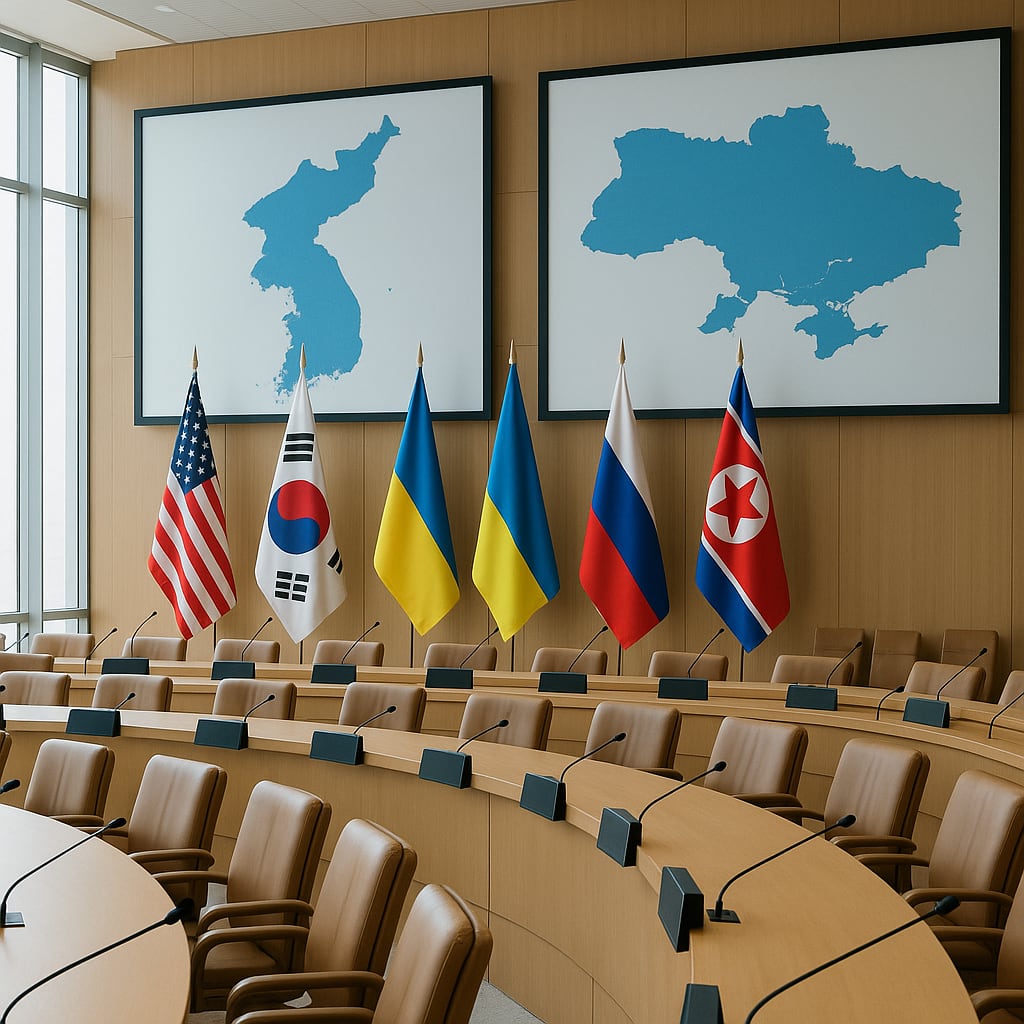
Zelensky warns of expanded North Korean support to Russia as U.S.–South Korea drills adjust and Seoul weighs arms constraints
Narrative Snapshot
Across outlets, Zelensky’s assertions anchor the story, but the evidentiary posture varies. Western and Ukrainian reporting foregrounds his warnings that Pyongyang is sending more ballistic missiles and could deploy up to 50,000 troops to Russia, with Ukraine framing the development as both a battlefield and strategic learning opportunity for North Korea. France24 notes he offered no sourcing for the troop figure, while the Kyiv Independent amplifies his claim that Russia “cannot wage war without supplies from North Korea.”
Asian and regional coverage pivots to the policy and operational implications for Seoul and Washington. The Bangkok Post reports next week’s allied exercises will explicitly simulate combat against North Korean units hardened by a Russia–Ukraine deployment. The South China Morning Post and TASS, from different vantage points, emphasize South Korea’s legal and political constraints on transferring arms to Ukraine, even as Zelensky urges air defense support and Kyiv signals openness to broader cooperation with Seoul via Ukrinform. Latin American and European live updates, including Clarin and Corriere della Sera, situate these moves against a backdrop of continued missile threats and routine North Korean denunciations of allied drills.
What Happened
Kyiv says North Korea’s role in Russia’s war is expanding. The Japan Times reported that, according to Ukraine, a North Korean missile unit has deployed in Russia, building on what it described as years of North Korean ballistic missile use by Moscow. President Volodymyr Zelensky subsequently warned that up to 50,000 North Korean troops could be sent to Russia and that Pyongyang is gaining battlefield experience and technology by aiding Moscow; France24 noted he did not provide sourcing for the troop estimate. Ukrinform and the Kyiv Independent quoted Zelensky urging coordinated action to stop North Korea from testing or expanding its involvement and asserting Russia’s dependence on North Korean supplies. In response to the shifting threat, the Bangkok Post and Clarin report the United States and South Korea will conduct 11 days of drills next week simulating combat with battle-hardened North Korean forces. TASS and the South China Morning Post highlight Seoul’s maintained stance against supplying weapons to Ukraine under domestic law, despite Kyiv’s requests for air defenses.
Why It Matters
The coverage traces a tightening feedback loop between the European and Indo-Pacific security theaters. If North Korea gains live-combat experience and technology insights through support to Russia, as Zelensky argues via Ukrinform and France24, it could recalibrate the military balance around the Korean Peninsula—an assessment already shaping U.S.–South Korea exercises, per the Bangkok Post. At the same time, South Korea’s export controls and legal limits on arming countries at war, underscored by TASS and examined by the South China Morning Post, constrain Kyiv’s options to offset Russian strikes and complicate allied burden-sharing. The result is a policy squeeze: Ukraine appeals for air defense capacity while Seoul weighs its laws, its own force readiness, and potential blowback with Moscow. The episode highlights how wartime supply chains, alliance planning, and arms-transfer norms interact under pressure, with decisions in one theater reverberating in another.
Diverging Narratives
The largest factual uncertainty lies in the scale and form of North Korea’s on-the-ground role. The Japan Times attributes to Kyiv the claim that a North Korean missile unit has deployed in Russia, while France24 emphasizes that Zelensky did not disclose sources for his statement that as many as 50,000 North Korean soldiers could be sent. Politika’s headline language mirrors the upper-bound figure but frames it through Zelensky’s warnings, leaving open whether an agreement exists or whether this is a Ukrainian assessment. Separately, the Kyiv Independent conveys Zelensky’s assertion that Russia is uniquely reliant on North Korean supplies, a point meant to signal vulnerability but not independently corroborated in these reports.
On the policy side, reporting diverges in emphasis rather than fact. TASS stresses that Seoul remains committed to not supplying weapons to Ukraine under its domestic law, while the South China Morning Post explores why Kyiv’s air defense request tests those limits and could further strain ties with Russia. The Bangkok Post and Clarin treat the upcoming U.S.–South Korea drills as a concrete adaptation to the possibility of “battle-hardened” North Korean units, while noting Pyongyang’s habitual portrayal of such exercises as invasion rehearsals. Together, the accounts agree on rising interaction between the wars but differ on verification, scale, and the levers available to constrain it.
What Happens Next
Key decisions will turn on Seoul’s interpretation and application of its arms export rules. If South Korea maintains its current stance against weapons transfers to Ukraine, as stated to TASS and analyzed by the South China Morning Post, Kyiv will need to pursue alternative suppliers while focusing bilateral ties with Seoul on non-lethal support or political coordination. If Seoul reconsiders aspects of air defense support, SCMP suggests officials will balance legal constraints, domestic defense needs, and the risk to relations with Moscow; observable signals would include revised guidance from South Korean ministries or tailored export licenses.
On the military track, the U.S.–South Korea exercises flagged by the Bangkok Post and Clarin will indicate how far allied planning assumes North Korean combat experience from Ukraine. Analysts should watch exercise scenarios, public after-action messaging, and any adjustments to readiness postures. On the Russia–North Korea axis, validation or refutation of Kyiv’s claims—through official confirmations, battlefield evidence of North Korean troops, or continued identification of North Korean missiles used by Russia, as framed by the Japan Times and the Kyiv Independent—will shape subsequent diplomatic and sanctioning responses Zelensky is urging via Ukrinform.