
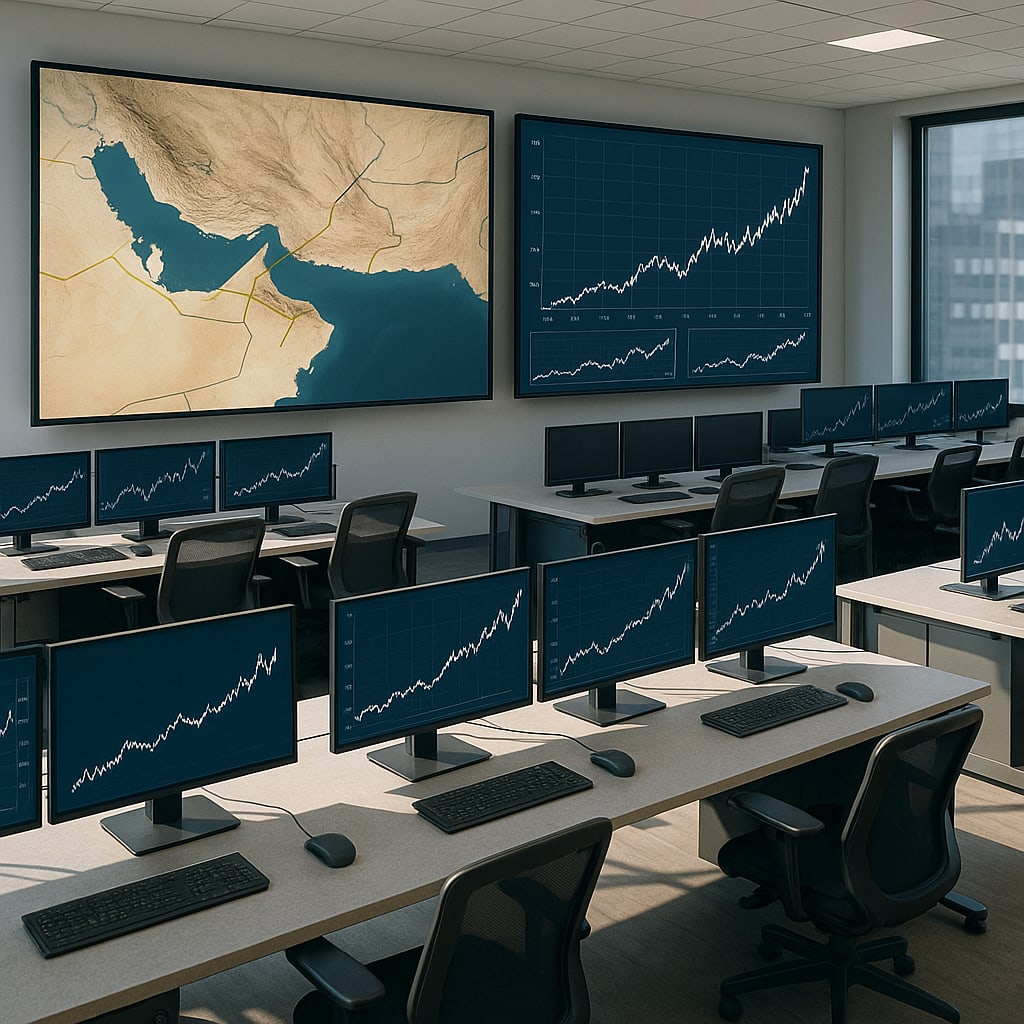
Oil majors’ profits surge as Gulf export disruption lifts prices; BP doubles, Aramco up 33%
Narrative Snapshot
Across outlets, the through line is clear: higher benchmark prices linked to war-related disruptions in the Gulf are buoying earnings across both international and state-owned producers. British and Middle Eastern coverage converges on BP’s outsize quarter, while U.S. reporting foregrounds Saudi Aramco’s adaptation to maritime risk. Spanish-language reporting widens the aperture to consumer consequences, linking corporate windfalls to higher fuel costs.
Where they diverge is in framing and operational detail. Middle East Eye explicitly characterizes the conflict as a US-Israeli war on Iran, while the Guardian uses the broader “Middle East crisis” formulation. Al Jazeera centers the closure of the Strait of Hormuz; the New York Times stresses “disruptions” and documents how Aramco worked around them via pipelines. That difference matters analytically: it distinguishes between full chokepoint closure versus partial or intermittent impediments managed through onshore capacity.
What is at stake is not only profit distribution but the resilience of global energy logistics. The New York Times points to infrastructure-led risk mitigation by a national champion. Clarin highlights downstream costs and the political optics of concentrated gains, noting criticism of U.S. energy firms. Together, the coverage delineates a policy problem set that spans maritime security, pipeline redundancy, and domestic legitimacy amid price spikes.
What Happened
BP reported $5.73bn in profits for the quarter ending in June 2026, more than doubling from the previous quarter and reaching its highest level since the first year of Russia’s war on Ukraine, according to the Guardian. The paper links the result to oil and gas price increases driven by the Middle East crisis and continued disruption of Gulf energy exports; it also notes Shell has posted its second-highest quarterly earnings on record. Middle East Eye similarly attributes BP’s gains to rising prices amid what it describes as a US-Israeli war on Iran, adding that U.S. President Donald Trump criticized major oil companies for “making too much money.” The New York Times reports Saudi Aramco’s quarterly profit rose 33 percent, crediting higher prices and the company’s use of pipelines to work around Strait of Hormuz disruptions. Al Jazeera frames record profits across Big Oil as the Strait remains closed. Clarin reports record gains among Europe and Middle East majors, alongside higher fuel costs for consumers.
Why It Matters
These reports collectively underscore the strategic centrality and fragility of the Strait of Hormuz and the value of redundancy outside maritime chokepoints. The New York Times’ account of Aramco using pipelines illustrates how state-backed infrastructure can cushion export flows when sea lanes are degraded, a capability that differentiates producers under stress. Al Jazeera’s emphasis on the strait’s ongoing closure, alongside the Guardian’s and Middle East Eye’s focus on export disruption, highlights systemic exposure to conflict near critical nodes.
Domestic politics and consumer welfare also surface as constraints. Middle East Eye cites President Trump’s criticism of oil company profits, and Clarin links corporate windfalls to elevated fuel costs and scrutiny of U.S. energy firms. That combination points to policy pressure on pricing and profit-taking during crises. For governments and multilateral actors, the coverage signals a dual agenda: securing flows through or around chokepoints, and managing domestic fallout from price transmission.
Diverging Narratives
Outlets differ on the severity and character of the supply shock. Al Jazeera states the Strait of Hormuz “remains closed,” presenting a hard constraint that helps explain record profits across Big Oil. The New York Times, by contrast, describes “disruptions” and emphasizes Aramco’s pipeline workarounds, implying that at least some Gulf crude can bypass maritime bottlenecks. The Guardian and Middle East Eye align on export disruption as the operative market driver but vary in conflict framing: the Guardian situates it within a generalized Middle East crisis, while Middle East Eye specifies a US-Israeli war on Iran.
They also diverge on who bears emphasis. The Guardian anchors the corporate ledger, highlighting BP’s jump and Shell’s near-record tally, whereas Clarin places consumer costs and political criticism in the foreground, particularly in the United States. Middle East Eye surfaces presidential rhetoric against oil-company profits, sharpening a narrative about windfalls amid wartime scarcity that is less prominent in the New York Times’ operational detail on Aramco. These emphases shape different policy takeaways: supply-chain resilience for some, distributive and affordability issues for others.
What Happens Next
Two inflection points dominate the forward path. First is the status of the Strait of Hormuz. If conditions remain as Al Jazeera describes—closed—sustained reliance on onshore and alternative routes becomes decisive; the New York Times’ reporting on Aramco’s pipeline use indicates how producers with such capacity can maintain flows. If maritime conditions shift toward the “disruptions” the Times describes, watch whether rerouting eases or tightens, and how quickly export volumes respond.
The second is political response to profit concentration and consumer costs. Middle East Eye notes President Trump’s criticism of oil-company earnings, and Clarin reports broader U.S. scrutiny alongside global fuel-price pressure. Analysts should track whether this rhetoric consolidates into concrete measures or remains signaling, and whether European and Middle Eastern majors’ subsequent disclosures—such as results akin to Shell’s near-record quarter noted by the Guardian—amplify or diffuse calls for intervention.