
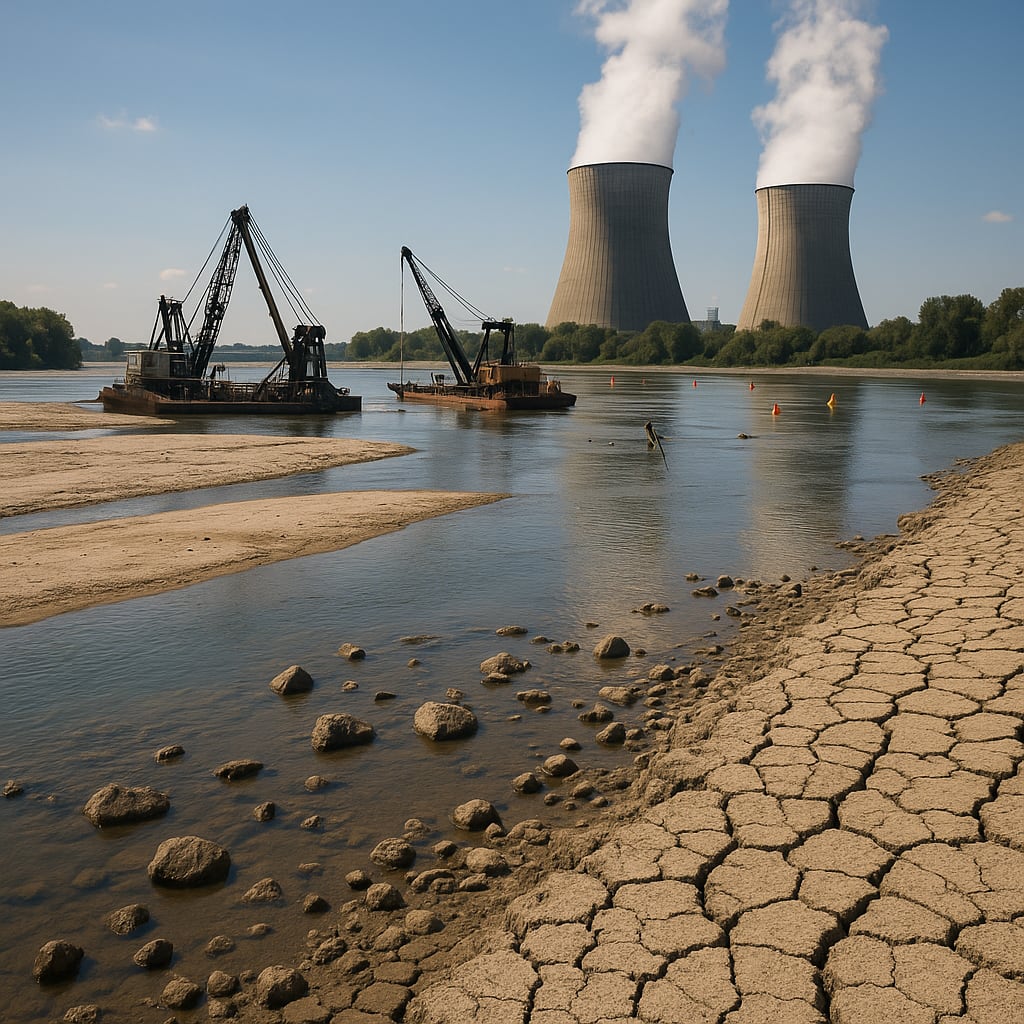
Romania detonates Danube riverbed to sustain Cernavoda cooling as drought curtails Danube‑cooled reactors in Hungary and Romania
Narrative Snapshot
Across outlets, there is broad agreement that Romania’s military intervention on the Danube was an emergency hydrological measure to preserve cooling water for the Cernavoda Nuclear Power Plant amid record-low flows. Italian and Spanish-language coverage foregrounds operational specifics: Corriere della Sera reports the Danube’s discharge near 1,550–1,600 cubic meters per second and that the emergency remains unresolved, while Clarín adds that 180 kilograms of explosives were used and that Cernavoda produces roughly 20% of Romania’s electricity. Al Jazeera and Deutsche Welle concur on the basic facts of an underwater demolition to redirect water.
Where outlets diverge is on the scale and immediacy of the parallel Hungarian crisis. Deutsche Welle cites Paks operating at about 10% capacity for lack of cooling water, while Al Jazeera reports officials preparing to shut it down. South China Morning Post goes further, saying Hungary fully closed its sole nuclear plant on August 2, whereas the Guardian the next day reported Budapest might “eke out” two more days from its only atomic facility. Telesur quotes Prime Minister Péter Magyar warning the “most critical five days” and a potential shutdown lasting over a month.
The stakes are framed variously. The Guardian links first-time Danube-cooled reactor shutdowns to an emerging regional energy crunch and notes Romania’s August-long nationwide state of emergency tied to declining electricity output. RT widens the lens to river-borne trade, describing Rhine and Danube constraints that compound industrial and energy pressures. CGTN situates the episode within Europe’s record heat, drought, and wildfire season, reinforcing a climate-exposure narrative that spans energy, transport, and public safety.
What Happened
Romanian naval forces executed a controlled underwater blast to remove a rock outcrop in the Danube and steer more flow toward the Cernavoda Nuclear Power Plant’s intake, a step multiple outlets describe as intended to secure cooling water for the site’s remaining operating reactor. Clarín reports the Army used 180 kilograms of explosives; La Repubblica and the Guardian both characterize Cernavoda as down to its last functioning unit. Corriere della Sera notes that, despite the operation’s success, the Danube’s flow has fallen to roughly 1,550–1,600 cubic meters per second and the emergency persists. In parallel, Hungary’s Paks plant has been variously reported as drastically curtailed—about 10% of capacity per Deutsche Welle—planned for shutdown per Al Jazeera, or fully shut on August 2 per South China Morning Post, with the Guardian and Telesur describing only days of margin and warnings from Prime Minister Péter Magyar.
Why It Matters
The episode underscores how Europe’s heat- and drought-driven hydrological stress directly constrains thermal power generation that depends on river cooling. CGTN chronicles record heat, precipitation shortfalls, and elevated wildfire risk across multiple EU states, while RT highlights river bottlenecks disrupting industrial corridors along the Rhine–Danube system—an intersection where electricity supply, heavy industry, and logistics are jointly exposed. The Guardian links the Danube’s low water to unprecedented reactor curtailments and a Romanian nationwide state of emergency through August, indicating that climate-linked water scarcity is now a system-level energy security variable. For decision-makers, the measures Romania and Hungary are taking—underwater demolition, contemplated barge-sinking to shape flow, deep curtailments at Paks—signal a shift toward crisis-time river engineering and load management that will test regulatory limits on reactor operations, cross-border water coordination on the Danube, and contingency planning for prolonged low-flow periods.
Diverging Narratives
Accounts of Hungary’s reactor status differ over a short time window. Deutsche Welle reports Paks at roughly 10% output due to insufficient cooling water; Al Jazeera says officials planned to shut the plant; South China Morning Post reports a full closure on August 2; and the Guardian the following day cites hopes of two more days of generation. Telesur provides the longest-duration risk framing, quoting Prime Minister Péter Magyar that a shutdown could extend beyond a month. These differences reflect rapidly evolving conditions and reporting cutoffs rather than clear factual contradiction.
On Romania, all outlets agree on the explosion’s purpose and execution, but they vary on operational detail. La Repubblica and the Guardian stress that only one reactor remains online, while Politika reports one reactor “not operating smoothly” and adds a prospective measure—sinking barges to further redirect flow—not present in most English-language coverage, along with the observation that water levels at Cernavoda had not further decreased. Corriere’s emphasis that the emergency remains open, despite a successful blast, contrasts with shorter dispatches that focus narrowly on the intervention. More broadly, CGTN and RT embed the story in pan-European climate and logistics stress, whereas Western European outlets center immediate nuclear and power-system risks.
What Happens Next
Two decision points are explicit in the reporting. First, Romania’s choice of additional hydrotechnical measures—Politika notes plans to sink barges—will hinge on whether the Danube’s discharge near Cernavoda stabilizes after the blast, as Corriere cautions the emergency persists. Analysts should watch official updates on reactor status at Cernavoda, water-gauge readings, and any military or civil-engineering advisories on further flow-shaping steps.
Second, Hungary’s operational posture at Paks remains fluid. Signals range from severe curtailment (Deutsche Welle) to reported full shutdown (South China Morning Post), with the Guardian and Telesur indicating only days of margin and the risk of a multiweek outage. Key indicators include government communiqués on reactor availability, grid-balancing measures, and water-level thresholds on the Danube. Regionally, CGTN’s depiction of ongoing heat and drought suggests that the persistence or easing of meteorological conditions will determine whether these emergency measures transition into longer-duration constraints on river-cooled generation and associated industrial transport along the Danube, as highlighted by RT.