
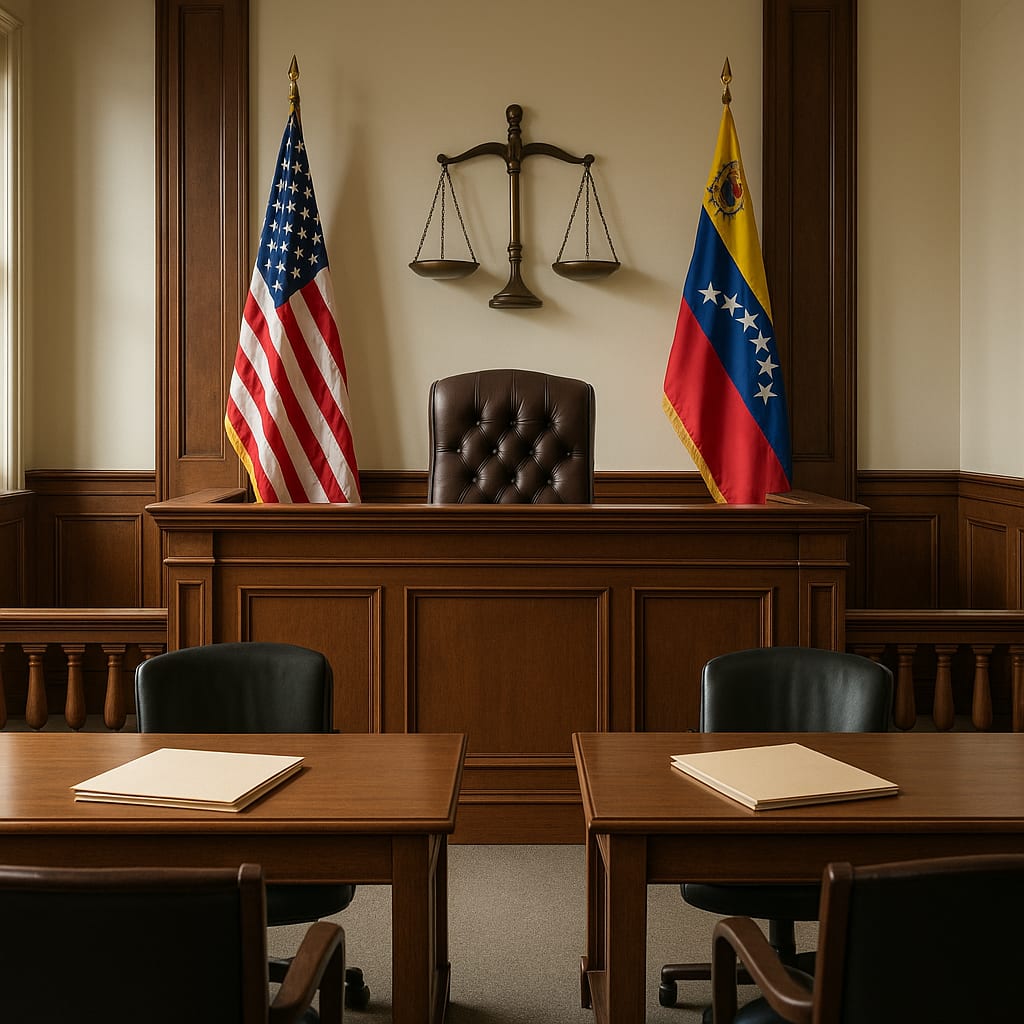
US judge sets June 1, 2027 trial for Venezuela’s Maduro and Cilia Flores
Narrative Snapshot
Across outlets, there is broad agreement on the immediate procedural outcome: a US federal judge in Manhattan has fixed June 1, 2027 as the start of Nicolas Maduro and Cilia Flores’s trial, following a brief hearing to set the schedule. Coverage converges on the defendants’ detention in a Brooklyn jail, their not-guilty pleas, and the defense’s plan to challenge the case on sovereign immunity and legality-of-capture grounds before any trial proceeds.
The accounts diverge most visibly in how they label Maduro and how they characterize the January operation that brought him to New York. Some describe him as Venezuela’s president, while others call him ousted, former, or deposed. The operation is variously termed a military raid, forcible seizure, capture, or, by pro-Maduro sources, a kidnapping. Outlets also differ in emphasis: several stress prosecutors’ allegations that the Venezuelan state enabled drug smuggling, while others foreground the defense’s immunity strategy and the street mobilization in support of Maduro at home and outside the New York courthouse. A few frame the case’s significance in superlative terms, highlighting its potential consequences for US legal and foreign policy practice.
What Happened
A US District Court judge in Manhattan scheduled the trial of Nicolas Maduro, 63, and his wife Cilia Flores, 69, to begin on June 1, 2027, after a short hearing to set the timetable. Both defendants, held in a Brooklyn jail since US forces seized them in a January military operation in Caracas and transported them to New York, have pleaded not guilty. Prosecutors accuse Maduro of using Venezuelan state power to protect and promote drug smuggling; charges include drug trafficking and firearms offenses. The defense indicated it will first move to dismiss on sovereign immunity grounds and challenge the legality of the military operation, a step positioned as potentially case-dispositive if successful. Reports note it was the couple’s third court appearance; some add that lawyers on both sides had sought a June 2027 window. Pro-Maduro media highlighted rallies in Caracas and outside the courthouse.
Why It Matters
The case places US criminal process at the intersection of contested sovereignty, head‑of‑state immunity, and extraterritorial law enforcement. The defense’s stated plan to seek dismissal on sovereign immunity and to contest the legality of the January military operation positions the court to address whether and how a US prosecution can proceed against a foreign leader brought to US jurisdiction by force. That question carries significance beyond this case, as outlets underscore by calling it one of the most consequential recent US criminal proceedings. The prosecution’s theory—that the machinery of a sovereign state was used to facilitate drug trafficking—raises issues about accountability when alleged criminal activity is intertwined with official authority. For governments and multilateral bodies, the dispute tests norms on use of force and immunities against the imperatives of transnational crime control, and could influence how states calibrate cooperation, sanctions, and law enforcement when political legitimacy is contested.
Diverging Narratives
Language choices signal competing frames. Some outlets refer to Maduro as Venezuela’s president, while others identify him as ousted, former, or a deposed dictator. Descriptions of the January action range from “military raid” and “forcible seizure” to “captured” and, in pro‑government Venezuelan media, “kidnapped,” reflecting sharply different views on legality and legitimacy. Coverage also splits on what to foreground: Deutsche Welle highlights prosecutors’ contention that Maduro used state power to abet smuggling, reinforcing the gravity of the alleged conduct. By contrast, Telesur emphasizes the defense’s forthcoming sovereign‑immunity motion and mass demonstrations marking 200 days since his seizure, centering claims of unlawful capture and political support. Procedural nuance appears in TASS and CGTN reports that both sides had requested a June 2027 timeframe and that the hearing lasted about 15 minutes, while The Guardian, The Hindu, and others stress continued defense objections to the US military operation and the couple’s ongoing detention in Brooklyn.
What Happens Next
The next inflection point is the defense’s anticipated motion to dismiss based on sovereign immunity and to challenge the legality of the January operation. If the court accepts sovereign‑immunity arguments, counsel for Maduro has indicated he would not need to continue litigating the case; if rejected, proceedings track toward the June 1, 2027 trial date set at a hearing that both sides requested for that timeframe. Analysts should watch for the court’s framing of head‑of‑state immunity for a leader described variously across outlets, and for how it treats the manner of apprehension. Continued references by multiple sources to the military nature of the seizure suggest that judicial handling of that issue will be dispositive for scope and timing of pretrial litigation. Outside the courtroom, demonstrations cited by pro‑Maduro media may not alter legal outcomes but will shape the political environment surrounding the case as deadlines fixed by the new schedule approach.