
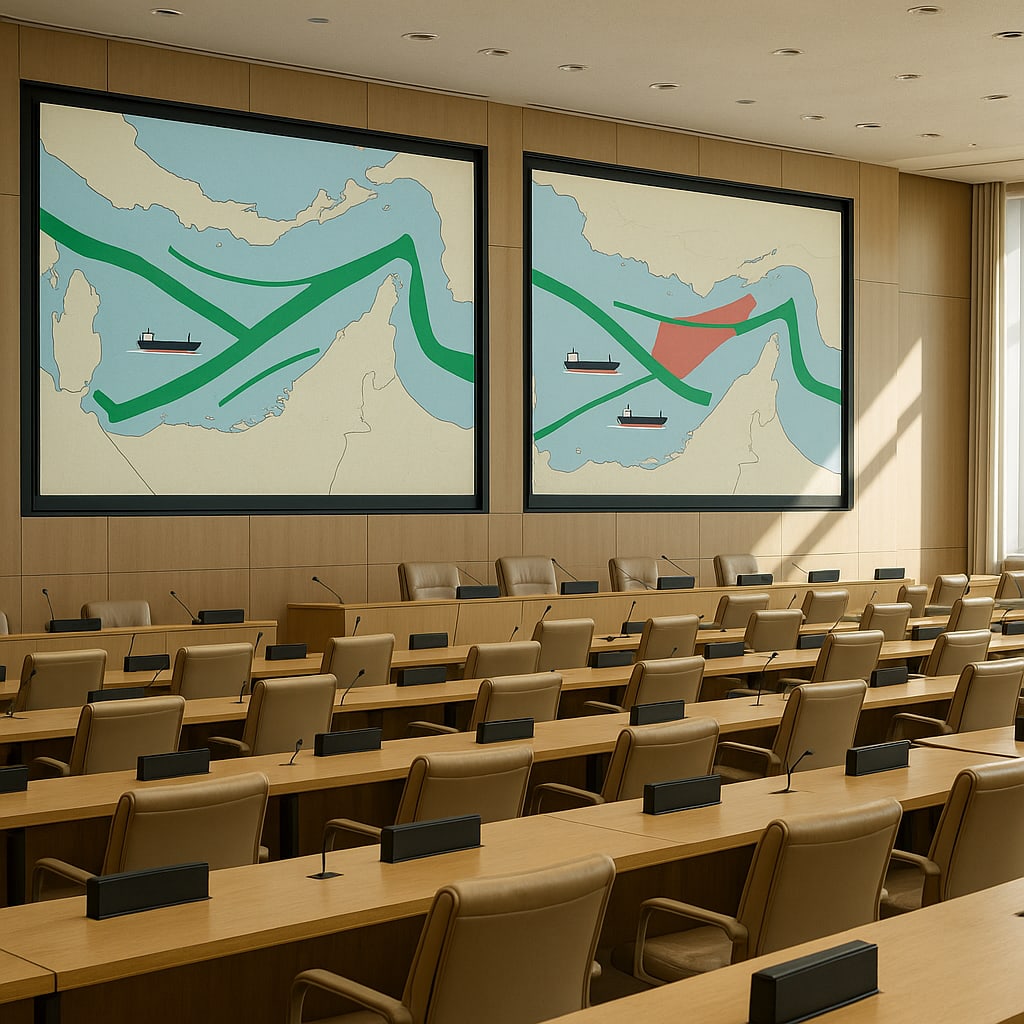
Hormuz shipping inches back but remains high-risk as carriers, unions, and Iran project conflicting control
Narrative Snapshot
- Risk consensus, recovery disagreement: Labor and industry keep Hormuz under “warlike” conditions even as oil throughput rises and some vessels exit. Unions (and The Hindu) stress persistent danger; energy flow trackers and selective departures suggest partial normalization.
- Control narratives diverge: Iranian state media emphasizes routing authority and “unapproved” transits; maritime trackers counter with vessel-level data, and international framing views Hormuz as a global waterway.
- Industry implications escalate: Major carriers report multi-month disruption and warn that acquiescing to new passage conditions or charges could set precedents affecting other chokepoints.
- Security posture in flux: U.S. basing debates underscore shifting protection dynamics for sea lanes, with potential tradeoffs between survivability and rapid response.
What Happened
Thailand’s foreign ministry said 10 of 11 Thai-flagged or Thai-chartered ships stranded since late February have exited the Strait of Hormuz; one vessel (Hatthaya Naree) remains pending cargo operations (Middle East Eye, 1 Jul). Traffic data show ongoing but depressed activity: Kpler verified 34 crossings on 1 July and Windward AI recorded 42 on 30 June, well below a recent 70 in a day (Middle East Eye, 2 Jul). Unions kept Hormuz classified as a Warlike Operations Area through 9 July after late-June attacks halted a UN-led evacuation plan (Middle East Eye, 2 Jul; The Hindu, 1 Jul). Iran’s state TV reported a foreign container ship ran aground on a route it did not approve (South China Morning Post, 1 Jul); TankerTrackers identified the ship as Arista and said it has been stuck since March (Middle East Eye, 2 Jul). CMA CGM reported multiple vessels still stuck and forecast months to normalize (Middle East Eye, 1 Jul; Corriere della Sera, 2 Jul). Oil flows via Hormuz rose to about 10 million bpd, with 5 million bpd moving on alternative routes (TASS, 1 Jul). Hapag-Lloyd warned of a “new normal” and Windward AI flagged resumed crude movements from Kharg Island (Fox News, 28 Jun).
Why It Matters
The situation tests norms governing transit through international straits and the balance between coastal-state controls and global navigation rights. Continued “Warlike Operations Area” status sustains elevated labor protections and operating constraints for carriers, shaping routing, insurance, and crewing decisions (Middle East Eye, 2 Jul; The Hindu, 1 Jul). Carriers’ warnings that months are needed to normalize—and concern about accepting passage conditions or tolls—signal the potential diffusion of bespoke controls across chokepoints if precedent is set (Corriere della Sera, 2 Jul). Energy security is under stress but showing adaptation: oil shipments through Hormuz have rebounded while alternative routes shoulder substantial volumes (TASS, 1 Jul). U.S. deliberations on dispersing Gulf basing could alter the tempo and character of maritime security assistance that underpins commercial risk calculus in the waterway (Fox News, 2 Jul).
Diverging Narratives
- Authority and legal framing: Iranian state media’s emphasis on “unapproved” routing and a grounded foreign ship communicates enforcement authority; SCMP contextualizes that the world has long treated Hormuz as an international waterway (South China Morning Post, 1 Jul). TankerTrackers’ claim that the cited ship has been immobile since March complicates Tehran’s narrative about recent routing violations (Middle East Eye, 2 Jul).
- Operational picture: Throughput data indicate partial recovery—10 million bpd via Hormuz plus 5 million bpd via alternatives (TASS, 1 Jul) and resumed Kharg liftings (Fox News, 28 Jun)—while vessel-count metrics show transits still below pre-war levels (Middle East Eye, 2 Jul). At the firm level, CMA CGM reports several ships still stuck and projects months to normalize (Middle East Eye, 1 Jul; Corriere della Sera, 2 Jul), contrasting with Thailand’s successful vessel departures (Middle East Eye, 1 Jul).
- Risk horizon: Hapag-Lloyd’s “new normal” characterizes persistent operational uncertainty (Fox News, 28 Jun), aligned with unions’ extension of warlike status (Middle East Eye, 2 Jul; The Hindu, 1 Jul), even as selective breakouts from the Gulf occur.
What Happens Next
- Labor risk designation: The ITF/JNG decision due by or after 9 July will shape crewing, routing, and cost structures. Extension would reinforce caution; a downgrade could prompt incremental return of traffic (Middle East Eye, 2 Jul; The Hindu, 1 Jul).
- Carrier operating postures: CMA CGM expects a multi-month path to normal; Hapag-Lloyd frames conditions as a “new normal.” Watch carrier advisories, re-routing patterns, and the status of stuck vessels for signals of operational stabilization (Middle East Eye, 1 Jul; Corriere della Sera, 2 Jul; Fox News, 28 Jun).
- Security guarantees: Pentagon consideration of dispersing Gulf basing may affect protection of shipping lanes and surge capacity. Monitor U.S. posture announcements and coalition maritime coordination for indications of escort or presence adjustments (Fox News, 2 Jul).
- Passage conditions and precedent: Industry concern about accepting new passage conditions or tolls could crystallize into policy positions. Track any formal coastal-state requirements and whether major lines comply or resist, given Saadé’s warning on precedent across straits (Corriere della Sera, 2 Jul).
- Throughput and incident indicators: Daily Kpler/Windward AI crossings and any new attacks or detentions will determine whether partial recovery consolidates or reverses (Middle East Eye, 2 Jul; Fox News, 28 Jun).