
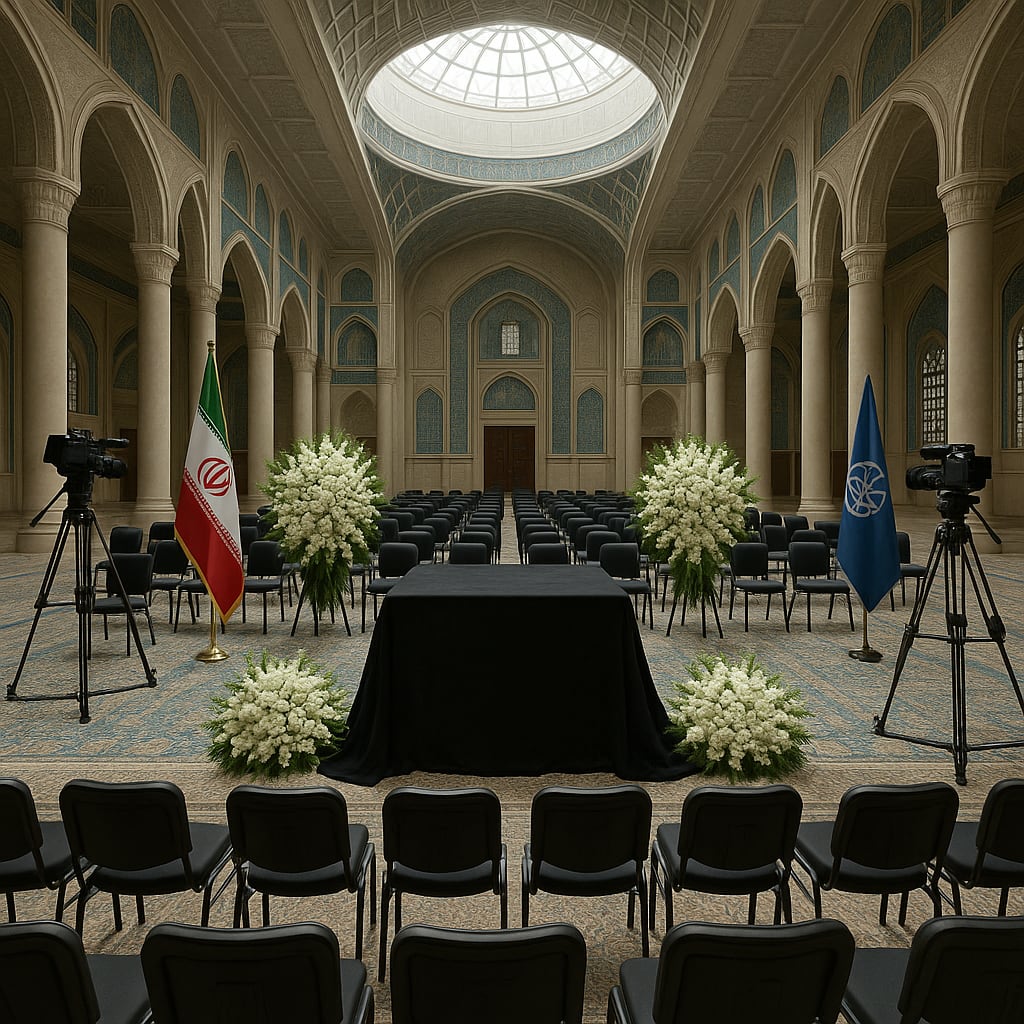
Iran begins multi-day state funeral for Ayatollah Ali Khamenei in Tehran
Narrative Snapshot
- Across outlets, there is convergence on the scale and choreography: large crowds at Tehran’s Grand Mosalla, a multi-day, multi-city program, and state-declared closures to maximize turnout (BBC; DW; Le Monde; NYT; Al Jazeera; The Hindu; CBC).
- Emphasis diverges on meaning: Iranian and pro-government outlets foreground martyrdom, loyalty, and continuity themes (Tehran Times; Al Jazeera), while several European outlets frame the events as a calibrated show of political strength and propaganda (La Repubblica; Corriere della Sera).
- Crowd-size claims vary markedly, from “thousands” to “hundreds of thousands,” with some projecting “millions” over the week (TASS; Middle East Eye; DW; NYT; RT). All agree on highly visible anti-U.S. slogans; some highlight explicit calls for “revenge” (Middle East Eye; TASS; Al Jazeera).
- Responsibility for Khamenei’s death is widely attributed to U.S.-Israeli strikes at the war’s outset (BBC; DW; NYT; Daily Nation; CBC), though language ranges from neutral (“killed in an airstrike”) to overtly accusatory (“assassination,” “martyred”) (RT; Tehran Times).
What Happened
Khamenei’s body arrived at Tehran’s Grand Mosalla on July 3, where it lay in state as clerics, officials, foreign dignitaries, and large crowds paid respects (ANSA; BBC; CBC). Funeral ceremonies formally began over the weekend in Tehran, with extensive processions and public displays of mourning (DW; Le Monde; NYT). Chants of “death to America” and calls for “revenge” were reported at major gathering points, including Enghelab Square and the Mosalla complex, with red banners symbolizing retribution visible among mourners (TASS; Middle East Eye). Authorities announced nationwide closures to encourage participation—Sunday and Monday were designated public holidays—and the multi-city program will culminate with burial on July 9 in Mashhad, Khamenei’s hometown (Al Jazeera; The Hindu; CBC). Coverage links the ceremonies to the February strikes that killed Khamenei at the outset of the U.S.-Israeli campaign against Iran (BBC; DW; NYT; Daily Nation).
Why It Matters
The funeral doubles as a state-managed mobilization, signaling regime cohesion and ideological continuity during wartime. Iranian outlets emphasize a narrative that fuses mourning with loyalty and resistance, reinforcing an elastic social-ideological contract around the system’s leadership (Tehran Times; Al Jazeera). Internationally, the framing of responsibility—U.S.-Israeli strikes—keeps escalation risks salient within an already expanded theater of conflict (BBC; DW; NYT; Daily Nation). The scale and conduct of ceremonies test the state’s organizational capacity and provide a barometer of public compliance under crisis (Le Monde; DW). Diplomatic optics—who attends and how they are featured—offer cues about alignments and hedging by regional and non-aligned states (CBC). For multilateral actors, the prominence of revenge-inflected rhetoric complicates de-escalation channels, increasing the salience of backstop mechanisms and third-party guarantors for crisis management (Al Jazeera; Middle East Eye).
Diverging Narratives
Outlets agree on the event’s magnitude but differ on its interpretation and implications. Italian coverage underscores an orchestrated demonstration of strength in the face of multiple crises, blending politics and martyrdom to project regime resilience (La Repubblica; Corriere della Sera). Iranian and aligned media cast the ceremonies as authentic mass grief and a reaffirmation of the state-people bond, elevating slogans as expressions of unity and duty (Tehran Times). On crowd size, estimates range from “thousands” to “hundreds of thousands,” with some outlets projecting “millions” over the week; the variance reflects both timing and editorial framing (TASS; Middle East Eye; DW; NYT; RT). Language around responsibility and intent also diverges: several Western outlets use neutral formulations (“killed in an airstrike”), while others use charged terms such as “assassination” or “martyred” (BBC; DW; NYT; RT; Tehran Times). A notable asymmetry concerns leadership references: only TASS describes Mojtaba Khamenei as the current leader, a claim absent from the other cited reports (TASS).
What Happens Next
- State messaging and policy linkage: Coverage highlights official promotion of “continuity and revenge” during the ceremonies (Al Jazeera). Analysts should watch for whether this rhetoric is codified in formal statements at subsequent processions or tempered in official communiqués, which would signal either escalatory intent or rhetorical containment (Middle East Eye; Al Jazeera).
- National mobilization and control: Declared public holidays aim to boost turnout (Al Jazeera; The Hindu). Indicators include participation levels in cities beyond Tehran and the degree of logistical coordination during the body’s departure from the Mosalla and the July 9 burial in Mashhad (The Hindu; CBC).
- Diplomatic signaling: The presence and prominence of foreign dignitaries provide cues to external postures toward Tehran during conflict; shifts in attendance or protocol may foreshadow alignment or hedging (CBC).
- Leadership clarity: Given isolated reporting that names Mojtaba Khamenei as “current leader” (TASS), monitor for any official titles, roles, or institutional announcements during the ceremonies. The absence or presence of such signals will shape assessments of internal consolidation versus ambiguity across the week’s events.