
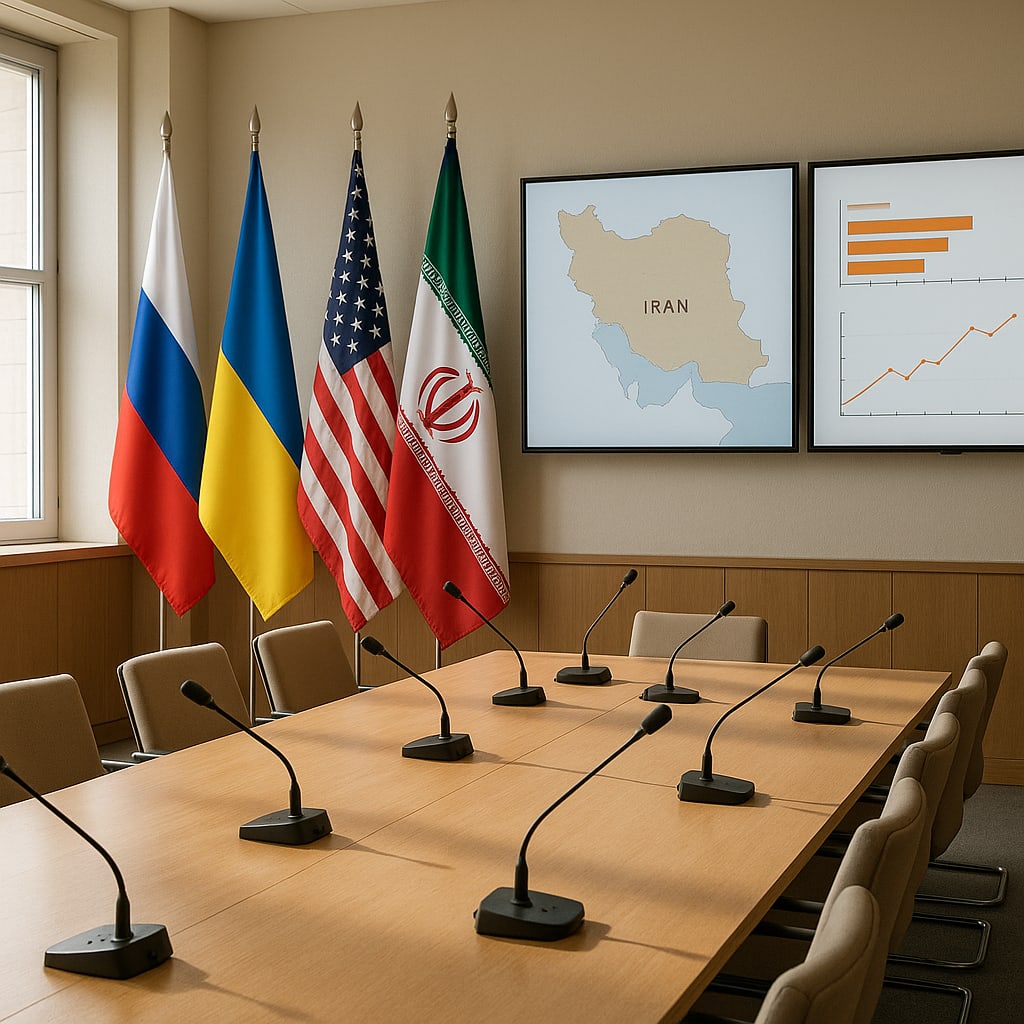
Putin claims Kyiv sought four‑region limits, vows to press offensive, links any U.S. talks to Iran, and concedes fuel strain
Narrative Snapshot
- Across European, Asian, and Indian outlets, Putin’s message couples openness to “discuss all details” with an insistence that Russia’s front-line push will continue and that Ukrainian strikes have not altered battlefield plans; several simultaneously note his admission of fuel supply pressure and air-defense shortfalls (Le Monde; Japan Times; The Hindu; Corriere della Sera).
- Italian coverage foregrounds two politically freighted assertions: that Kyiv asked to confine fighting to four regions and that any talks with Washington hinge on progress “in Iran” (La Repubblica; Corriere della Sera). No outlet in this set independently corroborates the four‑region claim.
- Reporting on the U.S.–Iran track diverges: RT depicts fragile, low‑trust talks with limited progress and regional de‑escalation mechanisms; Fox News highlights an Iranian influence campaign aimed at undercutting a Trump‑led deal (RT; Fox News).
- Middle East Eye spotlights Crimean Tatars’ contribution to Ukraine’s war effort—an operational factor absent from other coverage but relevant to Crimea‑centric dynamics (Middle East Eye).
What Happened
In late June, Vladimir Putin said Russia is “ready to continue negotiations and discuss all details,” while asserting that military operations will press ahead regardless of Ukrainian proposals and that strikes on Russian infrastructure have not affected the front lines (Le Monde; Japan Times). He claimed Kyiv asked to limit hostilities to four regions and stated “no one can beat us on the battlefield” (La Repubblica). Putin linked any talks with the United States to Washington first “resolving” matters with Iran and acknowledged fuel shortages stemming from Ukrainian attacks, alongside a need to strengthen air defenses (Corriere della Sera; The Hindu). Le Monde reported Donald Trump, at the G7 in France, said Russia should reach an agreement with Ukraine. Parallel reporting described recent U.S.–Iran contacts in Switzerland as tense and low‑trust, albeit with mechanisms to avoid broader regional escalation (RT). Fox News cited experts alleging intensified Iranian online influence efforts post‑February strikes. Middle East Eye reported Crimean Tatars’ growing role in Ukraine’s campaign.
Why It Matters
Putin’s linkage of any U.S. track to the Iran file suggests cross‑theater bargaining conditions that could bind Ukraine diplomacy to Gulf and Levant de‑escalation efforts (Corriere della Sera; RT). If sustained, this couples European security outcomes to the stability of U.S.–Iran arrangements and maritime risk in the Strait of Hormuz (RT). His acknowledgment of fuel shortages and air‑defense gaps, even as he downplays battlefield effects, underscores the strategic salience of Ukraine’s deep‑strike campaign against Russian logistics and critical infrastructure (Corriere della Sera; The Hindu; Japan Times). Le Monde’s note on Trump urging Moscow to conclude an agreement, juxtaposed with Moscow’s conditionality, highlights asymmetric expectations around timing and terms of talks. Finally, Middle East Eye’s focus on Crimean Tatars points to the operational and political weight of indigenous networks in and around Crimea—relevant to any settlement touching occupation, control, and local legitimacy.
Diverging Narratives
Putin’s assertion that Kyiv proposed confining hostilities to four regions appears only in Italian live coverage and is attributed to him; other outlets in this set neither echo nor verify it (La Repubblica; Corriere della Sera). Simultaneously, his claim that Ukrainian strikes have not affected the front contrasts with his admission of fuel shortages and the stated need for more air defenses—creating a tension between narrative control and logistic vulnerability (Japan Times; Corriere della Sera; The Hindu). On diplomacy, Le Monde reports Putin’s willingness to “discuss all details,” while also citing Trump’s view that Russia should conclude a deal—implying divergent focal points on who should move first (Le Monde). The U.S.–Iran context is depicted differently: RT underscores an anemic, highly mediated process with minimal trust, even as it notes mechanisms to blunt escalation; Fox News emphasizes an Iranian psychological warfare campaign aimed at U.S. domestic opinion and undermining a prospective deal (RT; Fox News). Middle East Eye’s emphasis on Crimean Tatars introduces an operational vector largely absent from the state‑centric framing elsewhere.
What Happens Next
- Moscow–Washington channel: Putin conditions talks on U.S. “resolving” Iran; watch for signals of movement in U.S.–Iran contacts (e.g., follow‑on meetings after the Buergenstock encounter, third‑party mediation by Qatar/Pakistan) or durable regional de‑escalation mechanisms cited by RT. Absence of such signals would keep the linkage intact; any visible progress could remove a stated precondition (Corriere della Sera; RT).
- Russian sustainment under strike pressure: Indicators include reported improvements in air‑defense coverage, changes in Russian fuel allocation, or continued admissions of shortages. Effective mitigation would support the Kremlin’s claim of unaffected front lines; persistent disruptions would validate Ukraine’s deep‑strike leverage (The Hindu; Corriere della Sera; Japan Times).
- Negotiation contours with Kyiv: Monitor for public articulation or denial of proposals to bound hostilities to specific regions, and for any references to “discussing all details” transitioning into defined agendas (La Repubblica; Le Monde).
- Crimea‑related operations: Track reporting on Crimean Tatar involvement and activity in occupied areas as a barometer of Ukraine’s intelligence and resistance capacity linked to the peninsula (Middle East Eye).