
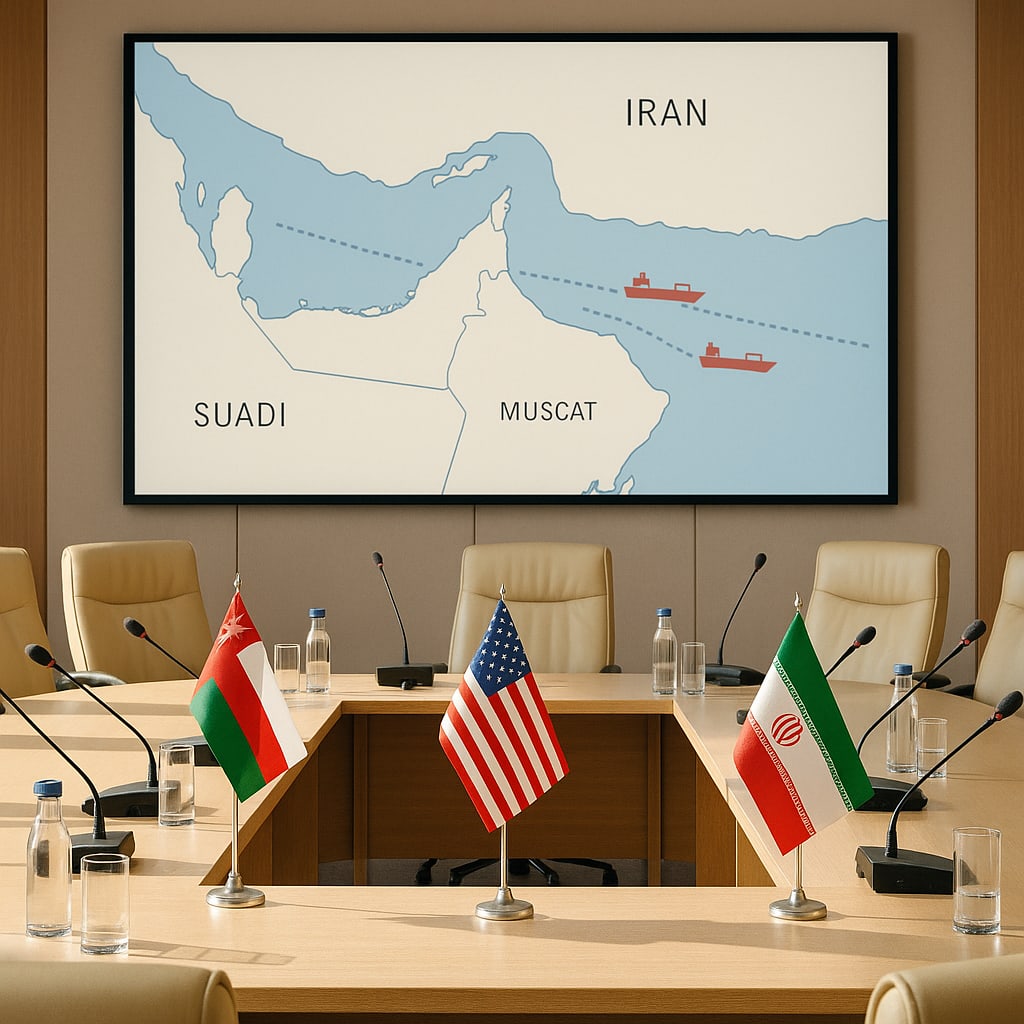
Oman-facilitated contacts on Hormuz proceed as Iran asserts leverage and Washington faces pressure to end the war
Narrative Snapshot
Across Iranian and Israeli outlets, the same set of moves is cast in opposite strategic terms. Tehran Times argues that months of fighting have left Washington short of its stated aims and vaulted Iran into control of the Strait of Hormuz, a position it “did not do before being attacked,” while Haaretz frames the emerging Hormuz arrangement as an “unprecedented geopolitical victory” for Tehran that leaves Israel seeing “only the downside.” In both tellings, leverage has shifted; the disagreement is whether that shift represents stabilizing deterrence or a dangerous reordering of regional security.
US-focused reporting pivots to political and institutional constraints. Middle East Eye highlights a Senate resolution to “put a stop to President Trump’s illegal war with Iran,” citing losses, price spikes, and depleted stockpiles, and regional press reports that America’s top military officer has urged the White House to find an exit, warning that further escalation could backfire. These accounts align with Fox News’ political reporting that the president is offering a “last chance” deal to reopen Hormuz even as Tehran publicly limits the scope of talks.
Energy and second-order security effects run through the coverage. Telesur English links a drop in the US Strategic Petroleum Reserve to a Hormuz closure that is disrupting global supplies, while Middle East Eye’s regional live blog notes intensified Houthi attacks on Saudi-backed forces in Yemen amid claims of a Saudi “large military buildup.” For Jerusalem, The Times of Israel underscores diplomatic isolation as Washington “again attempts diplomacy with Iran” under a Saudi-first rubric and international frustration mounts over Israel’s Gaza posture.
What Happened
Iranian, Arab, Israeli, US, and European outlets report a confluence of military, diplomatic, and political moves centered on the Strait of Hormuz and efforts to end active US-Iran hostilities. Tehran Times says Washington has failed to secure objectives from regime change to missile dismantlement and that Iran now “controls the Strait of Hormuz.” Haaretz describes a prospective Hormuz deal as delivering Tehran an “unprecedented geopolitical victory,” with Israel assessing only downside risk. After canceling what he called a major attack, President Trump has teased talks, with Fox News reporting a “last chance” offer to reopen Hormuz and RT noting Tehran’s negotiator dismissing “theater diplomacy.” Al Jazeera English quotes President Pezeshkian seeking to move beyond “neither war nor peace” via Omani mediation. Domestically, Middle East Eye reports US senators introducing a resolution to halt the “illegal war,” while Al-Quds News and La Repubblica say America’s military chief urged an exit. Energy strain is visible in Telesur’s report of a depleted US oil reserve.
Why It Matters
Control and access at Hormuz are central to the governance of a global chokepoint; claims that Iran now sets “the tempo” and controls the strait, paired with an Israeli assessment that a Hormuz deal hands Tehran an unprecedented win, signal a shift in deterrence and maritime risk that reaches beyond the Gulf. If Oman-brokered channels produce only narrow de-escalation without addressing the broader US goals Tehran Times lists—enrichment limits, proxy support, and missiles—Washington’s coercive leverage may be seen as eroding, a perception reinforced by congressional resistance to an “illegal war” and reported Pentagon caution. Energy security pressures, captured in Telesur’s account of a shrinking Strategic Petroleum Reserve, tighten policy timelines and heighten the cost of miscalculation. For regional alignments, The Times of Israel’s “Saudi-first” framing and Haaretz’s downside calculus suggest Israel’s preferences are marginal to talks in which Riyadh and Muscat carry weight, complicating Gaza-related diplomacy and Israel’s ability to shape outcomes.
Diverging Narratives
Iranian and Israeli sources converge on the idea that leverage has shifted but diverge on meaning: Tehran Times presents Iran’s asserted control of Hormuz as the fruit of resilience after US attacks failed to achieve maximalist aims; Haaretz warns that a Hormuz deal delivers Tehran a singular strategic gain with little upside for Israel. On diplomacy, Fox News reports a White House “last chance” offer to reopen the strait and eventually address the nuclear file, while RT quotes Iran’s top negotiator rebuking presidential “theater diplomacy” and Al Jazeera notes Tehran acknowledging only Oman-facilitated contacts to end a “neither war nor peace” limbo. Within the United States, Middle East Eye’s account of a Senate resolution to stop the war and press comments about losses and inflation contrasts with Fox News opinion pieces that argue maximum economic pressure is exposing Iran’s deepest weakness and caution that Iranian armored movements are decisive indicators. Operationally, Middle East Eye’s report of stepped-up Houthi attacks tied to Saudi deployments underscores that any Hormuz arrangement will intersect with active fronts in Yemen, while The Times of Israel stresses that Washington’s Iran diplomacy proceeds with Israel “in the dark” under a Saudi-first approach—an asymmetry of inclusion that shapes expectations and red lines.
What Happens Next
Three decision points emerge from the reporting. First, scope and substance of Oman-facilitated contacts: Fox News describes a US push to reopen Hormuz and address the nuclear program, while Tehran publicly narrows engagement to ending the stalemate; analysts should watch for concrete shipping assurances, inspection modalities, or third-party guarantees that would signal movement beyond rhetoric. Second, US escalation control: a Senate resolution to halt the war and reported advice from America’s military chief to find an exit create institutional friction against renewed strikes; committee action, floor scheduling, and Pentagon force posture changes will indicate which way the balance tilts. Third, regional spillovers and energy stress: Middle East Eye’s Yemen reporting and Telesur’s reserve drawdown suggest feedback loops between front-line violence and oil security; monitor Houthi targeting claims, Saudi deployments, insurance rates for Gulf transits, and SPR management. For Israel, coverage in Haaretz and The Times of Israel implies close tracking of US-Saudi terms and any linkage to Gaza diplomacy.