
Spain and Italy trade temporary Schengen checks after Ceuta crossings as Rome rejects Madrid’s demand to lift controls
Narrative Snapshot
Italian outlets foreground the diplomatic escalation and Rome’s internal calculus. Corriere della Sera highlights Madrid’s unusually sharp official note demanding an end to Italy’s controls, while ANSA characterizes Spain’s subsequent move as a direct retaliation and notes Rome’s plan to keep checks in place at least until mid-August. La Repubblica adds texture inside the Italian government, reporting that Foreign Minister Antonio Tajani pushed for mediation but a harder line prevailed with Deputy Prime Minister Matteo Salvini and Interior Minister Matteo Piantedosi opposing a deal, amid worries about impacts on tourism.
Anglophone and European coverage converges on the tit-for-tat dynamic and policy parameters. The BBC reports Spain’s view that Italy’s action is unjustified and its warning of countermeasures; Al Jazeera uses Madrid’s “proportional measures” framing; The Guardian specifies Spain’s checks start at midnight Saturday through September 7; Deutsche Welle underlines the unusual fact that the two Schengen members share no land border. France 24 calls it a rare spat within the EU, and Brazil’s Folha similarly describes Madrid’s move as a response to Rome.
Non-European reporting mirrors official lines from each capital. Telesur and Serbia’s Politika emphasize the Italian prime minister’s office rejecting ultimatums and affirming the August 15 timeline. RT departs from others by asserting a precise and very large figure for the Ceuta influx and linking it to a Spanish court ruling and viral videos; those causal details and numbers are not echoed in the other cited outlets, which reference a mass or “tens of thousands” crossing without quantification.
What Happened
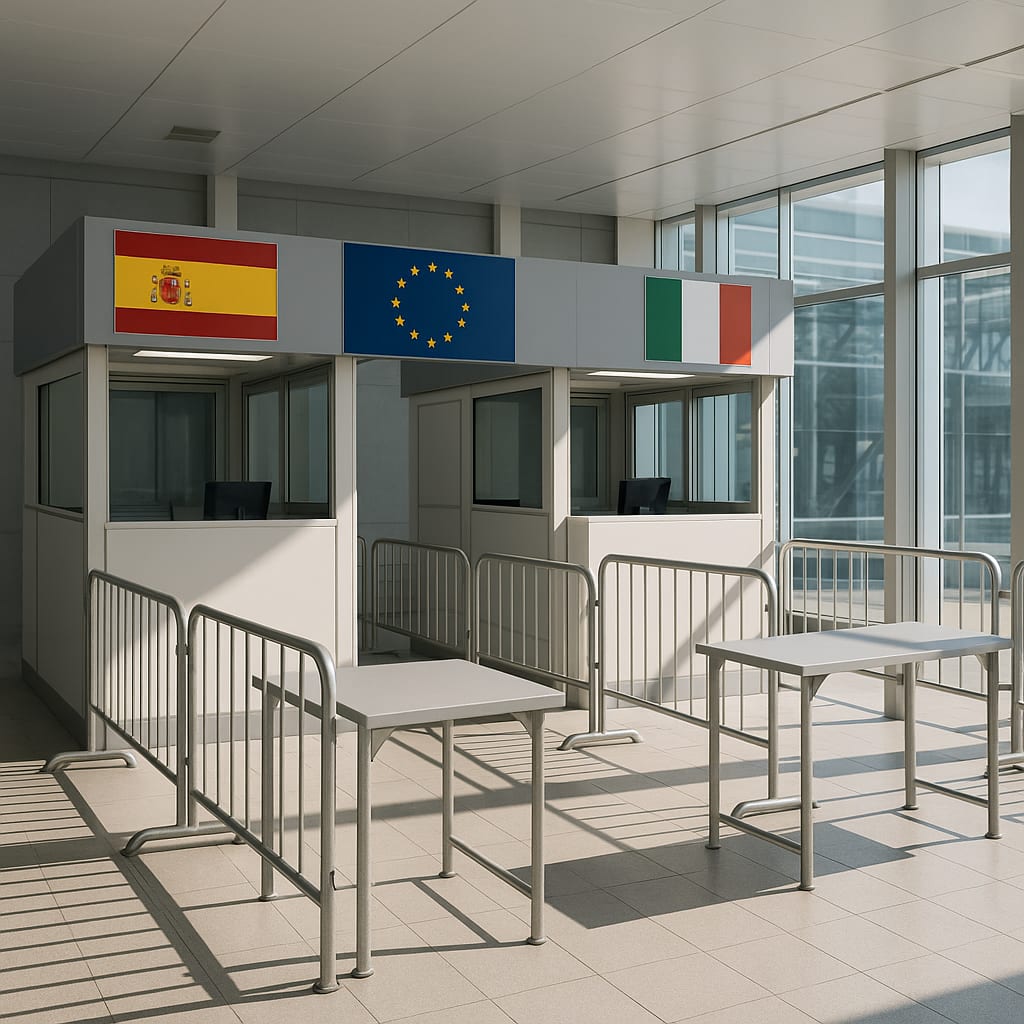
Following a mass crossing of people from Morocco into Spain’s North African enclave of Ceuta, Italy reintroduced border checks on travelers arriving from Spain, with Rome stating the measures would remain at least until August 15 and insisting it would not accept ultimatums from Madrid. Spain delivered a formal note urging Italy to end the checks and warned of countermeasures it described as proportional. With Rome holding its line, Spain announced temporary controls on visitors from Italy, to begin at midnight on Saturday and run until September 7, a move several outlets described as retaliation. Given the absence of a land border, the measures apply at air and sea entry points. Separately, La Repubblica reports the European Commission is examining Rome’s decision and, informally, has signaled doubts that the Italian controls are justified or proportionate to the Ceuta-triggered situation.
Why It Matters
The episode tests the Schengen acquis and the political norms that underpin it. The Schengen Borders Code permits temporary internal controls in exceptional circumstances, but the European Commission’s informal view reported by La Repubblica—that Italy’s move looks excessive relative to the Ceuta event—raises questions about proportionality, notification practice, and Commission oversight capacity when member states act unilaterally. A “rare spat” between two Schengen partners, as France 24 frames it, normalizes reciprocal checks as a political instrument and strains the mutual-trust logic that enables border-free travel.
For decision-makers, the dispute intersects with summer travel flows and tourism sensitivities highlighted by Italian reporting, while also signaling potential frictions in EU migration burden-sharing: an external-border surge in one member has triggered internal checks by another. The BBC and Deutsche Welle note Spain’s deadlines and follow-through on countermeasures, underscoring how quickly such disputes can escalate within legal gray zones absent rapid coordination.
Diverging Narratives
Spain presents Italy’s action as unjustified under Schengen rules and sought to compel a reversal with a deadline and threatened proportional measures, according to the BBC and Al Jazeera. Italy, as relayed by Telesur and Politika, frames its checks as a security necessity and rejects the very notion of an ultimatum, committing publicly to a least-until–August 15 horizon. The European Commission’s informal skepticism, reported by La Repubblica, introduces an institutional counterpoint to Rome’s justification but stops short of a formal legal position.
Descriptions of Spain’s response vary by outlet and tone. ANSA, Folha, and France 24 emphasize retaliation, while Spain’s interior ministry language cited by The Guardian stresses temporariness and proportionality with a defined end date of September 7. There is also divergence on the scope and drivers of the Ceuta event: several outlets reference a mass or unprecedented crossing without precise counts, whereas RT alone cites a specific, much higher number and attributes causality to a court ruling and social media videos—claims not corroborated in the other provided sources.
Inside Italy, La Repubblica reports competing approaches—Tajani’s attempted mediation versus a hard line backed by Salvini and Piantedosi—alongside concern about tourism impacts, illuminating how domestic coalition dynamics shape the external stance without altering Rome’s public message of resolve.
What Happens Next
Three decision points will shape the trajectory. First, whether Rome modifies or ends its checks by the August 15 benchmark it set; signals to watch are statements from the prime minister’s office and interior ministry, given La Repubblica’s reporting on internal divisions and ANSA’s timing note. Second, Madrid’s controls, currently set through September 7 per The Guardian, could either expire on schedule or be extended; Spain’s interior ministry communications will indicate if it views Italy’s actions as resolved or ongoing. Third, the European Commission’s examination, flagged by La Repubblica, could move from informal doubts to a public assessment; any Commission communication on proportionality or compliance would recalibrate member-state calculations.
Analysts should also monitor whether diplomatic mediation resumes, as suggested by La Repubblica’s account of Tajani’s earlier effort, and whether outlets like Folha and France 24 continue to characterize moves as retaliation or shift toward coordinated de-escalation language from both capitals.