
Hormuz transits drop sharply after US strikes on Iran, with contested routing and uneven market response
Narrative Snapshot
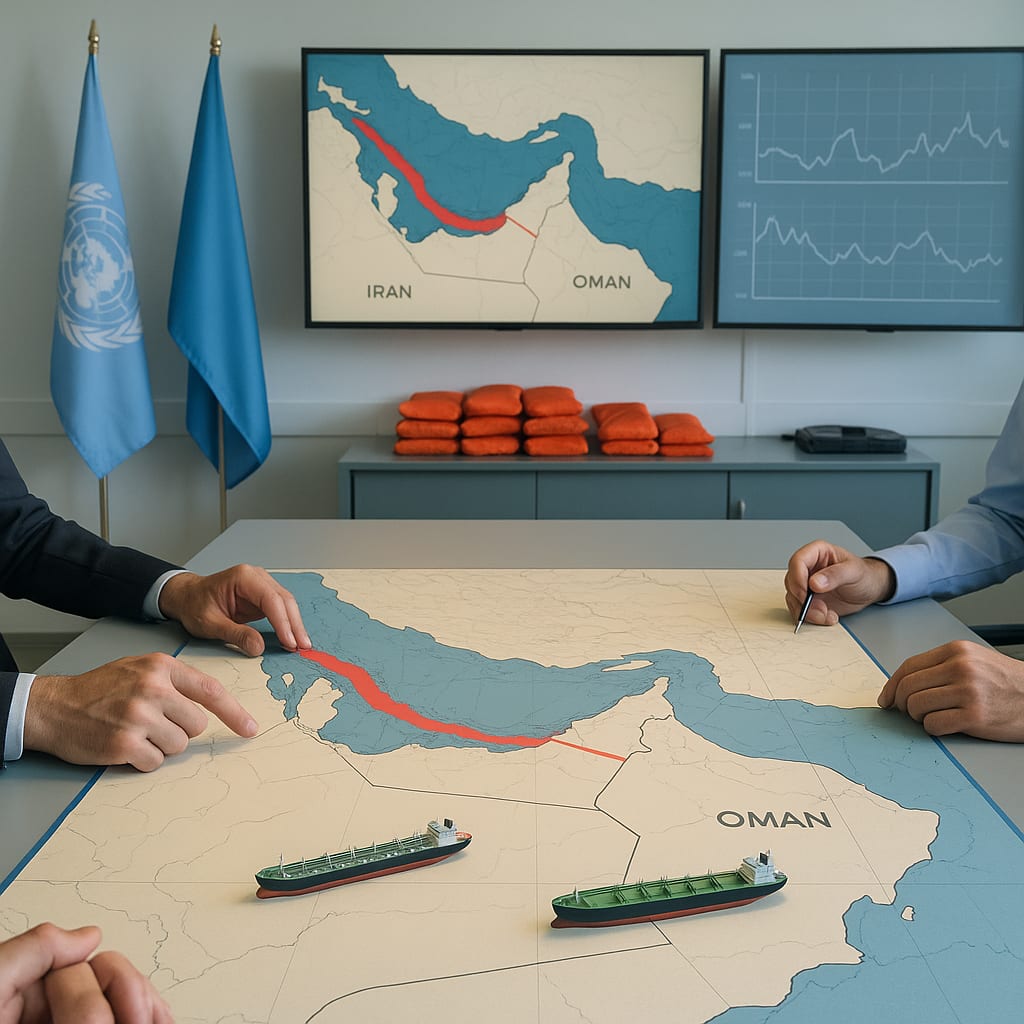
Across outlets, there is broad agreement that shipping through the Strait of Hormuz fell steeply after this week’s attacks and renewed US–Iran strikes. The emphasis differs on severity and geography: some reports describe a near-standstill outside a “northern corridor” along Iran’s coast that Tehran has approved, while others spotlight especially sharp declines on the UN-backed Omani passageway, even as a subset of tankers continued to move (TASS citing Bloomberg; Middle East Eye, 9 July; BBC; Al Jazeera). Coverage also records signs of partial resumption, particularly for LNG carriers and Japan-linked vessels, indicating adaptation rather than a full halt (Middle East Eye, 10 July; NHK).
The legal and operational framing diverges. US Central Command publicly rejected Tehran’s claim to dictate routing, saying Iran “does not control the Strait of Hormuz” and that US forces facilitated hundreds of recent transits and significant oil volumes, whereas Iranian media underscore that navigation is “open” under Iran’s safety and security coordination and reject an IMO Council draft as politicized (Middle East Eye, 9 July; Tehran Times). In parallel, NATO foreign ministers met with Gulf counterparts to discuss a Franco-British multinational maritime mission proposal that Iran has dismissed, highlighting competing models for ensuring passage (Middle East Eye, 7 July).
Economic coverage reflects inconsistency: one account notes Brent crude holding steady despite reduced flows, while another cites a sharp price surge tied to strike announcements and renewed sanctions pressure, underscoring uncertainty over whether markets price disruption risk or anticipate short-lived effects (Al Jazeera; RT). Regional and global actors pressed for restraint, including India and Australia, and the IMO’s chief flagged thousands of stranded seafarers, putting humanitarian and governance stakes alongside energy security (The Hindu; Middle East Eye, 8 July).
What Happened
A series of attacks on commercial vessels near the Strait of Hormuz early in the week included an “unknown projectile” setting a tanker ablaze off Oman and multiple additional strikes, one reportedly involving a drone and affecting a Qatari LNG vessel (South China Morning Post; Middle East Eye, 7 July). The United States revoked a temporary sanctions waiver for Iranian oil and launched strikes inside Iran on successive days under President Donald Trump, with explosions reported around key southern locations, including near Bushehr, Bandar Abbas, and Abu Musa Island (Middle East Eye, 7 July; Le Monde; CGTN; Telesur, 9–10 July). Ship tracking showed a sharp fall in Hormuz traffic, particularly along the UN-backed Omani route, even as some vessels transited a northern corridor off Iran and, later, LNG carriers and 22 Japan-linked ships resumed passage (BBC; Middle East Eye, 9–10 July; TASS; NHK). CENTCOM said it had facilitated more than 800 commercial transits since May, while Tehran reiterated its coordination role and rejected an IMO draft measure (Middle East Eye, 9 July; Tehran Times). NATO ministers met Gulf counterparts on maritime security, and officials at the IMO cited 6,000 stranded seafarers (Middle East Eye, 7–8 July).
Why It Matters
This episode tests how far coastal-state coordination claims can shape a chokepoint that underpins global energy flows, and whether third-party security frameworks can substitute or complement those claims. Iran’s assertion of designated “safe” routes and rejection of an IMO Council draft sits uneasily with CENTCOM’s denial that Tehran controls routing, raising questions about navigational norms and the capacity of technical bodies to manage acute security crises (Tehran Times; Middle East Eye, 9 July). The NATO–Gulf discussion of a Franco-British maritime mission signals pressure for coalition-based assurance, even as some regional actors denounce attacks and call for restraint, pointing to a fragmented yet active security architecture (Middle East Eye, 7 July; The Hindu). For energy importers and shippers, the mixed oil-price signals and adaptive routing highlight both resilience and vulnerability: market steadiness in one account versus sharp price sensitivity in another underscores how sanctions shifts and risk perceptions can move faster than physical supply constraints (Al Jazeera; RT).
Diverging Narratives
Assessments of disruption vary from near-standstill outside Iran’s approved northern corridor to evidence of continued transits and early resumption of LNG movements. Russian and regional outlets emphasize the constriction and Iran-approved routing, while others document steep but not total declines, especially on the UN-backed Omani passageway, and subsequent departures by Japan-linked ships (TASS; Middle East Eye, 9–10 July; BBC; NHK). Responsibility and legal framing also differ: UKMTO described an “unknown projectile” in the initial incident, yet Qatar publicly condemned an “unacceptable” Iranian attack on a Qatari LNG vessel, and Washington paired strikes with renewed sanctions, presenting them as responses to maritime threats (South China Morning Post; Middle East Eye, 7 July; Le Monde; Middle East Eye, 7 July). Tehran’s media stress that navigation remains open under Iranian coordination and reject IMO action, while CENTCOM rejects any Iranian authority over the strait and claims to have facilitated hundreds of transits (Tehran Times; Middle East Eye, 9 July). Market coverage diverges on impact, with Brent reported as steady in one account and sharply higher in another, reflecting different snapshots of timing and risk pricing (Al Jazeera; RT).
What Happens Next
Three decision points will shape trajectories. First, whether a multinational maritime mission advances after the NATO–Gulf consultations: Iran’s dismissal of such proposals and rejection of an IMO draft suggest limited consensus, so analysts should watch communiqués from Ankara and Gulf capitals for mandates, participation, and rules of engagement (Middle East Eye, 7 July; Tehran Times). Second, ship routing choices in practice: if more traffic concentrates in the Iran-designated northern corridor and avoids the UN-backed Omani route, it will signal operator risk calculus and de facto influence; tracking LNG flows and Japan-linked departures will be instructive (TASS; Middle East Eye, 9–10 July; NHK). Third, escalation management tied to sanctions enforcement and strikes: CENTCOM’s posture, reported explosions in southern Iran, statements at the UN, and public threats from Iranian officials will indicate whether risks to seafarers and traffic ease or persist; the IMO’s stranded-crew figures are a humanitarian barometer (CGTN; Telesur, 10 July; Fox News, 3 and 9 July; Middle East Eye, 8 July).