
Deadly wildfires on Crete force mass evacuations as winds halt air support
Narrative Snapshot
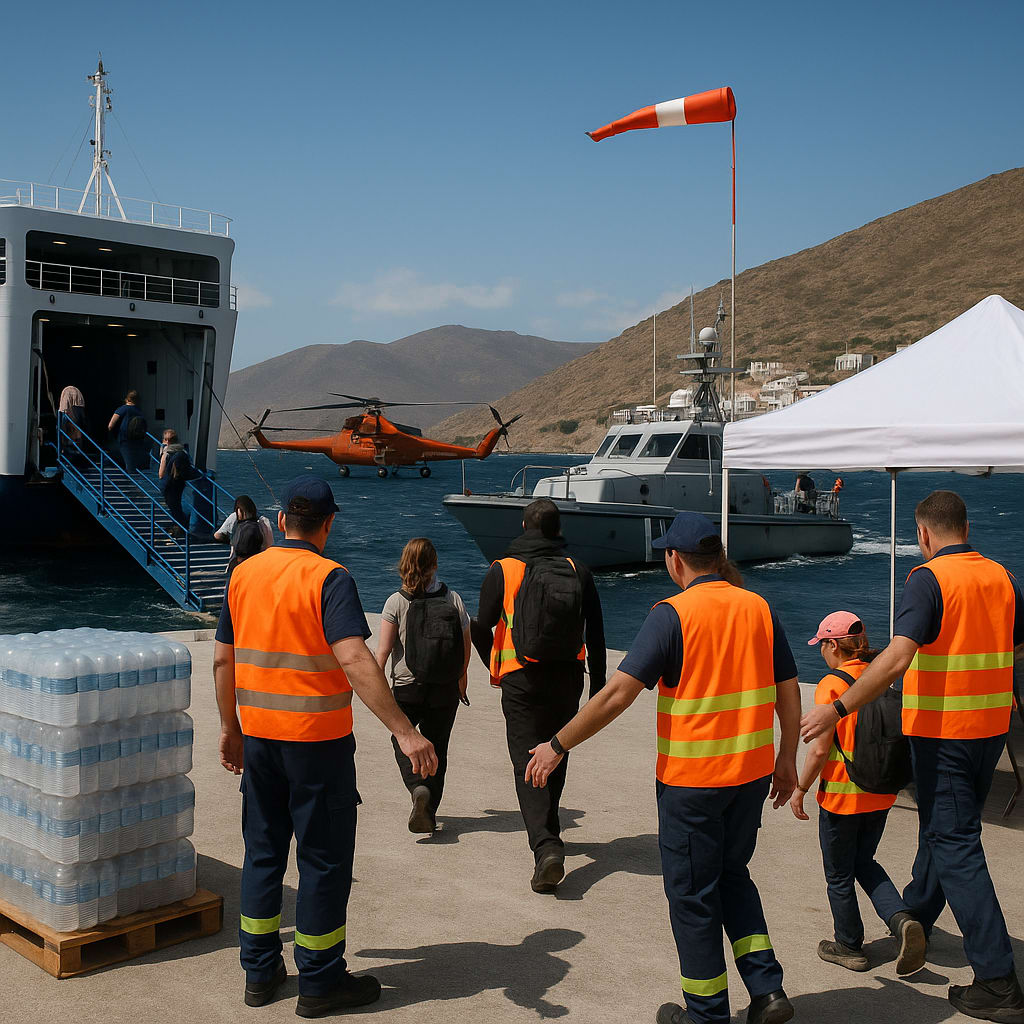
Across outlets, the operational picture converges on wind-driven constraints and large-scale evacuations centered in Rethymno. ANSA, the BBC, and Politika highlight gale-force gusts that have made aerial firefighting unsafe or impossible, with Politika specifying winds over 100 km/h in Rethymno and ANSA noting that aircraft were grounded as thousands were evacuated. Italian coverage also foregrounds maritime extractions: Corriere della Sera shows the Greek Coast Guard and Frontex transferring tourists to ships under a dense smoke plume, underscoring the reliance on sea assets when air options were curtailed.
Fatality reporting diverges in scope and attribution. The New York Times specifies two firefighters killed on Crete and another in the Peloponnese, while France24 and Deutsche Welle cite three firefighter deaths in Greece as winds complicated operations, with France24 adding that two more were lightly injured. These differences reflect whether outlets aggregate nationwide casualties or disaggregate by location.
The broader frame is European. The New York Times, DW, and France24 place Greece within a season of severe fires that recently hit Spain and France. Corriere della Sera notes Spain’s prime minister declared an end to the national wildfire emergency even as Greek authorities braced for “difficult days.” Folha de S.Paulo connects Greece’s situation to concurrent Turkish fires and to drought and heat waves intensified by climate change. RT presents a distinct angle, arguing that EU sanctions constrained Spain’s access to Russian-built helicopters during major blazes, contrasting with other outlets’ emphasis on meteorology and climate stress.
What Happened
Wildfires in Crete’s Rethymno region intensified under powerful winds, forcing the evacuation of thousands of residents and tourists, with Corriere della Sera and Folha de S.Paulo citing about 8,000 people moved from a threatened tourist area. ANSA and Politika report that gusts exceeding 100 km/h grounded aircraft, pushing responders to rely on maritime evacuations; Corriere documents the Greek Coast Guard and Frontex ferrying people to vessels offshore amid heavy smoke. Fatalities among firefighters were reported: the New York Times says two died on Crete and another in the Peloponnese, while France24 and Deutsche Welle note three firefighter deaths across Greece and two additional injuries as crews battled fires for a second day. The New York Times adds that Greece also worked to contain blazes on Lesbos and in the Peloponnese. Corriere reports some gradual returns in Agia Galini as conditions briefly allowed.
Why It Matters
The episode tests Europe’s ability to sustain civil protection during prolonged, multi-country fire seasons. Greek authorities’ turn to sea evacuations and Frontex’s role, documented by Corriere, illustrate how border and maritime assets can supplement domestic emergency services when aerial suppression is grounded by weather. Concurrent fires in Lesbos and the Peloponnese, noted by the New York Times, raise resource-allocation challenges inside Greece. Regionally, coverage by France24 and DW situates Crete within a cycle of severe fires in Spain and France, while Corriere notes Spain declared its national emergency over—potentially altering where political attention and assets are focused. Folha’s linkage to drought and heat waves intensified by climate change frames a structural risk to tourist zones and critical infrastructure. RT’s claim that EU sanctions hindered Spanish helicopter availability presents a competing policy lens on capability gaps during peak demand.
Diverging Narratives
Outlets diverge on casualty accounting and attribution. The New York Times confines two firefighter deaths to Crete and one to the Peloponnese, while France24 and Deutsche Welle report three firefighter fatalities in Greece without location-specific breakdowns, with France24 adding two injuries. This reflects varying aggregation rather than contradiction but leaves open how losses are distributed operationally.
Causal and constraint framing also differ. ANSA, the BBC, and Politika emphasize meteorological drivers—winds above 100 km/h in Rethymno that prevented aerial operations and accelerated spread—whereas Folha foregrounds structural climate factors, tying the Greek and Turkish fires to drought and heat waves intensified by climate change. RT advances a distinct policy frame focused on EU sanctions, arguing they limited Spain’s access to Russian-built helicopters during major fires. In operational reporting, Italian outlets stress maritime evacuations and Frontex’s involvement, while the New York Times broadens the lens to simultaneous Greek fronts on Lesbos and the Peloponnese. Corriere’s note on partial returns in Agia Galini introduces localized variation in risk conditions alongside mass evacuations elsewhere.
What Happens Next
Key operational choices hinge on wind conditions and asset deployment. ANSA and Politika indicate aircraft were sidelined by severe gusts; a shift in winds would create a decision window for reinstating aerial firefighting. If winds persist, authorities are likely to rely further on maritime evacuations and ground lines, as captured by Corriere’s coverage of Coast Guard and Frontex operations. Evacuation orders and controlled returns will be adjusted locality by locality, with Corriere’s report of gradual returns in Agia Galini providing a template for phased reopening if firelines hold. Nationally, Greece must balance resources across Crete, Lesbos, and the Peloponnese, per the New York Times’ reporting on multiple fronts. At the European level, analysts should watch whether the end of Spain’s national emergency, noted by Corriere, coincides with shifts in political attention or availability of support, and how competing narratives about capability gaps—highlighted by RT—shape policy debate.