
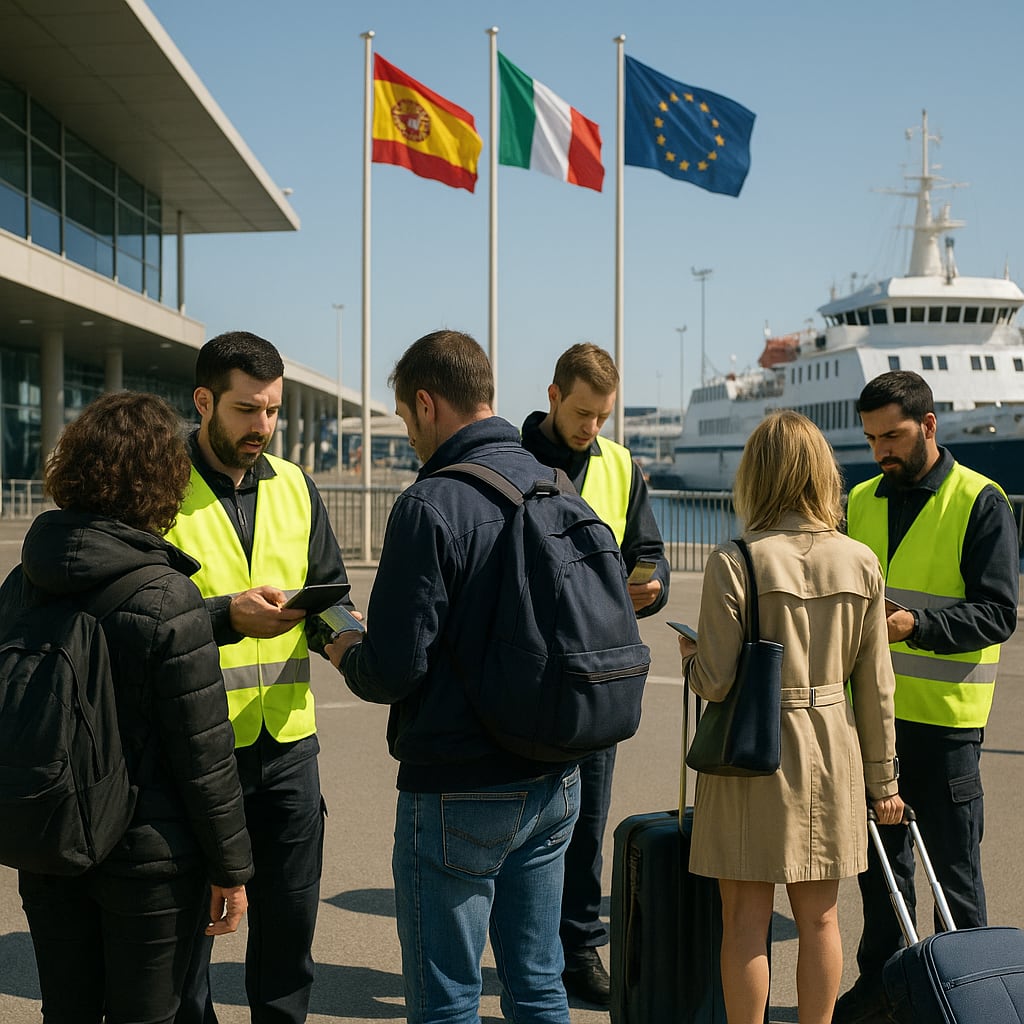
Spain introduces temporary checks on travellers from Italy after Rome’s controls over Ceuta crossings
Narrative Snapshot
Across outlets, there is broad alignment on the scope and mechanics of Spain’s move: checks will be random, limited to air and sea arrivals from Italy, and time‑bound to early September. Le Monde, South China Morning Post, and Spain’s state broadcaster as relayed by multiple sources specify a September 7 end date and an Interior Ministry decree authorizing identity and nationality checks at ports and airports. Reporting from Barcelona by EFE, cited in The Hindu, confirms implementation on the ground.
Accounts diverge on the underlying scale and character of the Ceuta event and the justification for subsequent controls. France24 cites “more than 70,000” crossings with most people later returning, and calls the episode unprecedented and deadly, while other outlets use “tens of thousands.” RT reports 72,000 crossings and asserts, citing local officials, that 3,000–5,000 people remain; it also attributes the rush partly to a Spanish court ruling and social media videos—elements not echoed elsewhere. La Repubblica highlights EU Commission doubts that Italy’s measures are justified or proportionate to Ceuta, contrasting with Rome’s refusal to accept Madrid’s ultimatum, reported by Politika and Telesur.
Italian coverage surfaces domestic political cross‑pressures that are largely absent in Spanish and anglophone reports. La Repubblica describes an internal debate in Rome—Foreign Minister Tajani favoring mediation, with Salvini and Interior Minister Piantedosi backing a hard line—and flags worries about impacts on tourism. BBC, DW, and ANSA frame the episode as an escalating reciprocal move between two Schengen members, with DW underscoring that, absent a land border, controls apply to air and sea routes only.
What Happened
Following a mass rush from Morocco into the Spanish enclave of Ceuta last week, Italy imposed border checks on arrivals from Spain. Madrid demanded Rome lift those controls by the weekend and warned of a proportional response if it did not, according to BBC, Corriere della Sera and ANSA. After Italy rejected the ultimatum and said checks would remain in place at least until August 15, as reported by Telesur and ANSA, Spain issued a decree launching temporary, random checks on travellers arriving from Italy by air and sea. South China Morning Post, Le Monde, The Guardian and CGTN say the Spanish measures began at midnight Saturday and run until September 7, focusing on verifying identity and nationality. The Hindu, citing EFE, noted random police checks at Barcelona airport as the measures took effect. France24 and DW characterize the steps as an escalation in a bilateral dispute within Schengen.
Why It Matters
The episode tests the resilience of Schengen’s free‑movement norms, showing how unilateral reintroductions of internal controls—permitted only under specified conditions—can cascade into reciprocal measures between major EU members. La Repubblica reports that the European Commission is examining Italy’s controls and, informally, views them as excessive relative to the Ceuta incident, signaling potential friction between national security claims and EU oversight. The exchange also lands amid a broader EU debate over external border management: in a letter cited by The Guardian, Commission President Ursula von der Leyen urged stronger border measures, including physical barriers where needed, after the Ceuta rush. Together, these strands underscore a structural tension between fortifying the EU’s external frontier and preserving internal mobility, with practical implications for tourism and air‑sea connectivity highlighted in Italian reporting, and for the Commission’s capacity to police proportionality across member states.
Diverging Narratives
Madrid frames Rome’s initial move as unjustified and disproportionate to events in Ceuta, per BBC and Corriere della Sera, and positions its own response as time‑limited and targeted, with randomized checks confined to ports and airports and a clear sunset of September 7, as reported by Le Monde, SCMP and The Guardian. Rome, by contrast, rejects what Politika and Telesur describe as Spanish ultimatums and asserts that its checks will remain at least until August 15, signaling a security‑first approach that prioritizes control even at some cost to travel flows.
There is also disagreement over causality and severity. France24 portrays the Ceuta crossings as unprecedented and deadly but emphasizes that most people subsequently returned. RT cites higher precision figures and attributes the surge partly to a Spanish court ruling and social media, while claiming thousands remain; these causal links and residual‑presence estimates are not corroborated in other outlets. At the EU level, La Repubblica reports informal Commission doubts about the legal justification for Italy’s measures, introducing a compliance lens that is absent from Italian government statements. DW adds an operational distinction—no land border exists—focusing attention on aviation and maritime checks rather than terrestrial controls common in other Schengen suspensions.
What Happens Next
Three decision points emerge. First, Italy’s stated horizon—“at least” until August 15 (ANSA, Telesur)—will determine whether Rome de‑escalates unilaterally or extends controls, prolonging the spat. Any extension would likely keep Spain’s reciprocal checks in place through September 7, as set out in Madrid’s decree (SCMP, Le Monde, The Guardian). Second, the Commission’s review of Italy’s measures, which La Repubblica says raises informal doubts about justification, could translate into formal guidance or pressure; movement here would signal whether EU institutions intend to enforce proportionality more assertively. Third, internal Italian dynamics described by La Repubblica—between mediation advocates and hard‑liners mindful of tourism impacts—will shape Rome’s margin for compromise. Analysts should watch for official notices modifying the duration or scope of controls, Commission communications on legality and proportionality, and concrete travel‑sector signals that might recalibrate each government’s cost‑benefit calculus.