
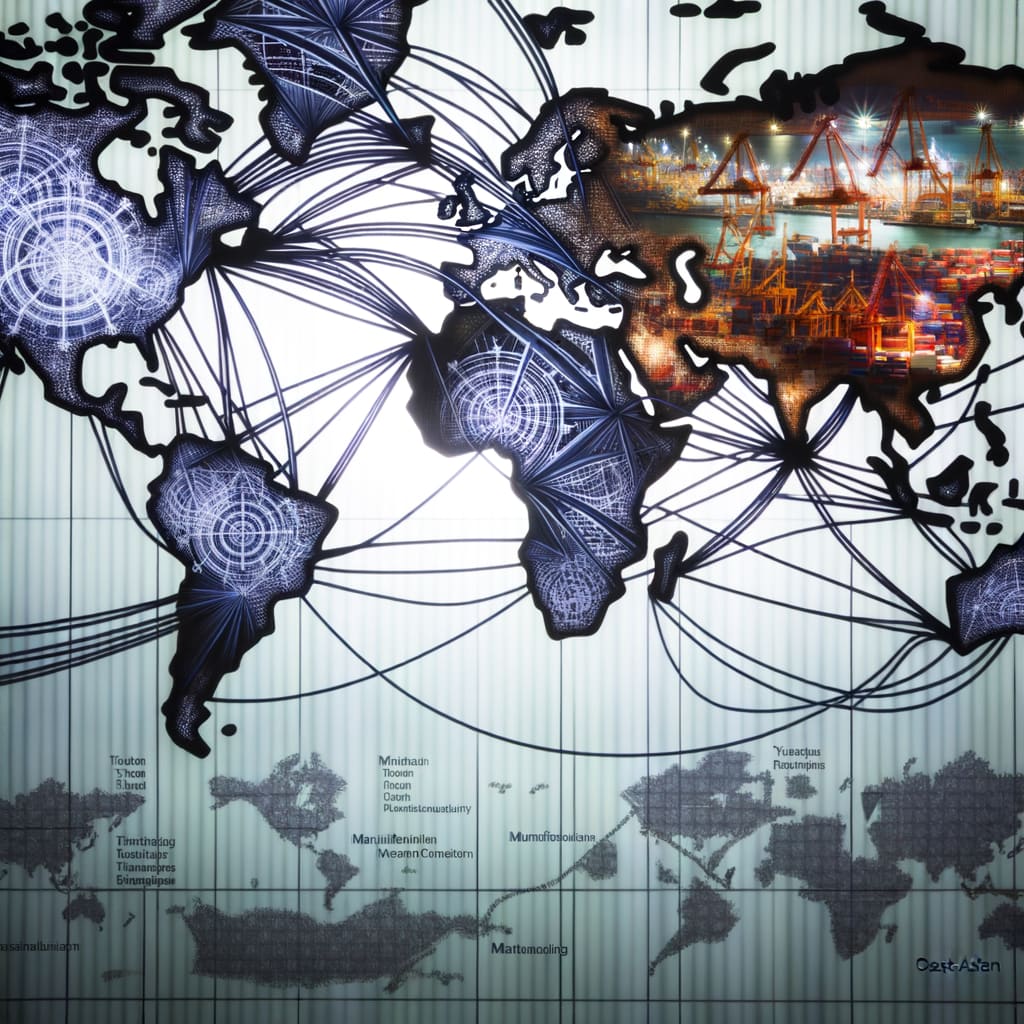
The End of Era: U.S. Shifts Global Trade Dynamics Amid Rising Powers
2025 marked a profound shift in global trade and power dynamics, with the United States diverging from the era of global trade convergence and acknowledging the limits of its global reach in its National Security Strategy (NSS). This recalibration has sparked a wave of uncertainty, impacting economies and diplomatic relations around the world.
A New U.S. Policy
In a six-page document submitted to the World Trade Organization (WTO), the United States listed grievances against the organization, with veiled attacks on China for accumulating massive trade surpluses and on India for blocking improvements in the WTO decision-making process, as reported by TASS. The new NSS, however, exhibits a paradoxical and selective U.S. posture of simultaneous disengagement and selective involvement, which could be particularly concerning for India, according to The Diplomat.
The Impact on Manufacturing and Tariffs
The year of 2025 was marked by tariffs and a global shift in economic power, as noted by Al Jazeera English. CBC News highlighted the impact of American tariffs on the manufacturing sector, which have turned routine paperwork into administrative nightmares for manufacturing executives.
China's Ascent and Strategic Recalibration
As the United States recalibrated its role in global politics, China seized fresh openings. South China Morning Post reported that historians are likely to point to 2025 as the watershed in China’s 21st-century ascent. In response to the tumultuous trade war with the United States, China's top leaders issued directives to fortify the domestic economy against persistent or heightened trade frictions, with a dual strategy of growth and resilience.
The Implications for Allies and Global Stability
The shift in U.S. policy has stirred uncertainty among its allies. Australia, for instance, remains central to the U.S.'s strategy, but is attempting to construct more independent, regionally-led security initiatives, as reported by The Diplomat. Meanwhile, the New York Times reported a deeper uncertainty for the global economy, with the reordering of trade rules impacting jobs, politics, and lives.
The Road Ahead
As the U.S. redefines its global role, long-standing U.S. national security architecture could face further disruption, threatening global stability. This could potentially benefit China, as it continues to mature its power projection across all domains. Meanwhile, India and other South Asian nations may need to navigate the paradoxical U.S. posture of simultaneous disengagement and selective involvement.
Despite the turbulent shift, the European Union (EU) has been relatively quiet, leading to speculation about whether it will react or be rendered obsolete, as suggested by Folha de S.Paulo.
In conclusion, the year 2025 marked the end of an era for global trade convergence, ushering in a period of uncertainty and recalibration. The implications of this shift are clear, but the trajectory and outcomes are yet to be fully realised.