
Lead
A morning knife attack at Winterthur’s main railway station, near Zurich, left multiple people wounded and triggered a rapid security response that quickly drew international attention. Swiss police arrested a 31-year-old Swiss man at the scene, while investigators began working to clarify a motive that some outlets linked—cautiously or prominently—to a religious slogan reportedly shouted during the assault. The incident has become a test case for how quickly a local crime scene in a transport hub can be reframed as a national security story before authorities have publicly settled key facts.
What Happened
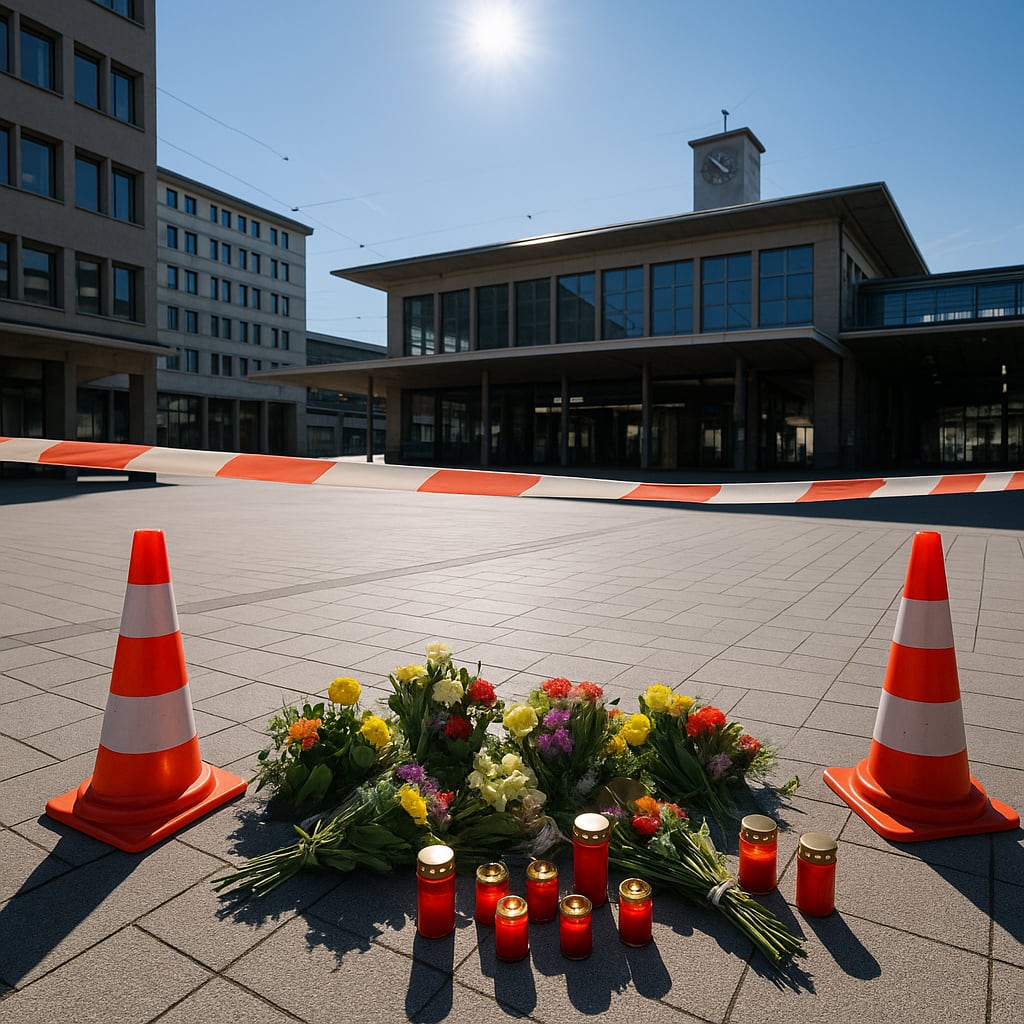
The attack unfolded shortly after 8:30 a.m. at the train station in Winterthur, a busy commuter city in the Zurich area. Multiple people were injured by a bladed weapon, and emergency services transported the victims to hospital. Police detained the suspected attacker shortly afterwards and cordoned off parts of the station as the operation continued.
Across coverage, several core elements are consistent: the incident occurred inside or around the station area; the weapon was a knife or “bladed weapon”; three victims were taken to hospital; and the suspect—identified as a 31-year-old Swiss citizen—was arrested at the scene by cantonal police.
Where accounts become less uniform is the total number of injured. A portion of the reporting describes three wounded, while other coverage states four people were stabbed, with at least one victim in serious condition. The timing, location, and arrest are broadly agreed, but the casualty count and severity are presented differently, suggesting either early, evolving information during a fast-moving police operation or differing thresholds for what counts as an “injured” victim in initial reports.
Another point that appears repeatedly, though not universally, is that the attacker allegedly shouted “Allahu akbar” during the assault. Some outlets present this detail prominently in headlines; others treat it as an allegation attached to early witness accounts rather than an established fact.
Why It Matters
Winterthur is not just a local station; it sits in the orbit of Zurich’s transport network, a daily artery for commuters and regional travel. Violence in such public infrastructure tends to have an outsized impact, because it targets—or appears to target—spaces designed for open access and predictable routines. The immediate police cordons and disruption underscore the vulnerability of transit hubs to sudden attacks and the need for rapid, visible security reassurance.
The incident also matters because of how quickly it intersected with a sensitive European debate: the boundary between ordinary criminal violence and ideologically motivated attacks. The reported invocation of a religious phrase—whether ultimately confirmed, contextualized, or disputed—can influence political interpretation far beyond the specifics of what happened on the platform. In many countries, similar details have been used to drive arguments over domestic security policy, policing powers, surveillance, integration, and the handling of radicalization risks.
At the same time, Swiss authorities’ early posture—as reflected in the coverage—centers on arrest, victim care, and investigation rather than public conclusions about motive. That sequencing matters: the first hours after a high-profile attack often become a contest between immediate narrative formation and the slower process of verified fact-building.
Diverging Narratives
The most consequential divergence is not over the basic occurrence of a stabbing, but over what kind of event it is implied to be.
1) The casualty picture: three wounded vs. four.
Some reporting consistently states that three people were injured and hospitalized. Other coverage describes four stabbed, including mention that one victim was in serious condition. These differences shape perceived scale and urgency: “three wounded” reads as a contained but serious assault; “four stabbed with one in grave condition” pushes the story toward the register of mass-casualty anxiety. The mismatch likely reflects the uncertainty of early casualty accounting in chaotic scenes—where victims may self-evacuate, where minor injuries may be treated on-site, or where initial police statements evolve—but the public effect is a different sense of magnitude.
2) The phrase allegedly shouted: central hook vs. cautious detail.
International outlets that foreground the alleged “Allahu akbar” shout tend to frame the story as potentially connected to jihadist-style attacks seen elsewhere in Europe, even when they still note that the motive is under investigation. Other reporting includes the phrase but gives it less interpretive weight, emphasizing the arrest and the factual outline over ideological cues. This split is more than stylistic: repeating the phrase in headlines effectively positions motive as the key question; omitting it keeps the incident closer to a public-order and policing story until investigators speak.
3) “Terror” framing by implication vs. “criminal incident” framing by structure.
Even when the word “terrorism” is not used, a story can be structured in a way that nudges readers toward that conclusion—through emphasis on religious slogans, public transport vulnerability, and security cordons. Conversely, a more crime-report structure emphasizes the suspect’s identity (Swiss, 31), the immediate medical response, and the procedural investigation, which can dampen assumptions of external networks or organized ideology.
4) Emphasis on public endangerment and proximity to children.
Some coverage highlights that children were nearby, an element that intensifies the emotional resonance and underlines the randomness of risk in a public place. Other outlets do not include this detail, keeping the focus on confirmed victims and police actions. The difference affects the social meaning: with children foregrounded, the incident reads as a broader threat to everyday civic life; without it, it remains a stark but more narrowly defined assault.
5) Severity of injuries: highlighted vs. unspecified.
Where injury severity is emphasized—particularly “serious condition”—the narrative leans toward national shock and urgent security questions. Where conditions are left unknown or unreported, the tone stays procedural and restrained. This is significant because severity often becomes a proxy for assessing whether an event will trigger heightened political response.
Across all these divergences, a common pattern emerges: outlets with a stronger focus on ideological markers and emotional proximity cues (like the shouted phrase or nearby children) produce a narrative of broader societal threat; outlets focused on verified identifiers and police procedure produce a narrative of an acute incident still awaiting classification.
Current Situation
The suspect remains in custody after being arrested at the station. Police have cordoned off areas around Winterthur’s railway station during the response and early investigative steps, while victims were transported to hospital. At least some reporting indicates that one person may be seriously injured, though this is not consistently stated across coverage, and victim conditions are not uniformly detailed.
The immediate outlook hinges on what Swiss investigators determine and publicly confirm: the final number of victims, the precise sequence of events inside the station area, and—most importantly for the broader public debate—whether any motive is established and how authorities characterize it. Until official statements settle those points, the story is likely to continue oscillating between a local act of violence with significant public impact and a case that some audiences interpret through the prism of Europe’s ongoing security concerns.