
Hamas dissolves Gaza government; technocratic NCAG readies handover under Board of Peace plan as Israel demands disarmament
Narrative Snapshot
- Cross-regional outlets agree on the basic sequence: Hamas has dissolved its Gaza governing structure and says a technocratic National Committee for the Administration of Gaza (NCAG) is prepared to assume civilian functions; Israel conditions any transition on Hamas disarmament and restricts access for new administrators (CBC; SCMP; Clarin; Le Monde; Japan Times).
- Coverage diverges on the institutional center of gravity. Middle East Eye and The Hindu frame the transition under “Trump’s Board of Peace,” including a Rafah pilot “humanitarian zone,” while TASS and Fox characterize the Board as UN-mandated/Security Council–backed and expecting disarmament (MEE; The Hindu; TASS; Fox).
- Aid architecture is part of the contest. The United States urges donors to shift from UNRWA to the Board of Peace, while the UN defends UNRWA’s mission (Fox).
- Analysts and officials split on intent and durability: some see a potential opening if disarmament and access are resolved; others call Hamas’s move propaganda or a stunt, and note Hamas’s residual influence (DW; ANSA; Japan Times; Folha).
What Happened
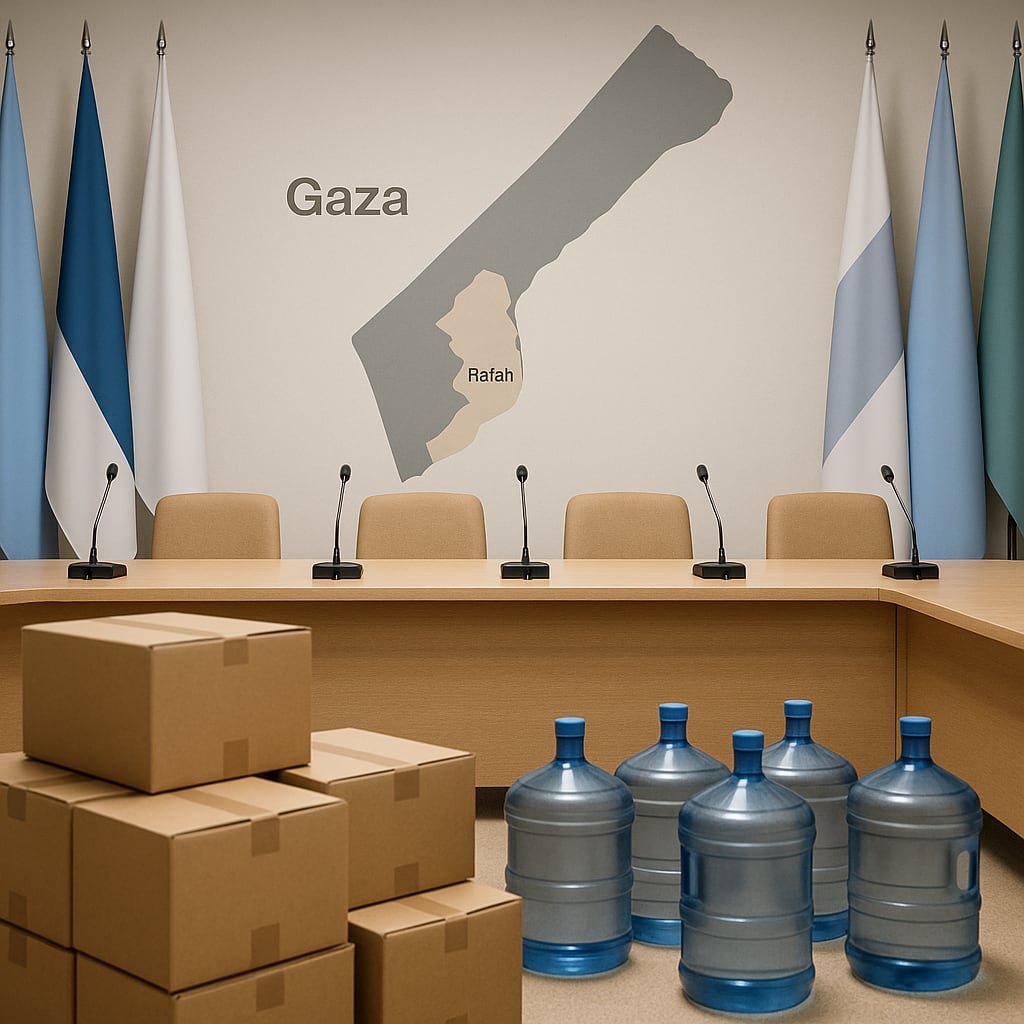
On July 6, Hamas announced it had dissolved its de facto government in Gaza and signaled readiness to transfer administration to the NCAG, a body of independent Palestinian technocrats (CBC; SCMP). Gaza authorities said preparations for the handover were complete, with NCAG operating under the supervision of the Board of Peace (TASS). Israel dismissed the move as “propaganda” and a “stunt,” and has blocked the technocrats’ entry pending total Hamas disarmament (ANSA; Japan Times; Le Monde). Middle East Eye and The Hindu, citing officials, reported that the Board of Peace is planning a pilot “humanitarian zone” in Rafah to house tens of thousands of vetted civilians and serve as a starting point for NCAG’s work (MEE; The Hindu). The United States is pressing donors to redirect funding from UNRWA to the Security Council–backed Board of Peace, a shift the UN contests (Fox).
Why It Matters
The handover plan tests whether a Security Council–backed transitional mechanism can reconstitute civilian governance in Gaza while a non-state armed actor retains coercive capacity. Israel’s linkage of administrative access to total Hamas disarmament, and DW’s note that Israeli withdrawal is also a factor, places the NCAG’s mandate at the intersection of security preconditions and humanitarian urgency (DW; Le Monde). Institutionally, U.S. pressure to reallocate aid from UNRWA to the Board of Peace signals a potential reconfiguration of the Gaza aid ecosystem and a contest over which international platform will anchor reconstruction and services (Fox). Regionally, the move caps two decades of Hamas rule outlined by Al Jazeera and follows an October ceasefire noted by SCMP, embedding the transition in longer-running questions about Palestinian governance, Israeli control measures, and international oversight (Al Jazeera; SCMP).
Diverging Narratives
Outlets differ on framing the transition’s provenance and legitimacy. Middle East Eye and The Hindu portray the dissolution as aligning with a U.S. presidential “20-point plan” and tied to “Trump’s Board of Peace,” while TASS and Fox emphasize UN mandate or Security Council backing, suggesting multilateral authority (MEE; The Hindu; TASS; Fox). Israel’s characterization of the move as “propaganda” or a “stunt” contrasts with reporting that technocratic preparations are “fully ready,” yet Le Monde notes Israel is blocking the NCAG’s entry until Hamas fully disarms (ANSA; Japan Times; Clarin; Le Monde). Analysts cited by DW and Folha warn that without disarmament and Israeli withdrawal, the transition may stall and Hamas’s influence will persist, even if civilian functions shift (DW; Folha). The proposed Rafah “humanitarian zone” is reported as a practical beachhead for NCAG, but details on security arrangements and access remain unspecified, underscoring operational uncertainty (MEE; The Hindu).
What Happens Next
- Disarmament–access sequence: Israel ties NCAG access to total Hamas disarmament; the Board of Peace “expects” disarmament as a next step (Le Monde; TASS). Indicators: any verifiable disarmament steps announced by Hamas or third-party arrangements; Israeli statements authorizing NCAG entry.
- Operational foothold: If the Rafah humanitarian zone proceeds, it could serve as NCAG’s initial platform; failure to secure or populate it at scale would signal a stalled handover (MEE; The Hindu). Indicators: site activation, vetting protocols, and security control announcements.
- Aid architecture shift: U.S. advocacy to divert funds from UNRWA to the Board of Peace versus UN efforts to sustain UNRWA will shape capacity on the ground (Fox). Indicators: pledging outcomes, donor reallocations, and budget disclosures.
- Gatekeeping and mobility: Le Monde reports Israel is blocking NCAG’s entry; Clarin and TASS report NCAG readiness. Indicators: issuance of permits, border opening statuses, and public rosters of incoming technocrats (Le Monde; Clarin; TASS).